
 E-Paper



Afforestation in U.P. - 85% of 100 cr saplings planted in 5 yrs survived: Chief secy
The chief secretary was speaking at the inauguration of a two-day national conference on ecological restoration


“Approximately 100 crore plant saplings have been planted in Uttar Pradesh over the last five years and 85% of the saplings planted, survived. Plant more trees and raise public awareness about plantations to help reduce environmental degradation,” said chief secretary Durga Shankar Mishra while talking about the plantation campaign being run by the UP Government.
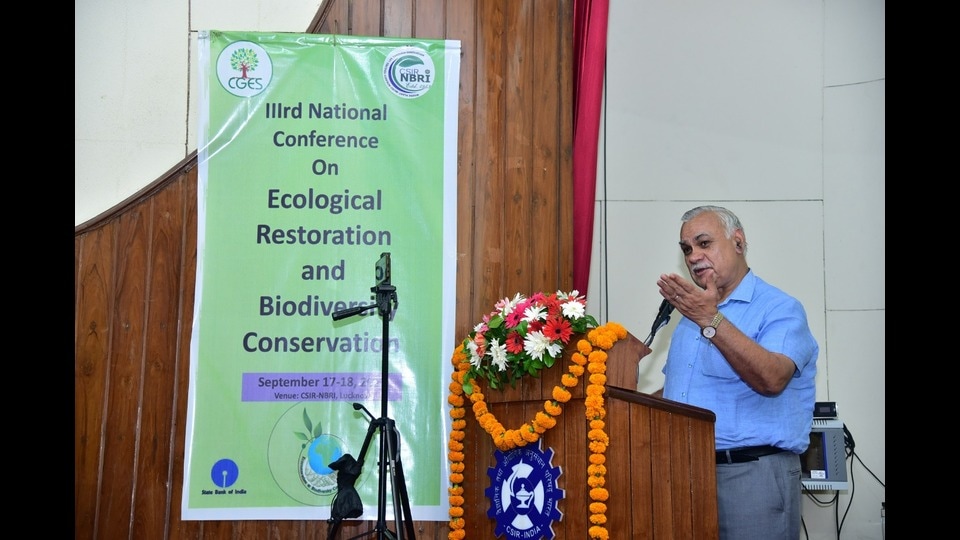
Mishra was speaking as chief guest at an inauguration function of a two-day national conference on Ecological Restoration & Biodiversity Conservation jointly organised by CSIR-National Botanical Research Institute (NBRI), Lucknow and Clean & Green Environmental Society, here, on Saturday.
“The government of India has set a goal of zero carbon emissions by 2070 to create a safe environment for future generations, and this goal can only be achieved with the help of the entire society,” he added.
In his keynote address, Prof Rup Lal, Indian National Science Academy (INSA) fellow and National Academy of Science, India (NASI), senior scientist and the guest of honour, highlighted the role of microbes in ecological restoration and biodiversity conservation. “Our intestines contain approximately 100 million symbiotic micro-organisms. Advanced genomic studies of these symbiotic bacteria revealed that they play a direct role in the human body. The majority of lifestyle disorders such as diabetes, obesity, and hypertension have been linked to these symbiotic bacteria,” he informed.
“70% of life on the earth is plants, followed by about 17% of microorganisms. Less than one gram of coronavirus, in terms of biomass, caused the devastating pandemic throughout the world. These microorganisms have a crucial role in our environment as well as in our body,” he added.
“According to the land degradation map prepared by ISRO, 97.85 million ha (29.7%) of India’s total geographical area of 328.72 million have undergone land degradation in 2018-19. Realising the gravity of such ecosystem degradation worldwide, the United Nations has declared the decade 2021-2030 as the decade of ecosystem restoration to ‘prevent, halt and reverse the degradation of ecosystems on every continent and in every ocean’,” said Prof SK Barik, director, CSIR-NBRI.
SC Sharma, vice-president of the Clean and Green Environmental Society was also present with other dignitaries.


