
 E-Paper



BKU no stranger to splits after Mahendra Singh Tikait’s death in 2011
In the latest instance, a group of BKU leaders announced the formation of a new group with the name BKU (apolitical) in Lucknow on Sunday


Divisions in the Bhartiya Kisan Union (BKU) are not new and the trend became noticeable after the demise of farmer leader Mahendra Singh Tikait, who headed the organisation, on May 15, 2011.
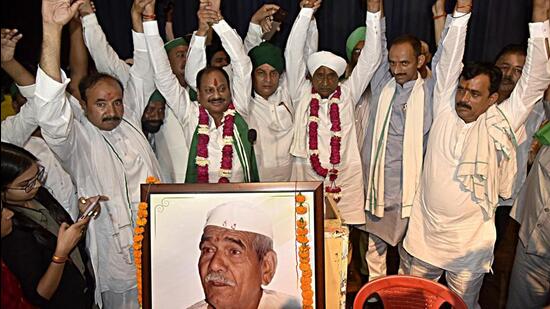
In the latest instance, a group of BKU leaders announced the formation of a new group with the name BKU (apolitical) in Lucknow on Sunday. They accused farmer leaders Rakesh Tikait and his brother Naresh Tikait of indulging in politics against the ethics of their farmers’ organisation.
The development coincided with the death anniversary Mahendra Singh Tikait (1935-2011).
Senior leaders said many prominent leaders broke away from the BKU after the death of the senior Tikait, who had charismatic leadership qualities.
Octogenarian Gulam Mohammad Jaula recalled how he participated in movements with Mahendra Singh Tikait in the 1980s.
“We spearheaded many successful movements for decades and established the identity of farmers,” said Jaula over the phone.
He was BKU’s national convenor for organising movements till MS Tikait’s death.
Jaula, resident of Jaula village in Muzaffarnagar district, left the BKU in 2012 and formed the Kisan Mazdoor Manch the same year.
The 2013 riots in Muzaffarnagar and Shamli broke the unity of Hindus (mainly Jats) and Muslims. It also weakened the BKU which derived its strength from these two communities.
The differences between the two communities narrowed during the 13-month farmers’ movement launched in late 2020. Jaula shared the dais with BKU leaders at the Muzaffarnagar mahapanchayat on September 5, 2021.
Harpal Singh Bilari, another prominent leader, parted ways and formed his own organisation BKU (Bilari) in 2015.
“I wanted the Tikait brothers’ support during a movement for reform in land acquisition, but they refused. I formed my own organisation to carry forward the fight of farmers,” Bilari said. His organisation is more active in the Moradabad and Bareilly divisions. He also played an active role in the Samyukt Kisan Morcha, which spearheaded the farmers’ movement.
Bhanu Pratap Singh, who was BKU state president when MS Tikait was alive, opposed forming a political wing. After parting ways, he formed BKU ( Bhanu). The organisation initially supported the farmers’ movement and launched a dharna in Noida, but later it ended its protest and often targeted BKU leader Rakesh Tikait.
Besides, many leaders led by Chaudhary Diwakar Singh of Rajabpur (Amroha) revolted in the past. Chaudhary Diwakar and his team were active in the BKU since farmers’ movement of 1987 in Meerut. He and his team also joined hands with Bhanu Pratap when Rakesh Tikait allegedly ignored their advice not to contest the Lok Sabha election from Amroha in 2014. Rakesh Tikait entered the poll fray on the Rashtriya Lok Dal ticket and finished fourth.
Rishipal Ambawat and Sanjeev Tomar also charted a separate course and formed their own organisations BKU( Ambawat) and BKU(Tomar).
Jaula acknowledged that many farmers’ organisations came into existence after MS Tikait’s death.
“Leaders of these organisations could have different views, but their sole motive is to raise issues of farmers and get them resolved,” he said.
He also said he believed that formation of the new organisation would dent the united movement of farmers, but expressed hope that BKU would overcome the crisis.
Rakesh Tikait also said this was not the first time that people had left BKU and formed their own organisation. He said it would not impact BKU because it was being run by people who worked in the fields. BKU will continue to raise their issues, he asserted.


