
 E-Paper



Dastan KD Singh ‘Babu’ ki: At 16, he stole limelight with his stick work against Olympian
Lucknow-based dastango (story-teller) Himanshu Bajpai gave a narration on the life and times of hockey wizard KD Singh ‘Babu’

 Prefer HTon Google


LUCKNOW Despite the partition of India, KD Singh ‘Babu’ took forward the legacy of Indian hockey to a new level and helped the country win gold at the 1948 and 1952 Olympics, said dastango (story-teller) Himanshu Bajpai during a narration on the life and times of the hockey wizard, before an audience at the Jaipuria Institute of Management on Monday.
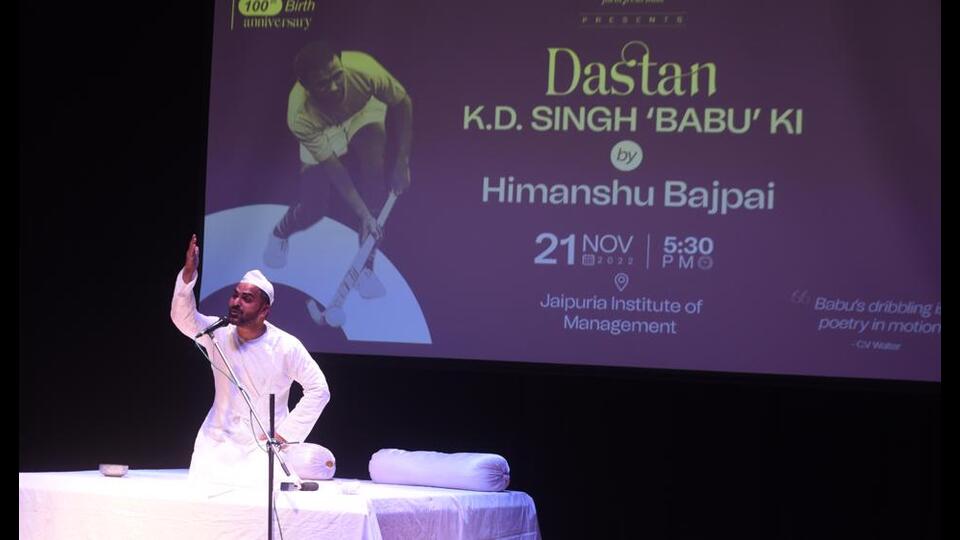
This was the first narration on a sportsperson by Bajpai who is known for his dastangois on the Indian Freedom Movement, Rani Laxmibai and many other personalities. Dastangoi is the ancient art of oral story-telling that is seeing a revival, more so here, in Lucknow.
Kunwar Digvijay Singh was born in Barabanki and was fondly called ‘Babu’. He is widely known for his mesmerising passing ability and is considered by many to be the greatest dribbler of the game comparable only to Dhyan Chand. Dhyan Chand is widely regarded as one of the greatest field hockey players in history. Known as The Wizard or The Magician of hockey for his superb ball control, he played internationally from 1926 to 1949.
‘Dastan KD Singh Babu ki’ began with his first match at the annual inter-collegiate tournament at Lucknow’s Dewa Mela in 1930s when he led his team to victory and caught the attention of other hockey players at the age of 13. Bajpai narrated an incident of how a 16-year-old Babu won the match for Lucknow Youngman’s Association team against Manavadar XI from where two-time Olympian Mohammed Hussain was playing. “In this match played in Delhi, Babu’s stick work kept Hussain on his toes throughout the match. The Olympian fell twice while trying to stop ‘Babu’ from scoring a goal. It was during this tournament when KD Singh shot into limelight,” stated the dastango. Impressed by Singh’s raw talent, Hussain predicted a great future in hockey for the teenager.
Bajpai also mentioned how sports administrators refused to make KD Singh captain of the team despite him being the best and senior-most player of the Indian squad. But he never complained against anyone and started coaching the new generation of hockey players, he added.
“Due to this, he refused to play the 1956 Olympics, from where the downfall of Indian hockey started. When the Indian team couldn’t make it to two the Olympics because of World War II, hockey enthusiasts across the world missed watching the wizardry of KD Singh,” he said.
Referring to another episode, Bajpai said KD Singh was the coach of Indian team when it participated in the 1972 Munich Olympics. Ashok Kumar, son of Major Dhyanchand, was also playing when the team was up against Great Britain. The Indians were leading 2-0 at half time, but were not playing well enough. The coach scolded Ashok Kumar for “poor performance”. Ashok replied: “Everyone in the team is playing the same way.” “You are talking like that…this is indiscipline,” said KD Singh.
Kumar was in tears, but lifted his game to score a goal, leading to India’s 5-0 win in the match. After the match, Singh gave 20 Marks to Kumar, saying that he should purchase a tie for his father, Dhyanchand.


