
 E-Paper



Families of Basti village grow mushrooms, beat joblessness
Not far from Lucknow, some 200 km away, lies Nagpur village, in Harraiya tehsil of Basti district


Not far from Lucknow, some 200 km away, lies Nagpur village, in Harraiya tehsil of Basti district. The village is setting a good example of self-reliance through unconventional farming by growing edible mushrooms. Several families in the district, which was once plagued by unemployment, are now expanding and actively engaged in mushroom cultivation.
Krishnawati was the first woman in the district to begin mushroom farming in the village, which eventually expanded to the entire area, employing up to 3,000 people, and was lauded and welcomed by governor Anandiben Patel.
“About eight years ago, the practice was adopted by one or two families, and it has since expanded to 160 families. This has further spread to more than five nearby villages and is still expanding, making the village closer to self-reliance. It involves all the members of the family with each family given a target. The more they produce, the more they earn,” said SN Singh, head of the department, Krishi Vigyan Kendra, Basti.
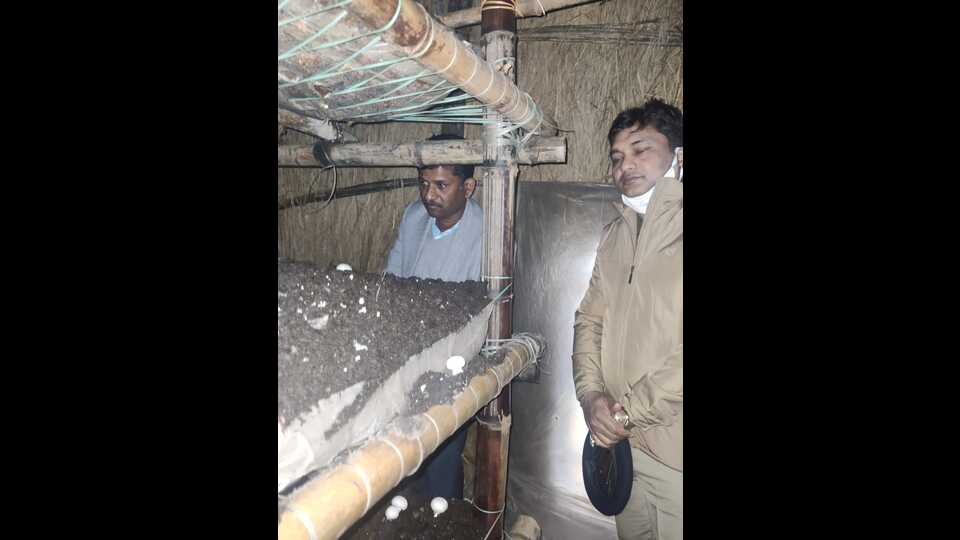
Mushroom cultivation is very different from other farming. It involves several processes that need to be done to ensure its growth. To manufacture one shed (a bed-like structure 22 feet wide and 50 feet long), ₹1-1.5 lakh is spent.
A single shed requires straw, ammonium sulphate, urea, pottash, calcium, ammonium nitrate or ammonium sulphate and gypsum etc, said Singh, adding that each bed-like structure produces approximately 25-30 quintals of mushrooms.
“A bed-like structure is created considering the maximum production in the least space. The raw material is mixed and moistened to create compost for aerobic fermentation. The process of composting takes from five to 18 days. Pasteurisation and ammonia elimination are the key goals of the composting process. After that, the beds are readied for spawning, which involves sowing mushroom mycelium (a fungus’s root-like structure).
“After spawning, the trays are covered with newspaper and sprinkled with water to preserve moisture content. It is then followed by casing, which involves combining finely crushed decaying cow dung with garden soil known as casing soil. The first flush is reaped in 3 to 5 days which can be freshly eaten and even stored.
Farmers sell 200-250 kg of produce at local markets or to local wholesalers who service other areas during the peak season. Due to its extreme perishability, vendors collect it every morning and sell it by the evening, or else it turns blackish.
Farmers have been producing mushrooms for the past eight years, and governments and their agencies have recognised it. Because of its limited shelf life, it necessitates packaging that will keep it fresh for a few days.
“However, even after the acknowledgement of the governor, no processing plants have been set up. There needs to be greater involvement of private and government players to increase mushroom cultivation, so that it spreads to the other districts of the state,” Singh said.


