Keeping up with UP: What if 33% quota for women in legislatures is implemented from UP?
The opposition described the government’s move as an ‘election jumla’ to appease women ahead of the 2024 Lok Sabha polls.
Published on: Mar 16, 2026, 14:51:25 IST
By Sunita Aron
Prefer HTon Google
Share via
Copy link
In September 2023, the Narendra Modi government convened a special session of Parliament to introduce the Nari Shakti Vandan Adhiniyam bill fulfilling the three-decade-old demand for a 33 percent quota for women in the Lok Sabha and State Legislatures. It became an act after the President signed off on it.
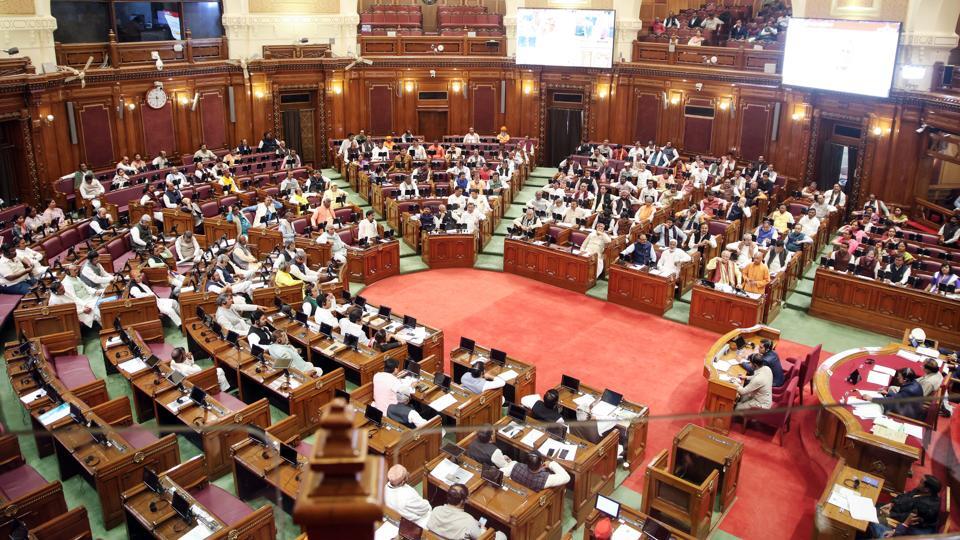
The Budget Session 2026-27 of the UP assembly underway at Vidhan Bhawan in Lucknow. (ANI)
The Opposition was not satisfied because its implementation was linked to the first Census and the subsequent time-consuming delimitation of constituencies, which itself is proving to be a knotty affair considering protests from southern states who fear a loss of population-based representation in the Lok Sabha.
The opposition described the government’s move as an ‘election jumla’ to appease women ahead of the 2024 Lok Sabha polls.
Adept at throwing surprises, the Centre is now turning the tables on the opposition. Three years after it became law, the government has now started fast-tracking its implementation by suggesting an amendment to the act to delink it from Census and delimitation.
Home Minister Amit Shah had said in 2023 said the women’s quota will be implemented only after 2029. Congress leader Jairam Naresh had then demanded the government spell out the timeline — a question that becomes more relevant if its implementation is advanced. The Congress has demanded an all-party meeting for a decision on a highly politically significant issue, especially for the male dominated regional parties.
Besides the timeline, opposition parties have also demanded a transparent process to reserve seats for women. They are apprehensive that the election commission (EC) might be influenced to reserve strong seats for women from where top opposition leaders contest. For instance, the constituency of Rae Bareli, which sent Congress leader Rahul Gandhi to the Lok Sabha or Kannauj, which elected Samajwadi Party (SP) chief, Akhilesh Yadav. Currently, the discussion is focused on reserving seats through a lottery system.
Uttar Pradesh as testing ground
Could the new Act be implemented from Uttar Pradesh (UP) in 2027, ahead of the state elections? Will implementing it help the ruling BJP counter the Samajwadi Party’s (SP) PDA (pichra, Dalit, alpsankhyak) formula, which delivered a spectacular victory in the 2024 polls?
Mulayam Singh Yadav, SP’s founder-president, favouring the 20 percent quota for women, had consistently advocated allocation/reservation of seats by the party. Even today, the party leadership advocates the same formula for seat reservation but also supports a 33 percent quota claiming they are fully geared up to implement it.
Ironically, barring the Congress which under Priyanka Gandhi’s ‘Main Ladki Hun, Lad Sakti Hun’ slogan had given 40 percent tickets to women in the 2022 assembly polls, the other three mainstream parties- the BJP, SP and BSP -had fielded women candidates in roughly 10 percent of the 403 constituencies in the state.
Of the 559 women candidates who fought the 2022 polls, the BJP-led NDA won 29 seats, SP-14 and BSP none. The Congress could win only one seat; Aradhana Mishra aka Mona, daughter of Congress veteran Pramod Tiwari won the election. Other candidates including women activists and victims of atrocities, received only a couple of thousand votes in an election where women outnumbered men in casting their votes.
As many as 62.24 percent women cast their votes while men clocked a voting percentage of 59.56 percent. The women voters did not vote for their clan despite promises made in manifestos as well as women-oriented poll campaign. However, there is no data to prove that the women voters cast their vote on women issues or for their clan candidate.
Contentious Issues
What will be the formula to reserve 33 percent seats in the Lok Sabha and state legislatures? The task will be gigantic in view of prevailing mistrust between the government and the opposition parties
In case the women quota is implemented from the 2027 UP Assembly elections, how will new candidates cover the extensive length and breadth of the constituency in less than a year’s time? Even the cadre-based parties like the BJP, SP and BSP will have to work hard to ensure they win.
Kitchen to Cabinet
While many women leaders who have been relentlessly working hard in their respective parties may finally get due recognition of their services by their accommodation in seat distribution, the preference for family members like wives or sisters can’t be overruled as every party will have winnability as a major criterion for selection.
Second, male MLAs who have nursed their constituencies for decades will push relatives in case their seat are reserved. They would want to protect their seat. Family support will be an advantage. Simultaneously, the ‘Vidhayak Pati’ culture will also be evident in the legislature though some strong leaders will eventually emerge from the crop.
Large-scale disgruntlement
Political parties have active women’s wings but contesting polls is different from staging demonstrations. Ironically, BJP, SP and BSP have never groomed women leadership for organisational positions; there have been ministers but not party presidents or general secretaries.
Not much has been done by political parties to groom women candidates, majority of whom would lack the confidence, training, wherewithal or muscle-money power to contest polls. As many as 21 women MLAs elected in 2022 were first-timers. The UP assembly speaker Satish Mahana had to organise an exclusive day-long women session, the first of its kind in the country, in September, 2022, to provide them an opportunity to speak.

 E-Paper




 Prefer HTon Google