
 E-Paper



Lucknow police probe motive behind son killing father, hiding chopped body in drum
According to the police, the relationship between the father-son duo had been strained for years, particularly over the accused’s career choices.

 Prefer HTon Google


The Lucknow police are probing the psychological trigger behind the killing of a businessman by his son, four days after the victim was shot dead inside his home in Lucknow’s upscale Ashiana area, as investigators piece together evidence suggesting years of familial conflict culminated in a single fatal moment.
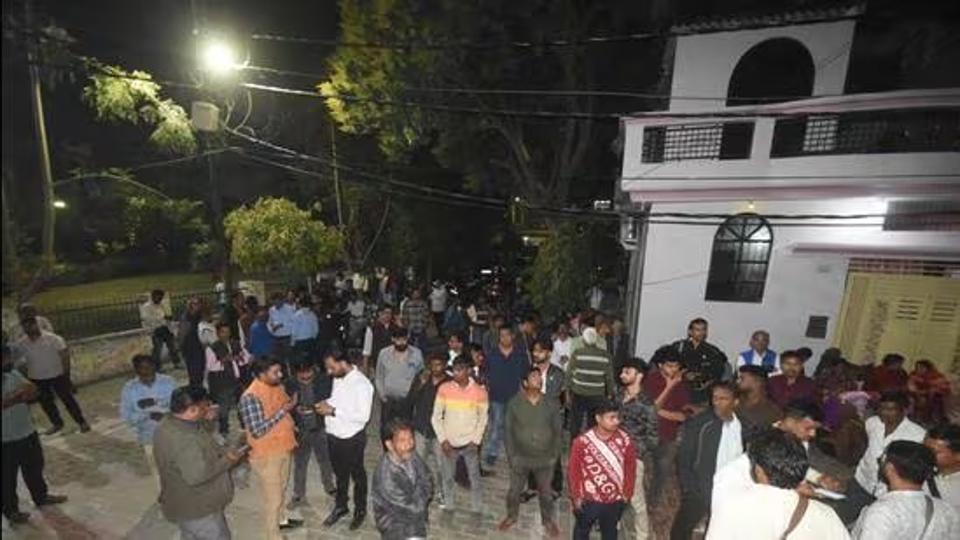
The accused, 21-year-old B.Com student Akshat Singh, allegedly shot his father, 49-year-old Manvendra Singh, with a licensed rifle in the early hours of February 20, dismembered the body, and attempted to conceal the remains in a blue plastic drum. The case has drawn grim comparisons with the Meerut ‘blue drum murder’ of March 2025 that shocked the country.
Police officials said the investigation has now moved beyond the mechanics of the crime to identifying the precise “trigger moment” that escalated a long-standing father-son dispute into murder.
According to deputy commissioner of police (central) Vikrant Vir, the relationship between the two had been strained for years, particularly over the accused’s career choices. “During interrogation, the accused revealed that his father frequently pressured him to prepare for the medical entrance examination and questioned his decision to pursue B.Com. He said he felt humiliated repeatedly,” Vir said.
Investigators are examining whether the argument on February 20 was a sudden escalation or the culmination of prolonged resentment. Forensic teams are analysing bullet trajectory, blood spatter patterns and the position of objects in the third-floor bedroom to determine whether the shot was fired in a moment of rage or after a calculated pause. “The sequence inside the room — distance of firing, angle of the entry wound, and movement marks — will help us understand whether there was a scuffle or a deliberate act,” a senior officer said.
The police are also analysing digital evidence, including search history and social media activity, amid claims that the accused had closely followed the Meerut drum murder case online.
Reconstructing the crime scene
The murder allegedly took place around 4.30am on February 20 at the family’s residence in Ashiana. The crime scene reconstruction suggests that a heated argument broke out between the two, following which Akshat accessed his father’s licensed rifle and fired a single fatal shot at close range. The act was allegedly witnessed by his younger sister, who was threatened into silence.
Investigators found drag marks from the third floor to a ground-floor room, indicating the body was moved soon after the shooting. Blood traces recovered from stair railings and flooring were partially wiped but detected during forensic examination.
On the ground floor, the police believe, the accused used household tools to dismember the body. The torso and head were placed inside a blue plastic drum, while other body parts were allegedly transported in the family car and dumped in a remote area near Sadrauna. Search teams continue to comb the area for missing remains.
“The dismemberment appears methodical. It was not a hurried act. It took time and effort,” said the Ashiana police station house officer, adding that tool marks are being matched with evidence recovered from the house.
Equally disturbing, the police said, was the alleged attempt to mislead investigators after the crime. Within hours of the killing, Akshat reportedly claimed his father had left for Delhi around 6am and later filed a missing person complaint, portraying himself as a worried son.
Police traced the victim’s last known mobile location to his pathology laboratory in Kakori but found no trace of him there. Investigators said inconsistencies in the accused’s statements raised suspicion. “He first suggested suicide. Later, his version changed. His timeline did not match technical evidence,” DCP Vir said.
Family members also grew suspicious after noticing him repeatedly cleaning the car. A forensic examination later revealed blood traces inside the vehicle. Sustained interrogation on February 23 led to his alleged confession, following which the police recovered the blue drum from the house containing mutilated remains.
The case has drawn parallels with the Meerut drum murder case in which a Merchant Navy officer was killed and dismembered by his wife and her paramour, with the body concealed with cement inside a drum. Police are examining whether media coverage of that case influenced the method used here. “We are verifying whether the accused consumed or discussed content related to the Meerut incident. The pattern is disturbingly similar,” an officer said.
A fractured family background
Manvendra Singh, who owned a pathology laboratory in Kakori and had interests in the liquor business, raised his two children alone since his wife’s death nine years ago. Neighbours described the family as reserved and well-settled, making the crime all the more shocking in this part of Lucknow.
As forensic analysis continues, investigators say the central question remains unresolved. “The trigger may have been a single sentence during an argument. Was the shooting a spontaneous eruption of anger, or the end point of a brewing psychological rupture? Our job is to establish that moment beyond doubt,” a senior officer said.


