
 E-Paper



Lumpy Skin Disease: Yogi govt to adopt Malaysian model to check virus
The Uttar Pradesh government has planned a 300-km long and 10-km wide ‘immune belt’ between Pilibhit and Etawah, passing through 23 blocks of five districts with an aim to curbing the lumpy virus disease among animals in the state


The Uttar Pradesh government has planned a 300-km long and 10-km wide ‘immune belt’ between Pilibhit and Etawah, passing through 23 blocks of five districts with an aim to curbing the lumpy virus disease among animals in the state.
The immune belt is the creation of a zone to check the spread of a virus. This belt will pass through Bisalpur, Barkheda, Lalorikheda, Marauri, and Amaria development blocks of Pilibhit district via Khudaganj, Nigohi, Sidhauli, Bhawal Kheda, Kant, Jalalabad, and Mirzapur development blocks of Shahjahanpur district, and Kaimganj, Shamsabad and Rajepur development blocks of Farrukhabad district. It will reach Kurawali, Sultanganj, and Ghirour development blocks of Mainpuri district and Badhpura, Jaswantnagar, Saifai, Basrehar, and Takha development blocks of Etawah.
So far, 21,619 cows from 2,331 villages of the state have been affected by the lumpy virus, out of which 199 have died, while 9,834 have been treated and have recovered. To overcome the deadly virus, the Yogi government is running a massive vaccination campaign. More than 5,83,600 cattle have been vaccinated so far.
A special enforcement team will be formed by the department of animal husbandry for surveillance under the Immune Belt. The task force will handle the tracking and treatment of animals infected with the lumpy virus, read a press statement from the state government.
Not only will a close watch will be kept by the team on infected animals, but there will also be a system to keep them within the immune belt. Earlier, a similar effort to prevent animal infection has been done in Malaysia in 2020, the results of which were very positive, the press statement issued on Thursday read.
The virus has spread to 23 districts of Uttar Pradesh. Of these, the highest number of cases has been reported in Aligarh, Muzaffarnagar, and Saharanpur. At the same time, the virus is spreading rapidly in Mathura, Bulandshahr, Baghpat, Hapur, Meerut, Shamli, and Bijnor.
Most cases of lumpy virus have been reported in the western districts of the state. In view of the same, the Uttar Pradesh government has prepared a plan to cover a distance of about 300 km from Pilibhit to Etawah with a 10-km-wide immune belt.
The animal husbandry department gave a presentation on the master plan relating to the immune belt to chief secretary Durga Shankar Mishra, which has been agreed upon by the government.
According to the information shared by the animal husbandry department, September is considered very sensitive, therefore, special vigilance is being maintained in nine divisions of the state regarding the spread of the virus.
There is no shortage of vaccines in the department and more than 32 lakh vaccines have been received, the officials informed. Now preparations have been completed to administer as many as two lakh vaccines a day, which will be further increased to three lakh vaccines per day, said the press statement.
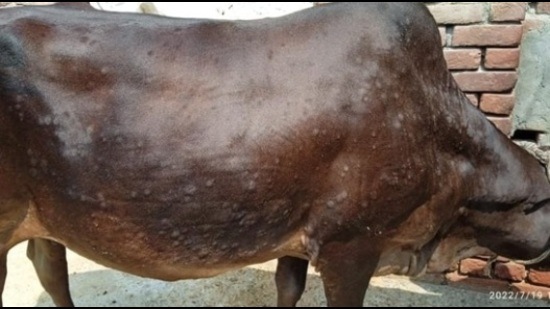
Lumpy skin disease is a viral disease that affects cattle. It is transmitted by blood-feeding insects, such as flies and mosquitos, and ticks. It causes fever and nodules on the skin and can lead to the death of the cattle.


