E-Paper



Mahakumbh a no-vehicle zone till February 4, VIP passes cancelled
Additionally, the government has made it clear that any VVIP movement must be informed at least a week in advance, an official statement said

 Prefer HTon Google


PRAYAGRAJ A day after at least 30 people were killed in a pre-dawn stampede at the Mahakumbh, the Uttar Pradesh government on Thursday enforced stricter measures for better crowd management and safety of devotees as it restricted vehicular movement, cancelled VIP passes, increased security deployment, and ended needless restrictions on pontoon bridges that connect the mela city.
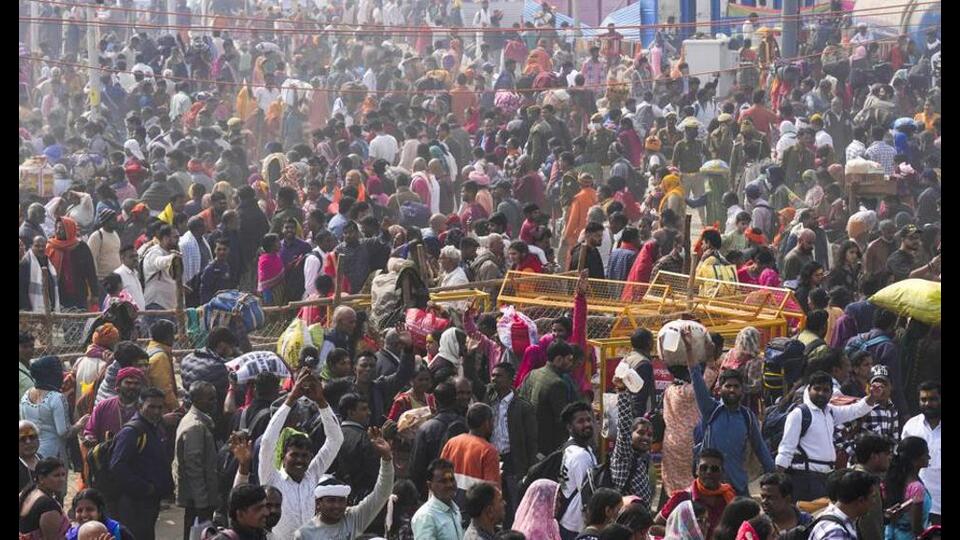
Officials familiar with the matter said the Mela area will be a “no-vehicle zone” till February 4, a day after the conclusion of the next “Amrit Snan” on Basant Panchami, during which millions of people are expected to congregate at the confluence of the Ganga and Yamuna. Before the directive, vehicles with valid passes were allowed to travel till different camps set up at Mahakumbh site.
“Vehicle passes will not be valid until all devotees have safely left for their destinations,” superintendent of police (traffic) Anshuman Mishra said.
The authorities clarified that there will be no restrictions on the movement of police and administration vehicles, ambulances, and other essential service providers.
The administration also revoked VIP passes to streamline people’s entry. Earlier, those having VIP passes were allowed access till tents of Akhadas and sadhus in various sectors.
“As a result, VIPs and VVIP delegations planning to visit Prayagraj ...will not receive special privileges or protocols. Additionally, the government has made it clear that any VIP or VVIP movement must be informed at least a week in advance. This rule will help prevent last-minute VIP visits that could disrupt arrangements for pilgrims,” an official statement said.
Addressing concerns over reports circulating on social media, Prayagraj district magistrate Ravindra Kumar Mandar clarified, “A viral message claims that vehicle entry in Prayagraj will remain restricted until February 4. This is completely baseless. The diversion scheme was implemented only in view of the Mauni Amavasya snan (holy bath).”As of today, January 30, devotees are returning, and police have been instructed to remove the diversions and barricades. There will be no entry restrictions on vehicles on January 31, February 1, and February 4,” he said, as per a PTI report. He said the diversion scheme would be re-implemented on February 2 and 3 for the Basant Panchami snan.
On Wednesday, surging crowds burst out of police barricades to rush towards a narrow strip of the riverbank at the Mahakumbh, leading to a stampede. Authorities said the tragedy occurred between 1am and 2am as millions of devotees jostled to find a toehold before taking a dip at the holy Sangam nose, smashing through cordons and putting the spotlight on administrative lacunae in preparing for the “Mauni Amavasya”, considered by many as the most auspicious moment of the six-week festival.
Eyewitnesses said the police did nothing. Saroja, who had travelled for the festival from Belagavi in Karnataka and gave only her first name, blamed the police for the deaths of four members of her family. “Police didn’t make proper arrangements. They are responsible for this,” she said. “We came in a batch of 60 people in two buses, there were nine people in the group. Suddenly there was pushing in the crowd, and we got trapped. A lot of us fell down and the crowd went uncontrolled.”
Hours after the disaster, UP chief minister Yogi Adityanath said such incidents “are heartbreaking and serve as a lesson.”
The curbs on the entry of vehicles led to heightened checking on key routes leading to Prayagraj from within UP and also other states leaving many stranded amid long traffic snarls.
“After reaching Phaphamau (outskirts of Prayagraj) by bus, I was left stranded due to a massive traffic jam as buses were not allowed to enter the city,” said Hemandra Dwivedi, a Lucknow resident.
After reassessing the crowd pressure in Prayagraj, the state government deployed more personnel across the city, according to officials aware of the matter. The Centre also rushed additional paramilitary personnel, from the Indo-Tibetan Border Police (ITBP), the Central Reserve Police Force (RPF), the Special Security Force (SSF), and the Border Security Force, following a request from the Adityanath government, they added.
“In anticipation of a large number of pilgrims, we are further strengthening the deployment of police personnel and security forces,” deputy inspector general of Maha Kumbh Nagar, Vaibhav Krishna said.
Officials claimed that the devotees who had gathered at the Sangam early on Wednesday pushed towards the main bathing area at the confluence of two rivers rather than spreading out, which triggered the stampede.
“We are looking at making some changes now,” Krishna, said, adding that the festival site will be divided into more sectors. The area where the rivers join “will have additional forces, and we will try to reduce the turnaround time of pilgrims in the bathing area”, he added.
Witnesses to Wednesday’s tragedy said that limited access to exit points worsened the disaster as the Sangam nose was choc-a-bloc with pilgrims, with no space left for people to turn back after taking the dip.
“People were asking police to open the barricades to other routes as it was suffocating to stand there in that crowd for almost an hour. We couldn’t breathe,” news agency Reuters quoted Jagwanti Devi, who was in the crowd with her family of six, as saying.
On Thursday, the state government also directed senior officials not to “unnecessarily” close pontoon bridges to ensure smooth entry and exit of pilgrims, especially on February 3, according to people aware of the matter. Pontoon bridges are temporary, floating structures, which serve as a link between the Sangam and the 4,000-hectare “akhada” area.
Uttar Pradesh chief secretary Manoj Kumar Singh and Director General of Police Prashant Kumar on Thursday reached the Mahakumbh Mela area for a review. The two senior officers first went to Jhusi and then to Sangam as they collected information about the stampede from district magistrate (Mahakumbh Nagar) Vijay Kiran Anand.
On Thursday, 20 million people took the holy bath at the Sangam till 8pm, according to the state government, as the number of devotees attending Kumbh was relatively low.
The three-member judicial commission set up by the Uttar Pradesh government to probe the stampede was scheduled to visit the incident site on Friday and submit its report in a month, panel head and former Allahabad high court judge Harsh Kumar said. “Tomorrow (Friday), we will visit the site to conduct an inspection and analyse the possible causes and circumstances surrounding the incident. We will carefully consider all factors and are required to submit our report within one month,” said Kumar. Former director general of police (DGP) VK Gupta and retired IAS officer DK are the other members of the panel.