
 E-Paper



Medical staff boycott work for two hours in UP, demand no-transfer policy for 2021
The protestors said that instead of shifting the staff and issuing a fresh list, the pending applications of those employees who themselves are seeking transfers can be entertained.


The medical staff in Uttar Pradesh resorted to a two-hour work-boycott on Friday, demanding “no transfers” during the current year for all the health employees working in government-run facilities.
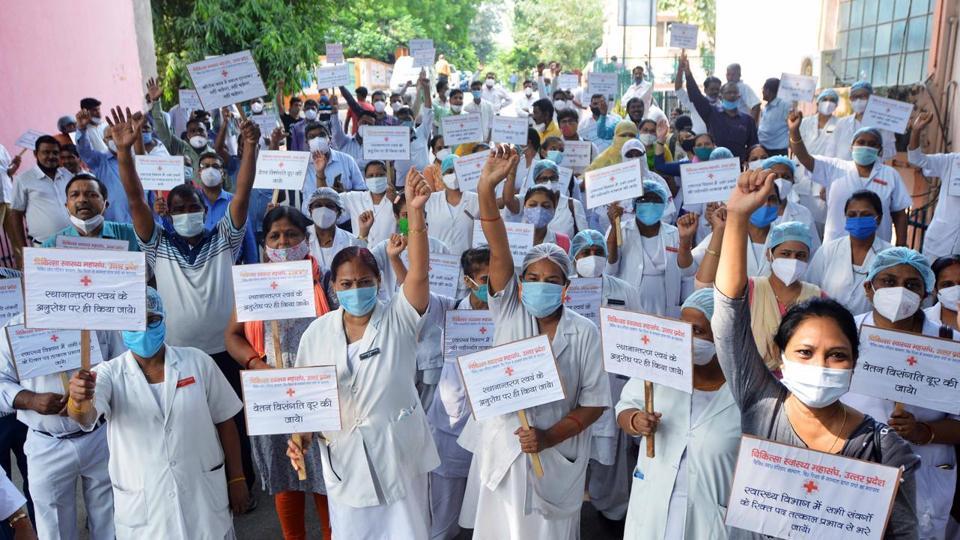
The statewide call for the work-boycott was given by the Chikitsa Swasthya Mahasangh (Health Federation). The protest began at 8am.
“All the hospital staff have worked since March 2020 without any leave. Even at present, we are preparing for the probable third wave of Covid-19 and working day and night, as required. There is no reason why transfers can’t be postponed as there are many health workers who have either recovered from Covid or have family members struggling with post-Covid complications,” said Ashok Kumar of the Rajkiya Nurses Sangh, an organisation of nurses working in government hospitals.
The protestors said that instead of shifting the staff and issuing a fresh list, the pending applications of those employees who themselves are seeking transfers can be entertained. This would come to more than the target decided by the health department for the transfer of 20% of the total staff, they said.
“Of the total of about 8000 staff nurses working in Uttar Pradesh, the health department needs to transfer 1100 and the applications submitted by staff nurses (personal requests for transfer) is 1500. Similar applications are pending from lab technicians, pharmacists, doctors and other staff members,” said Ashok Kumar.
“Such applications may be filtered and those found fit under the criteria laid down for transfer shall be acted upon to make sure transfers are done without actually disturbing the staff or putting them at risk,” said Dr Amit Singh, general secretary of the Provincial medical Services Association (PMSA), a body of about 14000 government doctors in Uttar Pradesh.
“Whenever you make a phone call, the voice message first says stay home and come out only if very necessary. Are the transfers so necessary that even the risk of life appears small before it?” asked Sunil Yadav, head of the Pharmacist Federation Uttar Pradesh.
“We have already given representations to senior health officials and now we will hold a massive protest at the health directorate on July 12, if our demands are not met,” said Dr Amit Singh.
The state has 167 district level hospitals, 855 community health centres, 3621 primary health centres, 129 mother and child hospitals and 42 trauma centres that have a total of about one lakh staff.
“As many as 20% of these were to be transferred, but this can be deferred this year. And we are ready for the transfers in 2022 once the Covid pandemic is over,” said Ashok Kumar.
Patient-care hit in Lucknow, stir to continue on Saturday as well
Patient care services were hit here on Friday when health care workers under the banner of the Chikitsa Swasthya Mahasangh observed a two-hour work boycott opposing the transfer policy. They will continue the work-boycott on Saturday as well.
Since 8am, the staff gathered at the main entrance of the Civil Hospital in the state capital, raising slogans while people in queue waited to get OPD (outpatient department) tickets made. The staff staged protest at all major government-run hospitals in the state capital, including BRD Hospital, Balrampur Hospital, Lok Bandhu Raj Narain Hospital and Rani Laxmibai (RLB) Hospital.
“I had to give my fasting and PP (post prandial) samples for checking blood sugar levels. The sampling will start only after 10am. Hence, I am going back and will be here again next week. I can’t visit the hospital thrice. PP sample has to be given after meal. That requires me to go back home after giving the fasting blood sample,” said an elderly patient who had come to give blood sample.
Many patients who came for sampling, x-rays, ultrasound tests, CT scans, and other pathological tests kept waiting, while a few went back. Barring emergency services, doctors and nurses, ward boys and technicians didn’t work till 10am.
The patients who went to government hospitals had a tough time. Some of these hospitals included Balrampur Hospital, Dufferin, RLB Hospital, and community healthcare centres (CHCs).


