E-Paper



One month of Vikas Nagar fire: Life limps to normality, but summer nights harsh without electricity
Rows of bamboo-supported tents with serial numbers now stand where ashes and twisted metal sheets had remained scattered after the blaze

 Prefer HTon Google


A month ago, residents of the Vikas Nagar slum were still coming to grips after flames lapped up their humble dwellings, reducing them to ashes on the evening of April 15.
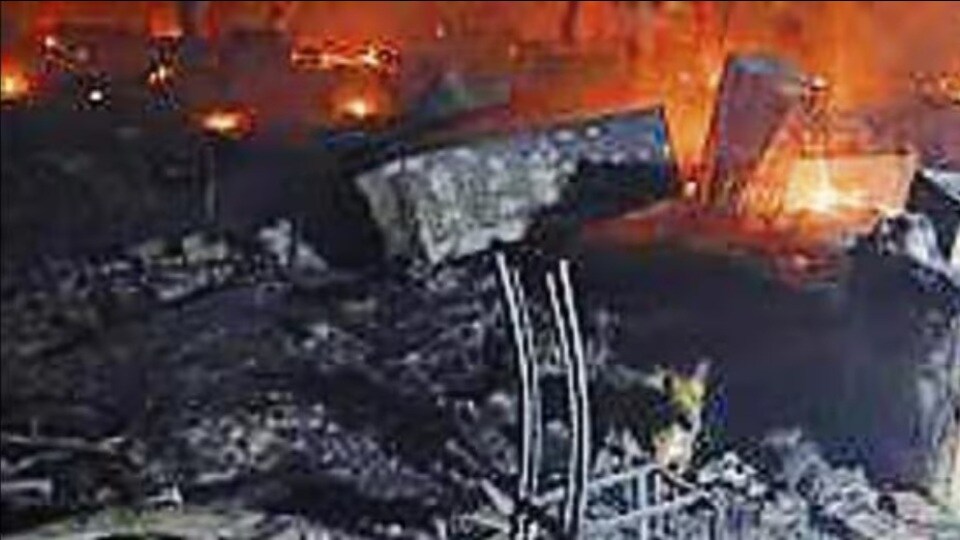
Today, along the banks of the drain, tea stalls are operating again, grocery kiosks have reopened, children have begun going to school, people can be seen cooking on small stove-cylinders: all signs of a settlement slowly rebuilding itself after the devastating blaze that killed two children and displaced over 1,000 people.
What had initially emerged as emergency shelters made of sarees, plastic sheets and salvaged cloth have gradually transformed into comparatively sturdier bamboo-framed structures given to them as charity, covered with thick tarpaulin and mountaineering-style tents donated by volunteers and aid groups.
Rows of bamboo-supported tents with serial numbers now stand where ashes and twisted metal sheets had remained scattered after the blaze.
Yet, normalcy remains distant. As temperatures continue to soar, most families still spend nights in complete darkness as electricity has not been restored in the settlement. Residents say the heat becomes unbearable after sunset.
“Charity workers erected my hutment for me. We also got gas cylinder, stove, bed, utensils that is helping us rebuild our lives again,” said Qaiser Jahan, 60, who lives with her son, a rickshaw puller and his three children
Residents said the first few weeks after the fire were focused entirely on survival — arranging food, temporary shelter and basic belongings. But over the last month, families have started rebuilding not just houses, but daily life itself. Men working as labourers have resumed daily wage work at construction sites while many women employed as domestic workers in surrounding colonies have also returned to work. Narrow lanes once filled with burnt debris, now have grocery kiosks and scrap collection points.
“I lost everything in the blaze and have restarted business using salvaged material, ₹4,000 borrowed money in these bamboo kiosks,” said Mohd Yusuf, 18.
Shaquila, 55, can’t work as a domestic help due to her being a handicapped, so she reopened her shop that has a few spices, Maggie packets, tobacco products most of which she got as relief material. “I’m trying to contribute whatever I can to the family of six,” she said.
Children who had stopped attending classes after losing books, uniforms and school bags in the fire have also started returning to schools. Talking to Hindustan Times, children who introduced themselves as Komal, 13, Sonakshi, 13, Anshika, 10, Janvi, 6, and Shivani, 15 have finally resumed their classes at a nearby government school.
“We got back our books, but we have to get our uniforms and textbooks. No electricity is a big challenge for our studies,” said Shivani, who will appear for Board exams next year.
A small informal primary school operating inside the slum run by Manju Devi, free of cost for underprivileged children, which had completely burnt down, has now been rebuilt using bamboo poles. Around 40 to 50 children had been studying there before the blaze.
“We have started again. We got books and other study materials, but we’re yet to get benches,” said Manju.
Despite visible rebuilding, many families say they remain far from recovery. Electricity continues to remain absent across the settlement, leaving families to battle unbearable summer nights inside tightly packed shelters.
Maya Devi, 53, a domestic help said, “Fortunately we got the roof. With no electricity, I cook food during the day, as this solar bulb which I got from someone hardly helps.”
Some still fighting to survive
While some received enough support to erect stronger temporary shelters, several residents living in the more neglected portions of the slum are still struggling with partially covered huts and inadequate resources.
Parvati Pannalal, 60, who is settled in the mid portion of the slum on a bank of drain still under a plastic makeshift shelter, said with moist eyes, “My husband Pannalal is mentally unstable. My earning from working as domestic help in two houses isn’t enough. Because we are in the centre of the slum, relief rarely reaches us. Household items like beds, utensils, tents get exhausted before they reach me.”
Power scene: What the authorities say
“The electricity will be restored only after the orders of the government. Earlier too, 20-22 electricity connections had been given legally on the basis of law for such shanties. The same procedure can be followed only after a decision is taken at the government level,” said VP Singh, chief engineer, Jankipuram zone, LESA.