
 E-Paper



Over 60% of 2.5L power poles are ‘open hazard’ in Lko
After the Gudamba incident, the Lucknow Municipal Corporation (LMC) initiated a drive to cover exposed poles using black polythene secured with brown tape. However, more than 60% of the 2.5 lakh poles under LMC’s jurisdiction remain uncovered.


Exposed electrical wires on steel streetlight poles remain a looming danger in the city, despite a tragic incident in August claiming the life of a 15-year-old boy in Gudamba.
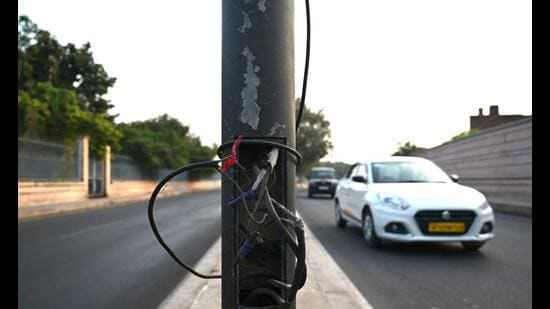
After the Gudamba incident, the Lucknow Municipal Corporation (LMC) initiated a drive to cover exposed poles using black polythene secured with brown tape. However, more than 60% of the 2.5 lakh poles under LMC’s jurisdiction remain uncovered. The temporary fix, according to LMC chief engineer Manoj Prabhat, has addressed approximately 1 lakh poles, with the remaining posing significant risks to unsuspecting pedestrians.
Residents from neighbourhoods like Gomti Nagar Extension, Jankipuram Extension, Indira Nagar, Lalkuan, and Mansarovar Yojana have voiced concerns about poles in inner lanes being left exposed. “While poles on main roads are taped, those in residential pockets are often ignored. Children playing or people walking nearby are at higher risk,” said Ashish, a resident of Hawett Road.
Mrityunjay, a resident of Gomti Nagar, echoed similar concerns. “Some poles are taped, but most in the inner lanes are exposed. It’s an accident waiting to happen,” he said.
Prabhat acknowledged the limitations of the current approach. “Regular tape is inadequate. We are planning to switch to insulation tape to prevent current leakage,” he said. However, the coverage provided by the LMC only extends up to 1.5 metres on poles that are 6 to 9 metres high, leaving the majority of the pole unprotected.
Adding to the challenge, the LMC chief engineer mentioned about frequent cases of residents tearing off the protective covers, complicating efforts to maintain safety.
The corporation has also explored a more permanent solution—applying dielectric coating to the poles—but budget constraints have stalled its implementation. “The coating would eliminate current leakage entirely but is significantly costlier,” Prabhat added.
Experts and residents alike urged the LMC to expedite efforts and prioritise high-risk areas to prevent further tragedies. “Temporary solutions are not enough. The LMC must act swiftly to address the issue comprehensively,” said a concerned resident.


