E-Paper



Two more J&K-origin doctors picked up from Hapur, Kanpur
With these detentions, security agencies have so far arrested or detained five doctors with Uttar Pradesh links for their alleged involvement in a Jaish-e-Mohammed (JeM)-inspired terror module comprising medical professionals

 Prefer HTon Google


Intensifying its operations following the recent blast near Delhi’s Red Fort metro station, the Uttar Pradesh Anti-Terror Squad (ATS) detained two more doctors with suspected terror links within 24 hours on Wednesday and Thursday. Both are residents of Jammu and Kashmir and currently working in Uttar Pradesh’s Kanpur and Hapur districts, senior police officials confirmed on Thursday.
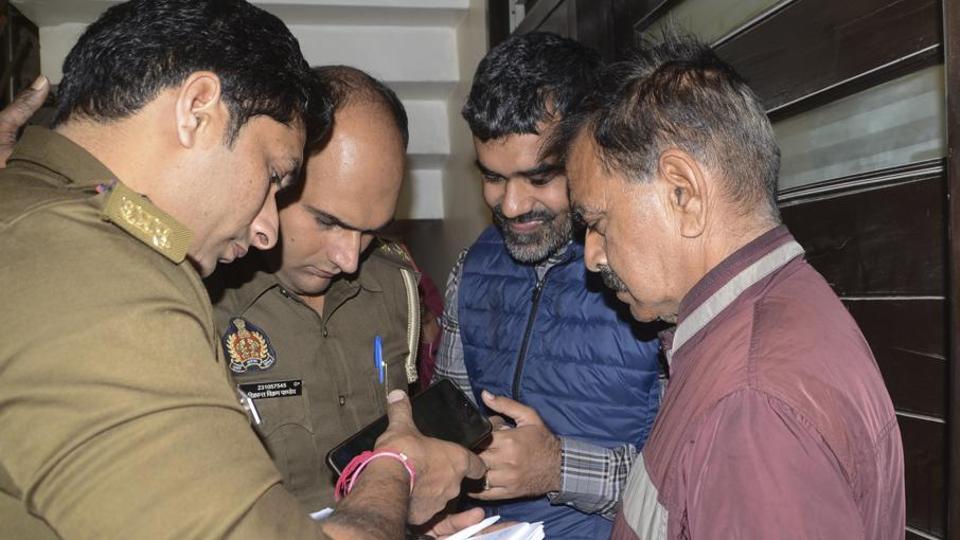
With these detentions, security agencies have so far arrested or detained five doctors with Uttar Pradesh links for their alleged involvement in a Jaish-e-Mohammed (JeM)-inspired terror module comprising medical professionals.
On Thursday afternoon, ATS officials detained Dr Farukh, a gynecologist from GS Medical College, Hapur, from his hostel.
Earlier, Jammu and Kashmir-origin cardiologist, Dr Mohammad Arif Mir (32), was detained late Wednesday night by the Uttar Pradesh Anti-Terrorist Squad and the National Investigation Agency (NIA) from the Cardiology Institute of Ganesh Shankar Vidyarthi Memorial (GSVM) Medical College, Kanpur, in connection with the ongoing probe into the Faridabad terror module and the Delhi blast case.
Both have been shifted to Delhi for interrogation in connection with the November 10 blast incident.
Confirming the Hapur action, GS Medical College director Dr Manoj Shishodia said, “A team of police personnel came to the campus on Thursday afternoon, enquired about Dr Farukh, and later took him along for questioning.”
Similarly, Dr Umeshwar Pandey, head of the cardiology department in Kanpur, said, “We only came to know that the ATS had taken Dr Arif for questioning. Beyond that, we have no information.”
According to ATS officials, preliminary investigation suggests that both doctors were in contact with Dr Shaheen Shahid, a Lucknow-origin doctor arrested from Faridabad on November 10, just hours before the Delhi blast.
People privy to the investigation said it was suspected that Dr Mir, who hails from Anantnag, was likely to be linked to Dr Umar Nabi, the cardiologist killed in the car explosion near the Red Fort, through a medical college in Kashmir. Dr Mir’s name surfaced after the arrest of Dr Shaheen. Officials said Dr Mir and Dr Shaheen had been in frequent contact for several months; agencies are now examining whether the association was purely professional or extended beyond that.
Dr Farukh studied with Dr Muzammil Shakeel Ganaie, arrested from Faridabad on November 9 with explosives in his possession.
According to the ATS, Dr Mir was picked up while returning from his night shift at the institute. Soon after, a police team reached his rented flat near Fatima Convent school in Ashok Nagar, questioned his landlord, and seized his personal devices for forensic analysis.
The landlord, Kanhaiya Lal, said that Dr Mir had moved in with Dr Abhishek about a month ago.
“They had taken the house on rent through a broker. Both lived in separate rooms and hardly interacted. Dr Mir used cabs for commuting and kept to himself,” the landlord said, adding that he had verified Mir’s identity documents before signing the rent agreement.
Dr Abhishek, who appeared before the media a a day after Dr Mir’s detention, said he knew little about his flat-mate. “We rarely spoke. Our duty hours were different,” he said.
“One month is too little to know anyone.”
Officials said Dr Mir and Dr Shaheen had been in frequent contact for several months; agencies are now examining whether the association was purely professional or extended beyond that.
All four — Dr Arif, Dr Farukh, Dr Umar, and Dr Muzammil — hail from Jammu and Kashmir, like Dr Adil Ahmad Rather, who was arrested from Saharanpur on November 6. Two others, Dr Shaheen Shahid and her brother Dr Parvez Ansari, both residents of Lucknow, were arrested on November 10 and 11 respectively. In all, five doctors linked to Uttar Pradesh are now in custody.
At GSVM’s Cardiology Institute, Dr Umeshwar Pandey, head of the department, said Dr Mir had joined the DM (Cardiology) programme three months ago through the NEET-Super Speciality 2024 batch, after securing All-India Rank 1008. “He had earlier completed his MBBS and MD from the Sher-i-Kashmir Institute of Medical Sciences (SKIMS), Srinagar. On the basis of his rank, he was first allotted SGPGI Lucknow, but later opted for GSVM in the second counselling. He was a diligent and composed doctor,” Pandey said.
Because of limited hostel accommodation for first-year residents, Dr Mir and others were living outside the campus.
The ATS and NIA are now scanning Dr Mir’s electronic trail to map possible links with the Faridabad network, which investigators believe had connections with Jaish-e-Mohammad operatives.
Officials said the ongoing probe has revealed a disturbing trend of highly qualified medical professionals being radicalised and recruited by JeM handlers. The network, believed to have become active in October, is suspected to have spread its operations across Lucknow, Saharanpur, Faridabad, Kanpur, and Hapur.
Explaining how the module came on the radar, officials said the first clue emerged on October 19, when posters bearing the insignia of Jaish-e-Mohammed appeared in Kashmir’s Nowgam area. A case was registered, and another batch of similar posters surfaced on October 27. CCTV footage from the area showed Dr Adil Ahmad Rather moving near the locations where the posters were pasted.
Subsequent surveillance revealed that Adil was in contact with Pakistani handlers, and his phone location was traced to Saharanpur, leading to his arrest. His interrogation led investigators to Dr Muzammil Shakeel Ganaie, and subsequently to Dr Shaheen Shahid and her brother Dr Parvez Ansari. The chain of links eventually brought Dr Arif and Dr Farukh under the scanner.
A senior ATS officer said the investigation is now focused on establishing the communication and funding trail of the module, believed to have been coordinated online through encrypted platforms.