E-Paper



With Vision-2030, UP to put brakes on road mishap deaths
The road map sets an annual fatality reduction target of 10% from 2025, using 2024 as the base year, with the goal of cutting total road accident deaths by 50% by 2030

 Prefer HTon Google


LUCKNOW The Yogi Adityanath government has drawn up a comprehensive Vision-2030 Road Safety Action Plan aiming to halve accident deaths by 2030 in the backdrop of UP’s status as the state with the highest number of road accident fatalities in the country.
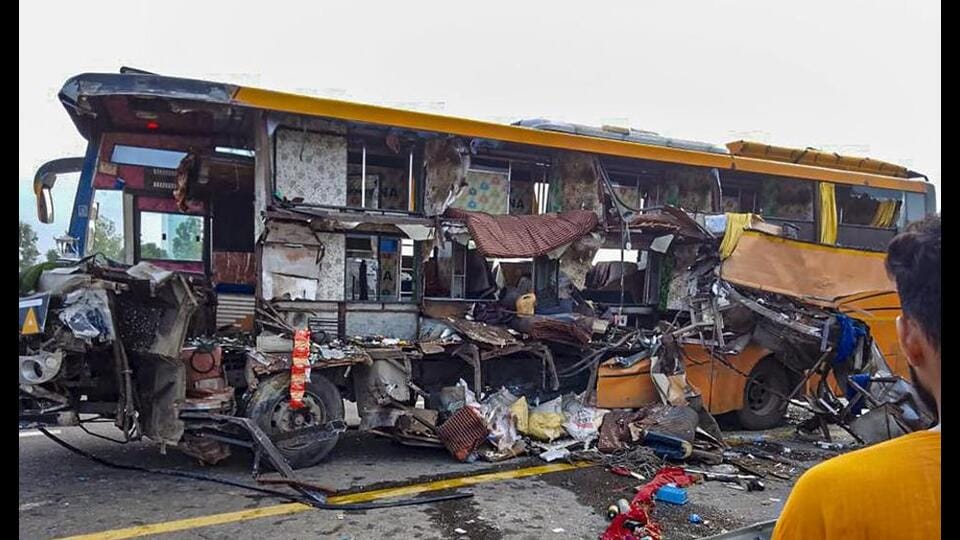
The move follows directives from the ministry of road transport and highways (MoRTH) under Section 136(A) of the Motor Vehicles Act, 1988, and Rule 167(A) of the Central Motor Vehicles Rules, 1989.
The road map sets an annual fatality reduction target of 10% from 2025, using 2024 as the base year, with the goal of cutting total road accident deaths by 50% by 2030. In 2024, the state reported 24,118 road accident deaths — a 2% rise from 2023.
Shockingly, the action plan reveals that nearly 40% of these victims died before receiving medical assistance, while 37% of fatal crashes were linked to speeding, 12% to drunk driving, and 8% to distracted driving such as mobile phone use. Children accounted for 8% of fatalities and 31% of serious injuries.
The action plan prepared by the transport department, after extensive consultations with various stakeholders, will be forwarded to MoRTH after the state government’s approval. It is grounded in a systematic, evidence-based and data-driven approach, anchored on the 5-E strategy: Engineering, Enforcement, Emergency Care, Education, and Environment.
“We have prepared Vision 2030, targeting year-wise reduction in fatalities. The action plan has been forwarded to the state government for final approval and will be submitted to the Centre through the state government very soon,” transport commissioner Brajesh Narain Singh told HT.
The key steps include the establishment of empowered road safety committees in all districts, a state-level Integrated Command and Control Centre (ICCC), deployment of AI-based traffic management systems, CCTV surveillance and integration of databases like Vahan and Sarathi.
He said states were preparing their Vision 2030 in compliance with the Supreme Court Committee on Road Safety directives to the centre.
Under Vision 2030, the state will roll out a year-wise action plan from the current year to 2030 to overhaul road safety governance and implementation.
District transport officers have been directed to submit inputs for the final plan, which also proposes strengthening enforcement mechanisms through coordination among key departments such as police, traffic, transport, PWD, and health. Special emphasis is being placed on addressing accident black spots, improving emergency response systems, and building capacities of trauma care facilities.
The state also plans to upgrade driver training and licensing systems, integrate road safety audits into standard practices and run community-driven awareness campaigns, especially targeting school children and pedestrians. The institutionalisation of these efforts will be backed by the creation of a State Road Safety Authority, tasked with ensuring sustainability of reforms beyond 2030.
The multi-pronged strategy calls for coordinated participation from departments, local bodies, NGOs, and private stakeholders to make UP’s roads safer and protect its citizens.
The plan outlines substantial infrastructure improvements across five phases: phase 1 (2025-26): focus on establishing foundational systems and emergency response protocols, phase 2 (2026-27): major highway safety upgrades and technology integration, phase 3 (2027-28): expansion to district and rural road networks, phase 4 (2028-29): implementation of advanced safety features and automation systems and phase 5 (2029-30): full system integration and performance optimization.
The transport commissioner said a growing number of road accident deaths in the state was a matter of grave concern and the Vision-2030, he added, would help the state apply brakes to this worrying trend.
DIGITAL INFRA EXPANSION
SPEED CAMS to be deployed on all major state highways by 2026; automated traffic violation systems to also come up.
AI-POWERED traffic management systems and GPS tracking across major highways to be installed.
ELECTRONIC TOLL COLLECTION systems with real-time vehicle monitoring to be implemented.
ROAD MAP sets an annual fatality reduction target of 10% from 2025, using 2024 as base year.
NEARLY 40% of mishap victims in UP died before receiving medical assistance
37% of fatal crashes linked to speeding
12% to drunk driving
8% to distracted driving such as mobile phone use.