
 E-Paper



2,50,000 idols immersed, floral offerings turned into agarbattis
Over 39,000 idol immersions took place on the final day of Ganeshotsav in Mumbai, with a total of over 205,000 immersions over the ten-day festival. Natural water bodies were still the preferred choice for immersions, but artificial ponds are becoming more popular. The BMC collected 500 metric tonnes of flower remains, which will be converted into compost for use in the gardens department. In G North ward, the remains are made into incense sticks. The NGO Shiva Sneha Samajik Pratistik has developed a process to turn the flowers into incense sticks, with 70% of the flower remains usable.


The tenth day of Ganeshotsav ended with a musical bang on Thursday, with 39,758 idol immersions taking place till 12 noon on September 29. This took the total number of immersions over the festival’s ten days to a whopping 2,05,722.
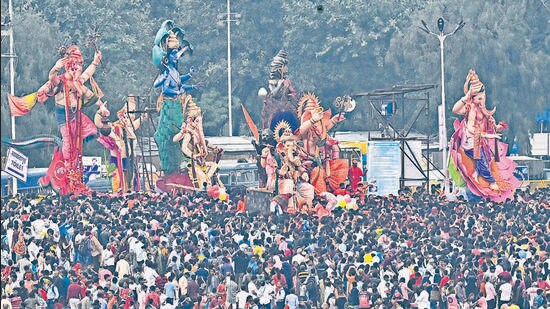
While natural water bodies are still favoured by devotees, with 1,29,013 such immersions taking place, artificial ponds are slowly gaining favour, with 37 percent of total immersions or 76,709 immersions taking place in these. On the final visarjan day, however, this inclination dipped; only 740 of the 6,951 public idol immersions and 10,207 of the 32,345 domestic ones took place in artificial ponds.
After the music died down, the ones who remained were the municipal cleaners working around the clock to sweep the roads and get them ready for the next day. Among the waste collected was 500 metric tonnes (MT) of flower remains or nirmalya. The majority of these remains will be converted into compost by the BMC to be used by the gardens department.
There’s one ward, however, where the flowers retain their scent. G North ward (covering Dharavi, Dadar and Mahim) collects the most nirmalya at around 60 MT, the remains of the floral offerings are made into incense sticks or agarbattis.
The plant where flowers are turned to incense is located at the back of the Meenatai Thackeray flower market in Dadar. This Ganeshotsav, it received a minimum of 2 MT of nirmalya on every immersion day. On Thursday, at least 5 MT were sent, with more being counted.
The flowers go through a certain process, the first and most time-consuming bit being the segregation and cleaning. “A lot of other waste comes along with the flowers, like threads, plastic and leaves,” said Hitesh Jayantilal Purabia from the NGO Shiva Sneha Samajik Pratistik, which runs the plant. Purabia said that 70 percent of the nirmalya received was usable while the rest was trash.
The selected flowers then go through a machine that squeezes them dry, dehydrating them in eight hours. Then it’s time for the pulveriser, which crushes them into a talcum-powder-like consistency. Finally, additives to make the incense are added, after which the sticks are made.
This is a formula the NGO has cracked after working on it for three years. “The dehydrating machine is the same one used to make fertiliser, but there is not much of a market for that,” said Hitesh. “So we did some R&D and settled on agarbatti. But our product was not very good initially.” The process continues all through the year although not as many flowers are received.
A hundred kg of flowers turn into 50 to 60 kg of powder, which then gives 30 to 40 kg of agarbatti sticks; each kilogram yields 1,500 to 2,000 sticks. Hitesh admitted they had not perfected their marketing yet but have reached out to women self-help groups to make the incense sticks and selling them. The NGO’s five employees are all women, asserted Hitesh, as the NGO’s aim was to increase employment for women.
Leftover nirmalya from G North ward and nirmalya from other wards go to 36 processing sites in the city where a pit composting process is followed to turn them into organic compost. This compost, when ready, is handed over to the BMC’s garden department or used locally.
On September 29, 1,350 kg of nirmalya and 46 metric tons of garbage were collected in a cleaning drive organised by the BMC on Juhu Beach, with over 2,000 volunteers present.

Stay updated with all the Breaking News and Latest News from Mumbai. Click here for comprehensive coverage of top Cities including Bengaluru, Delhi, Hyderabad, and more across India along with Stay informed on the latest happenings in World News.


