
 E-Paper



6.7-million-sq-feet Surat Diamond Bourse bags honour at global architecture festival
Surat manufactures 92% of the world’s natural diamonds and SDB was set up by Surat’s diamond industry as a one-stop hub for both manufacturing and trading. Prime Minister Narendra Modi is scheduled to inaugurate the bourse built at the cost of ₹3,500 crore on December 17

 Prefer HTon Google


Mumbai: The Surat Diamond Bourse, the world’s single largest office building spanning 6.7 million sq ft of built-up area, has bagged the prestigious ‘Best Office Building’ award at the ongoing four-day World Architecture Festival, (WAF) held this year in Marine Bay Sands in Singapore.
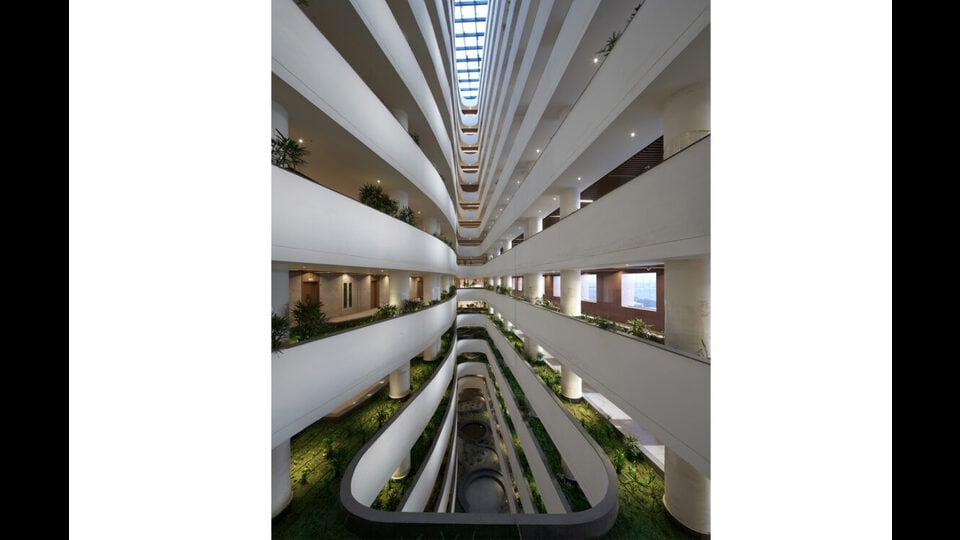
The building has been designed by Delhi-based award-winning architects Sonali and Manit Rastogi and their firm Morphogenesis and was adjudged the winner on Wednesday night. The WAF is a coveted annual global festival that brings together more than 1,800 architects from all over the world and showcases the world’s best-designed buildings in multiple categories.
The Surat Diamond Bourse (SDB), completed in April 2022, was part of the 18 shortlisted buildings announced in July in the category of completed office buildings. Other contenders included the RCS Building in Hainan, China, the postal headquarters of Luxembourg, the Quatuor building in Brussels, Belgium, and the Surbana Jurong campus in Singapore. But in terms of its sheer scale and size, there was no competition with the SDB, which has nine towers of 15 storeys linked by 24 spine corridors with over 4,200 offices.
Surat manufactures 92% of the world’s natural diamonds and SDB was set up by Surat’s diamond industry as a one-stop hub for both manufacturing and trading. Prime Minister Narendra Modi is scheduled to inaugurate the bourse built at the cost of ₹3,500 crore on December 17.
Speaking to HT from Singapore, architect Manit Rastogi said, “We are happy that the building has won the Office Building of the Year award. The entries for WAF come from all over the world, and 18 were shortlisted to make live presentations before the jury. Three finalists are further shortlisted, and the winner is chosen. WAF is equivalent to what the World Economic Forum at Davos is to global economy and industry.”
When asked about what factors led to the SDB project bagging the award, Rastogi said, “When you do small boutique projects, it is far easier to achieve a lot of innovation – sustainability, efficiencies, communities - that the architects strive to do. When the scale is this big, solving the complexities of such large numbers could take precedence over the design elements. I think what caught the jury’s imagination was that the attention to design attributes was prevalent irrespective of the scale.”
The Surat Diamond Bourse core committee had organised a global design competition, and they approached Morphogenesis. “When they came to us, we realised that it was a cooperative of 4,700 diamond traders, and so we don’t have one client, we have 4,700 clients,” says Rastogi. The firm had never designed a single building of 70 lakh sq ft in size spread over 35 acres.
“We asked why not separate towers for these 4,700 offices. They told us that the diamond industry had very small and very large businesses, and the bourse wanted to function as a single organism. It was a very interesting design brief for us – they were all competing, and yet cooperating with each other at the same time.”
Rastogi said the biggest challenge was how to design a single building that will have nearly 65,000 people move in and out. “65,000 people is like a football stadium; it is an airport terminal and a high-security zone. It is not a staggered timing building – all its occupants will come in and out of the building at the same time in an hour. How do you get them to their offices in less than seven minutes in an hour? That’s how that shape of the building has evolved – like a vertebra, the most efficient way of the nervous system of delivering the signal,” said the architect who specialises in sustainable design.
He said since its a diamond business, they wanted lots of natural light coming into each office, but not direct sunlight. “So, we have designed all the offices either to pure north or to pure south to avoid direct sunlight and control the glare coming in,” he said.
The design employs a series of active and passive cooling techniques that reduce the building’s energy consumption by 50%, and compared to the global benchmark of an energy-efficient green building of 90 kilowatts an hour per sq m per year, the building has achieved a performance of 45 kWh/sq.m./yr. It has an Indian Green Building Council (IGBC) Platinum rating. The SDB also features one of the largest installations of radiant cooling, where spaces are cooled by a system that uses chilled circulated water on the floors and ceilings.


