
 E-Paper



Back in classroom, students find it tough to sit put. How schools are helping
As students returned to the classroom, there was a higher incidence of learning deficit attributed to both classes and examinations being held online for the past two years.


MUMBAI: Arushi Pandya (15) was excited to return to school, after the state government in January allowed students across the state to resume physical classes after two years of pandemic-induced lockdowns and online sessions. Pandya couldn’t wait to meet her friends, run in her school’s corridor during break hour, and interact with her teachers. But there was one problem she knew she would face: sitting for hours on end to attend her lectures. Two years of online classes meant that she was used to taking breaks during a class and sit leisurely in the comfort of her home.
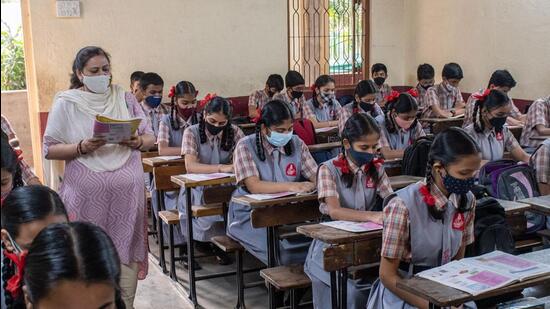
“Most days, I could not sit for lectures for more than three hours in a day. Our school was very supportive and eased us into the process, but the struggle was still very real and most of us felt out of place in our own school and classroom for the first few days,” said Pandya, a class 9 student of a suburban ICSE School.
More than six weeks after school began, Pandya and her classmates still find it difficult to stay put. And this is how her teachers have dealt with it: breaks between every class, no more fixed seating arrangement, allowing children to sit with their peers, and starting the day with a five-minute meditation session.
As students return to the classroom, schools have also reported witnessing a higher incidence of learning deficit which they attribute to the fact that both classes and examinations were held online in the past two years.
To address this, several Mumbai schools across boards have planned activities to make up for the loss of learning. These range from extra classes to help students brush up on the previous academic year’s curriculum to ‘mental math’ sessions to help strengthen mathematical concepts.
“Mathematics as a subject is understood only when the basic concept of each and every theorem or application is clear. While teachers worked very hard in online classes to ensure students’ basic concepts are clear, we are noticing more and more students in higher classes not able to solve basic mathematical problems, despite having covered the topic in the last two years,” said a Mathematics teacher of a south Mumbai school, who did not wish to be named.
“To solve this problem, once schools reopened for physical classes, we invited students to sign up for a mental-math programme after school hours. This programme was well appreciated and many parents and students have asked for another workshop (after exams) in April,” she said.
One of the biggest challenges students faced, post commencement of physical classes late last year, was to get back to writing. After spending nearly two years submitting online projects and appearing for online (multiple-choice question) exams, many students found it difficult to attempt three hour exams (theory papers).
“Something as simple as writing is now a task for students, so our teachers realised it was time to put together a fun project where students are not being forced to write, but encouraged to do so,” said Saba Patel, principal of Anjuman-i-Islam High School, Bandra. Teachers at this school asked students to bring a book and call it ‘meri saheli’ (my friend), and write or share thoughts and ideas with the book. “The idea was to make the process fun, and not burden students with assignments. Many students loved this and started writing every day, and were taking care of their books at the same time,” Patel said.
Schools dedicated to education of special children too are working extra hours to ensure that past two years of online education does not affect the overall growth of a child. “Different children reacted differently to online education and now with schools finally open for physical classes, teachers are finding out where every child stands, and accordingly helping each and every child,” said Manjushree Patil, founder and director of Aatmaon Academy in Thane, an inclusive school for children with different learning disabilities.
Education institutes that completely shut down in March 2020 following the nation-wide lockdown reopened by October 2020. They were shut again in January the following year. In September 2021, school education minister Varsha Gaikwad announced reopening physical classes for classes 5 to 12 in rural areas and classes 8 to 12 in urban areas started from October 4. Classes 1 to 7 in city schools resumed physical classes only from December 15. However, schools were asked to shut in January 2022 as the third wave driven by Omicron began to peak. By March, the state government called for 100% attendance of staff and students across all schools.

Stay updated with all the Breaking News and Latest News from Mumbai. Click here for comprehensive coverage of top Cities including Bengaluru, Delhi, Hyderabad, and more across India along with Stay informed on the latest happenings in World News.


