
 E-Paper



Did not find material against MSC Bank directors, officers: Mumbai Police to court
The Mumbai Police on Friday informed a special anti-corruption court that they did not find any evidence against any of the persons connected with Maharashtra State Cooperative (MSC) Bank concerning a fraud case


The Mumbai Police on Friday informed a special anti-corruption court that they did not find any evidence against any of the persons connected with Maharashtra State Cooperative (MSC) Bank concerning a fraud case.
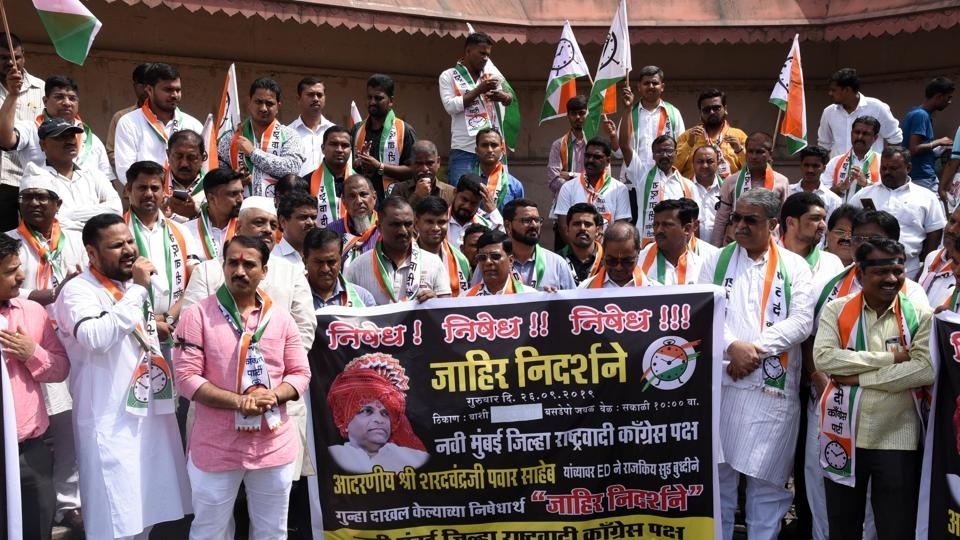
The statement was made in an affidavit filed by Mumbai Police in response to a protest petition filed by the complainant in the MSC Bank fraud case.
The complainant Surinder Mohan Arora had last week filed a protest petition against the closure report filed by the Mumbai Police. He alleged that the closure report revolved around statements of accused persons – the then office bearers of the bank, completely neglecting the reports of inquiry, investigation and audit conducted by reputed independent organisations like the National Bank for Agriculture and Rural Development (NABARD) and the Comptroller and Auditor General (CAG).
Mumbai Police on Friday filed a reply on the protest petition, claiming that while investigating the case, the agency was not concerned with anyone’s political affiliation but was concerned with the illegal acts, if any, committed by them, constituting a criminal offence. “The allegations made by naming persons holding responsible posts and high offices are baseless and merely ipse-dixit,” read the statement by Mumbai Police.
“During the investigation, the agency did not come across any material pinpointing any specific allegation against any specific person, director or officer of MSC Bank or any unlawful gain or undue pecuniary advantage received by an individual of MSC Bank,” read the reply.
The prosecution further said, “Erroneous or imprudent decisions collectively taken in consonance with various policies, which though may result in undesired results, cannot be said to be a dishonest act with malafide intentions for causing wrongful loss to one’s own institution.”
The police further claimed that NABARD’s report is “merely suggestive or recommendatory in nature”. “Those directions do not suggest any registration of offence or even direction to take action against the persons who are at the helm of the business transactions of the bank,” the statement added.
The economic offence wing (EOW) of the Mumbai Police had filed a first information report (FIR) in the case under relevant sections of the Indian Penal Code (IPC), the Prevention of Corruption Act, and Securitisation and Reconstruction of Financial Assets and Enforcement of Security Interest Act.
The case was filed in August 2019 on the direction of the Bombay high court (HC), which was hearing a public interest litigation (PIL) filed by Arora, who had alleged police inaction into the fraud.
The complaint pertained to thousands of crores of rupees obtained in loans by sugar cooperatives, spinning mills and other processing units from the district and cooperative banks.
MSC Bank, the apex bank that controlled credit to the co-operative sector in the state and was handled by the then ruling politicians, landed in trouble in 2011 after an inquiry report by NABARD found that the bank was in the red with a deficit of ₹144 crore. The report indicted the board of directors of the bank for financial mismanagement that led to a ballooning of non-performing assets.
The complainant Arora had then alleged that illegal loans were sanctioned, and secured assets were sold at throw-away prices, contrary to norms.
The NABARD report had said that balance sheets had been fudged to show a profit of ₹2 crore when the bank was facing losses of ₹798 crore. The board had 76 directors, of whom 44 were elected representatives — 25 from the Nationalist Congress Party (NCP), 14 from the Congress, two each, from the Bharatiya Janata Party (BJP) and the Peasants and Workers Party, and one from the Shiv Sena.


