
 E-Paper



Are farmers’ outfits losing influence in the state?
The last noteworthy agitation was the farmers’ protest under the umbrella of Samyukta Kisan Morcha in 2020. This unity is not mirrored in Maharashtra

 Prefer HTon Google


MUMBAI: There was a time – in the late 1970s-’80s – when a farmers’ leader like Sharad Joshi could pull a crowd of over a lakh to support his agitation to seek better price for their produce and prominent political leaders could not afford to ignore his clout. In 1979 Joshi set up Shetkari Sanghatana, to represent farmers and table high output prices. He led several agitations and farmers’ unions in states neighbouring Maharashtra, forcing the governments to accept their demands.
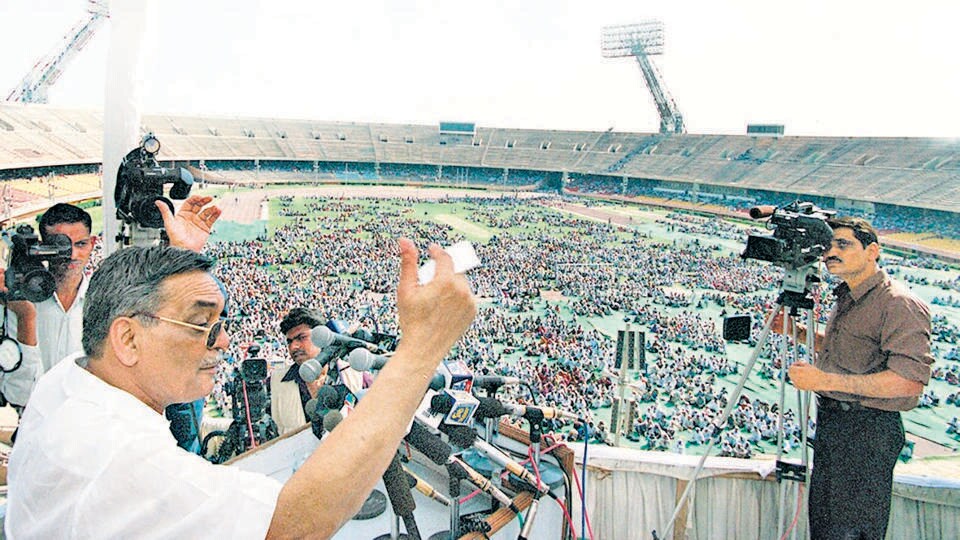
Less than two decades later this high was on the wane, as the body split up into various factions in the ’90s, with heads of the splinter groups trying to keep the pressure on the government. Two prominent groups were led by Raju Shetti and Raghunathdada Patil.
It has been a downhill slide since then. Joshi’s 1980 agitation against crashing onion prices saw more than a million farmers taking the state highways. Today, despite the rising number of farmer suicides and farm distress such agitations are absent.
Rise in rural wages, minimum support prices and a record flow of bank credit have failed to change their lives. According to data released by the state relief and rehabilitation department, 2,942 distressed farmers ended their lives in 2022. In the previous year, the number stood at 2,743, while in 2020, 2,547 debt-ridden farmers died by suicide.
The big question today is – have farmers in Maharashtra lost their leadership?
The last noteworthy agitation the country witnessed was the year-long farmers’ protest led by Rakesh Tikait on the borders of Delhi, under the umbrella of Samyukta Kisan Morcha (SKM) in November 2020. This unity is not mirrored in Maharashtra. Farmers’ outfits and their leaders are losing their influence as political parties are caught up in a battle to garner numbers.
The Swabhimani Shetkari Sanghatana, a union led by Raju Shetti, is on the precipice of a second split, as Ravikant Tupkar, a senior leader who has a sway over Vidarbha, has turned against him. The Shetti-led outfit is considered the strongest farmers’ organisation in the state. Speculations are rife that Tupkar has been in touch with leaders of Bharatiya Janata Party (BJP) and the Ajit Pawar-led faction of the Nationalist Congress Party (NCP).
The outfit has a strong presence in the sugar belt of western Maharashtra. Shetti won the Hatkanangale Lok Sabha constituency in Kolhapur district twice before losing it to Dhairyasheel Mane of Shiv Sena in 2019. He had also supported the BJP in 2014 for the farmers’ cause but chose to exit the National Democratic Alliance (NDA) as it did not implement the double input cost as minimum support price (MSP) for farm produce.
The same year Shetti’s colleague and farmers’ leader Sada Khot was expelled for anti-party activities as he was suspected to be aligning with the BJP, a party he eventually joined. At one time, both Shetti and Khot were Joshi’s close aides.
Shetti has alleged that the ruling BJP is luring away his leaders “to divide us”. “This is the only option available to them; but they cannot scare us with threats of actions from Enforcement Directorate (ED) and Central Bureau of Investigation (CBI) as we have not made money by misusing our position,” said Shetti.
Another breakaway faction of Shetkari Sanghatana – is being led by veteran farmers’ leader Raghunathdada Patil who has now joined Telangana chief minister K Chandrashekhar Rao-led Bharat Rashtra Samithi (BRS).
Former MLA and farmers’ leader Wamanrao Chatap said all parties are engaging in a game of ‘divide and rule’ to edge out pressure groups. “Farmers’ leaders who joined politics became a part of the system. Their misery will not go away until the government changes its policy for rural economy,” Chatap said. He is also a trustee of the Shetkari Trust formed by Joshi.
Shetti questioned why the National Agricultural Cooperative Marketing Federation of India Ltd (NAFED) did not step in “to buy their produce when farmers were throwing their tomatoes on roads because of low prices”. He criticised how the government intervenes through exporting only when prices go up. “This time they imported tomatoes from Nepal – what sort of policy is this,” said Shetti.
Vijay Jawandhia, one of the founder members of the Shetkari Sanghatana who left Joshi in 1994-’95 after the latter supported free market economy for agriculture, said: “Few know that today’s price of cotton in the international market is around 95 cents per pound of cotton lint which is less than what was in 1994 — one dollar and 10 cents per pound of cotton lint. How can a farmer will survive without subsidy.”
Jawandhia, who was once heading the All India Kisan Samanway Samiti (a national-level coordination committee of all the farmers’ organisations), pointed out that at the beginning of the movement in 1980, no farmer was “dying by suicide, unlike today”.
In the past few years, Akhil Bhartiya Kisan Sabha (ABKS), a Communist Party (Marxist)-led body has attempted to stand by the farmers – it held state-wide strike in 2017 seeking a loan waiver for debt-ridden farmers. The following year, it managed to get 30,000 to 40,000 farmers to march from Nashik to Mumbai for implementing the loan waiver and land rights of the tribals. This forced the then Devendra Fadnavis-led BJP government to declare a loan waiver for the debt-ridden farmers.
In March this year, a long march was organised from Dindori (Nashik) to Mumbai, demanding aid from the government for onion producers and buying their produce through the NAFED. The Shiv Sena-BJP government held talks with their leaders and convinced them to return from Thane.
ABKS has influence in tribal belts of Thane, Palghar and Nashik districts and non-tribal districts such as Ahmednagar, Beed, Parbhani, Solapur, Sangli and Nanded.
Ajit Nawale, national joint secretary of ABKS, does not feel that the farmers’ voice has weakened. He said, “We have proved that issues can be resolved by hitting the streets even today.” He added that farmers’ issues are more complex and complicated today than they were in the ’80s and ’90s because of the neo-liberal policy accepted by Joshi and adopted by the government.
With rural folks shifting to urban areas and the young turning away from the ancestral profession, the attitude of the government has also changed. As Shetti said, “With urban population reaching 45%, the government’s focus has shifted towards them. This will impact its perspective on the sector and issues, which will be detrimental for the farmers.”


