
 E-Paper



State seeks Coast Guard’s help to curb illegal fishing by LED lights
The specialised devices attract tiny phytoplankton – microscopic marine algae – which use the light as a food source in the absence of natural sunlight.

 Prefer HTon Google


Mumbai: For the first time, the state fisheries department has sought the Coast Guard’s support to crack down on light fishing – an illegal method in which powerful, submersible light-emitting diodes (LED) are used to attract fish at night.
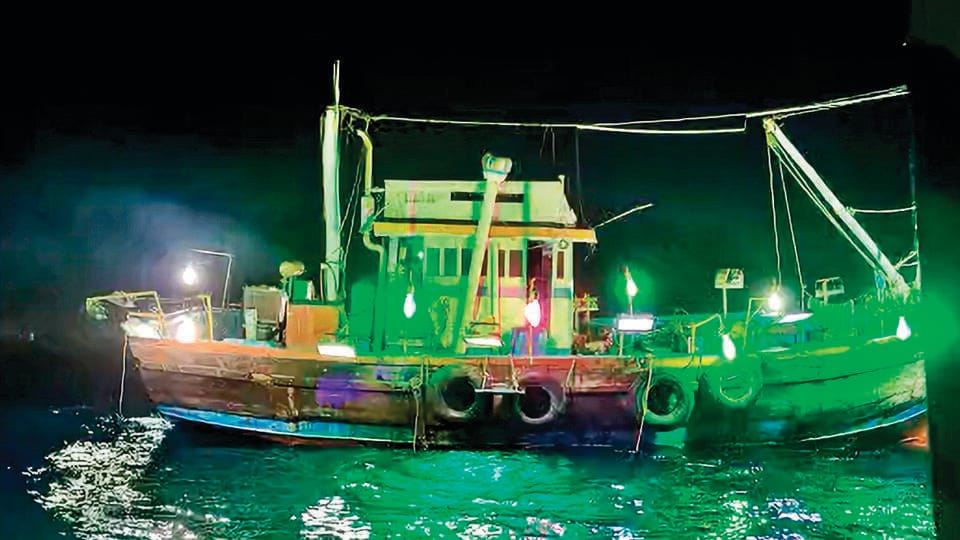
When lowered into the water, the specialised LED devices attract tiny phytoplankton – microscopic marine algae – which use the light as a food source in the absence of natural sunlight. This acts as bait for other, larger varieties of marine life, creating an underwater fish-feeding frenzy that is exploited by vessels, usually with purse seine nets that are capable of enclosing fishes over large and deep areas. These nets can run up to 2,000 metres in length and 250 feet in depth.
Though the Centre banned it in all coastal states in 2017, fishers say the use of LED lights remains rampant in waters just beyond the 12 nautical mile limit, where the jurisdiction of the state marine police ends and the Indian exclusive economic zone (EEZ) begins.
In a letter on March 24, Atul Patne, commissioner of fisheries (Maharashtra), wrote to the Coast Guard’s commander in Maharashtra, saying, “The jurisdiction of the state government is within state territorial waters, which is up to 12 nautical miles. The department of fisheries has limitations to regulating or taking action against illegal LED-light fishing vessels being operated beyond the state territorial waters in the Indian EEZ. A large number of purse seine fishing vessels using high-power LED lights beyond the 12 nautical mile limit may cause heavy losses to marine fish stocks in Maharashtra. This will harm the marine environment and livelihood of traditional fishermen.”
Seeking the Coast Guard’s involvement in clamping down on this unsustainable practice, Patne further wrote, “The government of Maharashtra is requesting you to take action to prevent the use of LED lights for fishing beyond state territorial waters, i.e. 12 to 200 nautical miles.”
“It is an indiscriminate method and is a direct cause of overfishing. Despite regular complaints to the fisheries department, there are hundreds of boats off the Maharashtra coast which every night can be seen doing such fishing, particularly in the south Konkan districts. The Coast Guard and fisheries department need to work together to arrest and penalise violators,” said Bernard D’mello, working president, Akhil Maharashtra Machhimar Kruti Samiti (AKMMS).
When the parliamentary constituencies of Raigad, Ratnagiri and Sindhudurg went to polls in 2019 along with 12 other Lok Sabha seats, the crackdown on LED fishing emerged as a central poll issue among coastal communities that practise artisanal and regulated mechanised fishing. It remains the cause of conflict between artisanal fishers not just in Maharashtra but across the west coast, including in Goa and Karnataka.
A cursory search reveals that LED devices for explicit use in the fishing industry are easily available for purchase online, costing around ₹8,000 for a 100-watt device, going up to ₹60,000 for a 1,000-watt light and around ₹80,000 for a 25,000-watt light. The Food and Agriculture Organisation (FAO) classifies their use as a means of illegal, unreported, and unregulated (IUU) fishing. This would also include other destructive methods, such as the use of explosives to stun fish before netting them.
A senior scientist with the Central Marine Fisheries Research Institute (CMFRI) in Mumbai, emphasised the urgent need to regulate this practice. “It leads to the capture of juvenile fish along with mature individuals, which is a threat to fish stocks,” he said.
The scientist pointed out to a 2017 paper published, which states that, “In Maharashtra, the use of lights designed for fishing was limited earlier, and mostly confined to squid fishing boats (squid jigger) along the coast. Currently, high-power light-emitting diode (LED) lights ranging from 2,000 to 6,000 watts are used by purse-seine net operators with the help of power generators and almost all kinds of pelagic fish such as mackerel, tuna, seer fish, sardine, moon fishes, pelagic sharks etc. which are attracted to the light get netted. This fishing practice was first observed in the Raigad district of Maharashtra.”


