
 E-Paper



Maharashtra tightens curbs amid Delta Plus Covid cases
The state has found 21 cases of Delta plus variants covering six districts. Of them, nine cases are in Ratnagiri, seven in Jalgaon, two in Mumbai and one case each in Thane, Palghar and Sindhudurg.

 Prefer HTon Google


Amid cases of Delta Plus variants, the Maharashtra government has decided to impose stricter lockdown norms, reducing the five-level relaxation plan to three. The first two levels, which had maximum relaxations, have been removed till further order, according to a notification issued by chief secretary Sitaram Kunte on Friday.
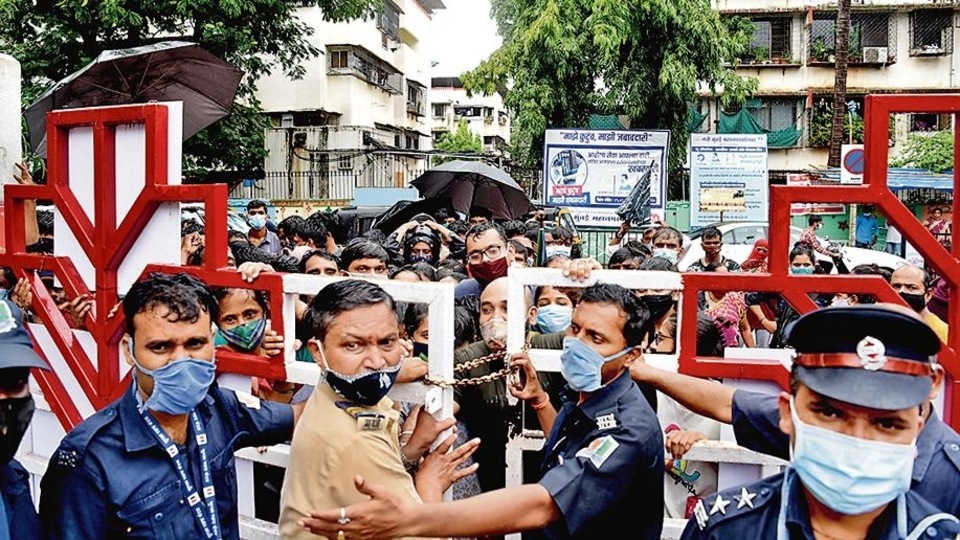
The state has found 21 cases of Delta plus variants covering six districts. Of them, nine cases are in Ratnagiri, seven in Jalgaon, two in Mumbai and one case each in Thane, Palghar and Sindhudurg.
The change means, malls and theatres will be completely shut across the state again. Section 144 has been imposed and not more than five people can gather at a public place, while movements should be minimal post 5pm. Shops selling essentials can stay open till 4pm daily and those related to non-essentials are allowed to operate only on weekdays. Gyms and salons will be operational only till 4pm, with appointments and without air-conditioners. Restaurants can open till 4pm only on weekdays, after which, only takeaways will be allowed. The decision has been taken, considering emerging cases of Delta plus variants in the state. However, there won’t be any changes for Mumbai as the city already comes under level three category of restrictions, officials said.
“Given that the virus causing Covid 19 is undergoing mutations in various geographies, and that these mutations are displaying more transmissibility and potential reductions in monoclonal antibody response, a state-level trigger mandating all administrative units, irrespective of values of the indices of weekly positivity rate and oxygen bed occupancy percentage, to remain at a level not below 3 is to be in operation till withdrawn by specific order of the State Disaster Management Authority (SDMA),” the notification issued by Kunte stated. “New variants like Delta, Delta plus etc. have come to spread and are fuelling the potentiality of imminent (4-6 weeks), more severe third wave with wider geographical area,” the notification said.
The state task force and ministry of health and family welfare (MOHFW) have directed the state not to let its guard down, following which it was decided to cut down the relaxations, said Aseem Gupta, secretary, relief and rehabilitation department.
“It simply means that of the five-level relaxation plan, we have removed the first two levels having maximum relaxations. It also means all the districts and cities will get maximum relaxations that are provided under the level 3 plan,” Gupta said.
“Before the second wave hit the state, cases started rising in Amravati and then it spread across the state. This time we have decided to be more careful considering the Delta plus variant cases have been found in a few districts. We cannot be at peace when there is a threat of a possible third wave looming large,” the relief and rehabilitation secretary said.
In its new order the state government further decided that the districts cannot reduce restrictions based on weekly positivity rate. They will have to observe the trend for two weeks, but for increasing restrictions they won’t have to wait for two weeks and the decision can be taken in a few days. “While coming down to a lower level, the district disaster management authority (DDMA) shall look into two weeks’ trend before accepting a lower level of restrictions. When there is an upward trend in the number of positive cases being identified daily and requiring a higher level of restrictions than the current one, DDMA however shall do so without waiting for two weeks’ trends,” says the notification.
More importantly, weekly positivity rate, a major criterion for deciding on restriction levels, should be determined only on the basis of RT-PCR tests. This is being done as many districts were also conducting rapid antigen tests (RAT), which were less accurate than RT-PCR, and in that case, ground situation was found to be different from what the figures were saying, officials said. “There are districts which have a 12% positivity rate going by RT-PCR tests and less than 5% going by RAT, which is the reason the change has been adopted,” the relief and rehabilitation secretary said.
The state further asked local administrations to push vaccinations in their districts or municipal corporations to 70 per cent of their population, especially of blue collar workers. The state has also emphasised districts to create flying squads to check whether people are following Covid-appropriate behaviour in malls, marriages, restaurants etc. Establishments have also been asked to put up proper ventilation due to the ‘air borne nature of the droplets of the virus’ and hence establishments have to have HEPA filters or proper exhaust fans.
Meanwhile, the Thane Municipal Corporation has announced that it will now be a part of level 3 instead of level 2. On June 18, a notification was released by the TMC stating shops, malls and restaurants will remain open all day including weekends owing to the lower positivity rate. “As per the new restrictions, shops and restaurants that fall under non-essential category will be allowed to open only till 4pm on weekdays. Meanwhile, all essential services can remain open on all days including weekends till 4pm,” said Vipin Sharma, commissioner, TMC. Malls and theaters will also remain shut as per guidelines for level 3.


