
 E-Paper



Maratha quota stir: All-party meeting called today; what's the protest all about?
In a first, the Shiv Sena-BJP administration has called for an all-party meeting to seek opposition's views on the Maratha reservation row.

 Prefer HTon Google


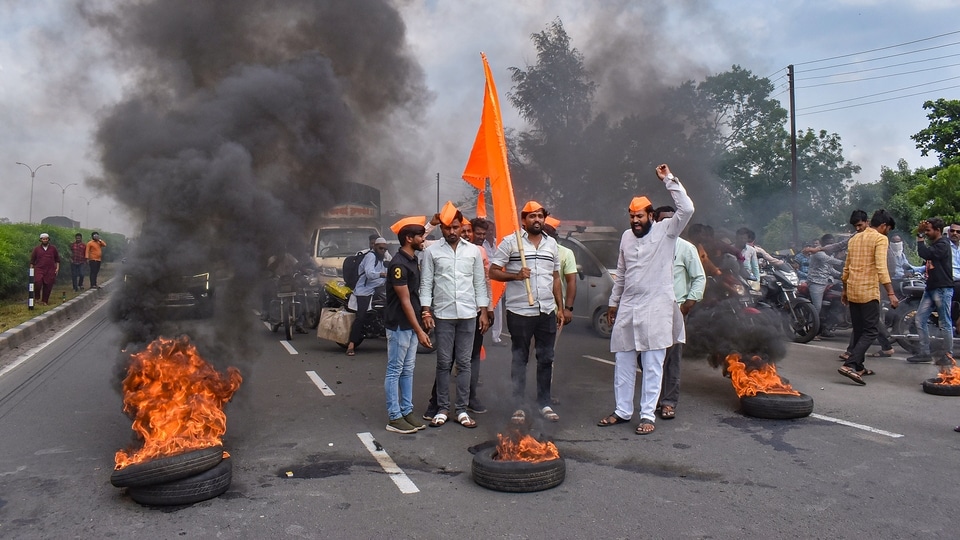
The controversial Maratha reservation issue has once again taken the centre-stage ahead of the 2024 Lok Sabha elections. Manoj Jarange-Patil, who spearheaded the stir demanding state-level reservation for Marathas, recently announced that he had given up water and intravenous support. Meanwhile, other backward classes (OBC) groups and Kunbis – a subset of the Maratha community – have opposed the move. Caught in between the supporters and those who are opposing, the BJP-Shiv Sena-led state government has called for an all-party meeting today, a first such move where the ruling administration sought to understand the views of opposition parties since the protests first surfaced roughly two weeks ago.
Also read: Quota stir escalates as Marathas, OBCs dig in
“We have made all possible efforts to end Jarange-Patil’s hunger strike but he refused to call it off,” said deputy chief minister Ajit Pawar in Pune on Sunday.
Kunbis get reservation in the OBC category while Marathas come under the general category.
What is the stir about Maratha reservation?
- With roughly a third of state's population, Maratha community has an influential presence in Maharashtra politics. The community has been demanding reservation in government jobs and educational institutions.
- The reservation demand has remained an integral part of the state politics since 1981 and witness several mass protests. The first such protest was held by Mathadi Labour Union leader Annasaheb Patil in Mumbai around 32 years ago.
- The current crisis began on September 1, when protesters demanding OBC status for Marathas were lathi-charged by the police in Jalna — the site of Jarange-Patil’s hunger strike.
- The decades old demand failed to reach a lasting solution. However in 2014, the Prithviraj Chauhan-led state government introduced an ordinance to give 16% reservation to Marathas based on the Narayan Rane Commission recommendations.
- In 2018, the state government granted 16% reservation in the face of sweeping protests. It was slashed to 13% in jobs and 12% in education by the Bombay high court. In 2021, the Supreme Court quashed the move.
- Given the intensity of the current protest, chief minister Eknath Shinde announced last week that Marathas from the central Maharashtra region can access reservation under the OBC category if they can produce a certificate from the Nizam era classifying them as Kunbis.
Why is there a disappointment among Marathas?
- The state government's demand to produce certificate proving they are Kunbis disappointed the protestors.
- The Maratha groups said they wanted reservations without any stipulation, and not just for the eight central Maharashtra districts.
- Jarange-Patil and some Maratha outfits say that until the Nizam rule was dismantled in September 1948 in central Maharashtra, the Marathas were considered Kunbis, and were effectively OBCs.
- The lead protestor announced to reporters in Jalna that he had stopped drinking water and accepting IV fluid from Sunday. “The government should take its decision as per its convenience. I am not in any hurry,” he said
Who is opposing the quota demand?
- Meanwhile, the OBC and Kunbi groups feared their quotas will be eaten into by the fresh entrants.
- The OBC groups said they are not willing to ‘give up our share of reservation for anyone else’. If the government wants to give reservation to the Maratha community, it should consider giving it from the open category,” said Baban Taywade, president, OBC Mahasangh.
- Kunbis demand that certificates should not be given to all Marathas and the existing OBC quota will not be touched to provide reservation to the Maratha community.
- Both Kunbis and OBC groups carried out protests seeking a written assurance from the government that they would not have to share their quota with any other community.


