Mumbai’s air quality showed signs of stabilising on Wednesday after a spike in pollution during Diwali, as the 24-hour average air quality index (AQI) settled at 138 in the moderate category and 23 out of the city’s 25 functional AQI monitors recorded readings in the moderate, satisfactory and good categories.
The two stations which recorded poor AQI levels were Navy Nagar and Malad West, at 207 and 206, respectively. Among the rest, 17 stations remained in the moderate category, while four recorded satisfactory air quality and two recorded good air quality.
According to the Central Pollution Control Board (CPCB), an AQI of 0-50 is considered good, 51-100 satisfactory, 101-200 moderate, 201-300 poor, 301-400 very poor and 401-500 severe.
Also read: Mumbai air pollution: What are BMC’s construction ban rules, and when can work be suspended?
Firecracker emissions push Mumbai's air quality into very poor category
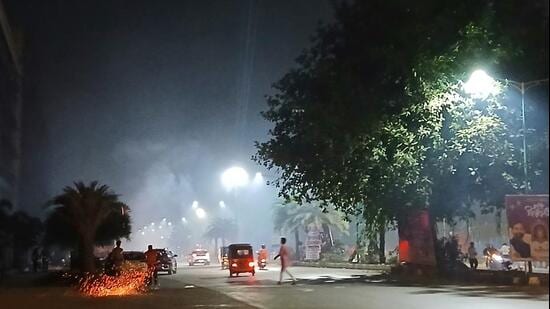
Mumbai’s AQI registered a sharp spike between Sunday evening and Monday, as hundreds of firecrackers were burst and the city was engulfed in smoke and haze. PM2.5 was the primary pollutant, and the AQI slipped to the very poor category at several monitoring stations, touching nearly 400.
{{/usCountry}}Mumbai’s AQI registered a sharp spike between Sunday evening and Monday, as hundreds of firecrackers were burst and the city was engulfed in smoke and haze. PM2.5 was the primary pollutant, and the AQI slipped to the very poor category at several monitoring stations, touching nearly 400.
{{/usCountry}}The deterioration was particularly pronounced in areas like the Bandra Kurla Complex (BKC), Chembur, Kherwadi, Navy Nagar and Shivaji Nagar. At the BKC, the AQI on Monday was 240, which dropped to 182 by Wednesday. In Chembur, the AQI fell from 208 on Monday to 164 on Wednesday, while at Kherwadi, it fell from 266 on Monday to 126 on Wednesday. However, Navy Nagar continued to record poor air quality, its AQI dropping from 230 on Monday to 210 on Tuesday and 206 on Wednesday. Malad West also remained in the poor category, its AQI declining from 231 on Tuesday to 206 on Wednesday.
Also read: Mumbai pollution spikes overnight after Diwali firecrackers, AQI crosses 400 at several spots
Stronger winds likely to keep AQI between 120 and 180, says expert
Dr Gufran Beig, chair professor at the National Institute of Advanced Studies (NIAS), said that stronger winds would keep Mumbai’s AQI in the 120-180 range over the next few days, with neither significant improvement nor deterioration likely.
“The haze is currently trapped close to the surface because surface-level winds are weak. However, wind patterns have become more dynamic, and the coming days remain difficult to forecast due to the El Nino” Dr Beig said.
Mumbai is likely to remain warm and dry over the next few days, with the India Meteorological Department (IMD) forecasting mainly clear skies and temperatures touching 37°C on Thursday and Friday. The maximum temperature is expected to ease to 35°C on Saturday and 34°C on Sunday, while minimum temperatures are likely to hover between 23°C and 25°C. On Wednesday, Colaba recorded a maximum temperature of 36.5°C, 2.5°C above normal, while the minimum stood at 25.5°C, 1.4°C above normal.
Also read: PM2.5 readings of 1K+ excluded from AQI: CPCB clarification after HT reports on ‘dark monitors’
Cracker calls
Since Diwali on Sunday, the Mumbai police control room has received more than 3,500 calls regarding nuisance caused by firecrackers and revellers. Patrolling teams attached to all 96 police stations across the city responded to these complaints even as many callers could not get through as phone lines were constantly busy.
“We kept a watch on social media platforms and responded to complaints posted by users, which kept us busy through the night,” said a police officer.
Stay updated with all the Breaking News and Latest News from Mumbai. Click here for comprehensive coverage of top Cities including Bengaluru, Delhi, Hyderabad, and more across India along with Stay informed on the latest happenings in World News.
Stay updated with all the Breaking News and Latest News from Mumbai. Click here for comprehensive coverage of top Cities including Bengaluru, Delhi, Hyderabad, and more across India along with Stay informed on the latest happenings in World News.