E-Paper



Hard rain: Lessons from 2005
Mumbai has made progress in flood management since the 2005 cloudburst, implementing recommendations from a fact-finding committee. However, challenges remain, including unbridled development and the need to integrate urban planning with extreme weather events. The Brihanmumbai Municipal Corporation (BMC) has received INR 1,000 crore ($134.8 million) of a special grant of INR 1,200 crore ($161.8 million) for flood management. The BMC has also taken steps to curb reckless dumping of construction debris and has implemented early warning systems and flood mapping technologies. The widening and deepening of the Mithi River has also been undertaken to enhance its carrying capacity.

 Prefer HTon Google


Mumbai: Mumbai came to a grinding halt on July 26, 2005, when a cloudburst led to 944 millimetres rainfall in 24 hours, claiming 1094 lives. The phenomenon exposed how woefully ill-prepared the Brihanmumbai Municipal Corporation (BMC) was to face a disaster which it termed “unprecedented” in the history of Mumbai.
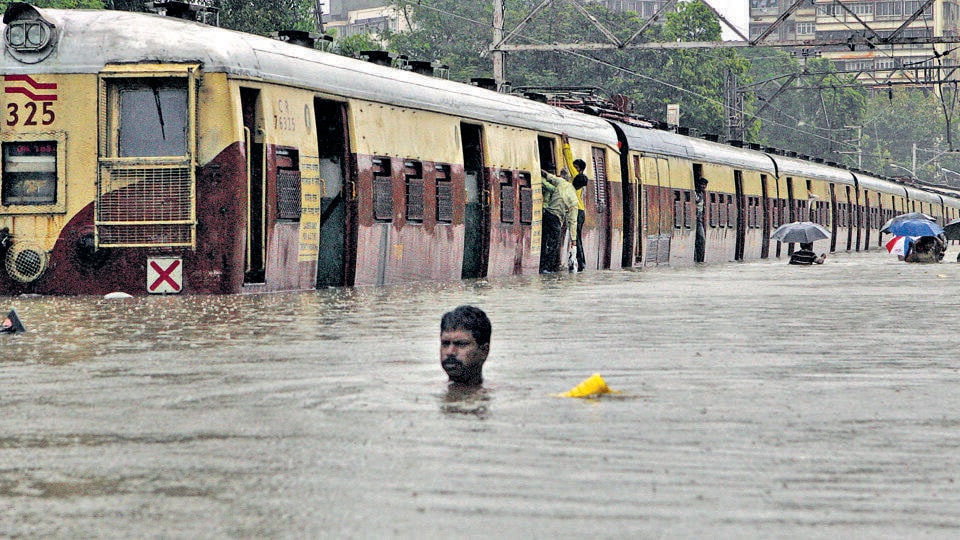
After the deluge, a fact-finding committee of experts under the chairmanship of Dr Madhavrao Chitale, a hydrologist and former secretary of union ministry of water resources, was constituted to examine the causes of extreme weather event and assess the disaster preparedness and management of Mumbai. A comprehensive report was published in 2006 which served as a handbook for the civic body to mitigate flooding.
In nearly two decades since the event, while BMC admits that much needs to be done, many of the committee’s recommendations -- pertaining specifically to Mithi River, under the storm water drain’s (SWD) department -- have been met, including implementing the Brihanmumbai Stormwater Disposal System (BRIMSTOWAD) project, to overhaul the city’s centuries old drainage system. 33 of 58 tasks mentioned in the project have been completed.
The areas of concern remain unbridled development, integrating urban planning with extreme weather events, separation of sewage from storm water drains, conservation of natural ecosystems including mangrove and wetland protection, banning development on river flood plains, creeks and increasing urban green zones.
Two years after the deluge, the Centre had sanctioned a special grant of ₹1,200 crore to start the project. Of the kitty, BMC has received ₹1,000 crore till date.
Meanwhile, BMC’s Climate Action Plan, drawn in 2022 for developing climate resilient infrastructure, has taken baby steps to curb reckless dumping of construction debris. The Chitale Committee Report largely influenced framing national guidelines for urban flood management, in 2009. This led to emergency support functions kicking off in 2011 – it was an attempt by BMC to provide a systematic and efficient system to organise all stakeholders engaged in disaster management. The BMC also recently published its 13th edition on ‘Flood Preparedness Guidelines 2023’ authored by Mahesh Narvekar, BMC’s disaster management chief.
In the report, Narvekar, wrote: “Flooding is a chronic and recurrent problem in Mumbai during the monsoon season from June to September, particularly when spells of intense rainfall coincide with high tide. The process of urbanisation, however, has played a major role in aggravating the problem as it has caused significant alternation to hydrology, morphology, habitat and ecology of the area. Floods are basically meteorological events conditioned by the characteristic of the drainage basins. If rainfall exceeds the retention capacity of the basins, drainage increases both in speed and volume causing floods.”
The report mentions three different kinds of flooding evident in Mumbai – localized due to inadequate drainage, overflows from Mithi River and a combination of high and low tides.
Localised flooding occurs due to informal settlements in the drain path, improper drainage network and reduction in drain capacity due to siltation. Land use practices, solid waste management practices and inadequate drainage maintenance in the city have also accentuated the floods, Narvekar explained in the handbook.
BMC caught unawares
The 2005 deluge was managed by the disaster control room. Narvekar joined BMC as the deputy chief of disaster management in 2008 and in a few years was promoted to helm the cell.
The disaster control room’s equipment and manpower were limited to face the deluge until then. Since 2008, a GIS system, digital mobile radios, and command and control applications were introduced, which enhanced the civic body’s ability to respond to unprecedented disasters. More people were hired to field the volume of daily calls. Also, emerging technologies, like the Doppler radar, were gamechangers.
‘Early warning and early action’ became the rule of thumb.
On alert
BMC has installed 60 automatic rain gauges which transmit rainfall data to the disaster control room every 15 minutes. A preset alarm is triggered if rainfall exceeds 10 mm in 15 minutes, and respective wards are alerted. Any further escalation leads to localities in catchment areas receiving signals. If rainfall measures 80 mm rain for over an hour, a risk waring is issued to the catchments and main river channels. Thereafter, rescue operations are pressed into service – live information of rainfall, traffic updates, waterlogging and diversion of buses are shared on the cell’s website and social media pages.
Mapping water levels
The department will install flow level transmitters so that authorities receive early alerts about vulnerable spots in danger of flooding. The devices, which will work on solar power, will have a sensor, a transmitting system using SIM cards and GPS. It will help them receive real-time updates of water levels. Mithi River and lakes in Oshiwara, Dahisar, Poisar, Vakola, Powai and Vihar will be monitored constantly.
This will help authorities plan early evacuation in low-lying areas.
Widening rivers
After Dr Chitale was brought on board, MMRDA appointed Central Water and Power Research Station (CWPRS) and Indian Institute of Technology IIT-Bombay as consultants to examine measures to mitigate flooding situations. The consultants took steps to enhance the carrying capacity of Mithi by widening and deepening its course. The work was carried out in two phases. The first was between April 8 and June 31, 2006. The 11.8 km stretch of the river between Vihar Lake and CST Road, was desilted and widened. About 3800 structures were demolished at an expenditure of ₹32.88 crore. In the second phase which started in April 2007, the stretch of the river under BMC’s jurisdiction was divided into five sections and work on each entrusted to different contractors.
On August 19, 2005, the state government, under the chairmanship of the chief minister,
formed Mithi River Development and Protection Authority, to improve it. Of the river’s 17.8 kms length, 11.8 kms is in BMC’s jurisdiction, and 6 kms under MMRDA. Retaining wall will be constructed on both the banks – BMC has completed 16.490 km, and work order has been issued for the remaining section.
Going under
Adhering to the Chitale Committee Report, BMC has constructed underground tanks and holding ponds. In the first phase ponds were constructed in Pramod Mahajan Udyan with a capacity of 1.62 crore-litres and St. Xavier’s Ground with a capacity of 1.05 crore-litres, in 2021, to abate flooding at Hindmata Cinema. In the second phase, another holding pond at St. Xavier Ground with the capacity of 1.81 crore-litres was completed in 2022.
Milan Subway’s waterlogging issue got some relief when a holding pond, with storage capacity of 2 crore litres, was constructed in Vile Parle (West), in 2022. This will allow uninterrupted traffic through the subway during monsoon.
(Information collated from BMC’s Flood Preparedness Guidelines, 2023, authored by BMC’s disaster chief, Mahesh Narvekar.)