
 E-Paper



Muslim women’s body demands reform in family law, legal protection
In a press conference on Tuesday, co-founders Zakia Soman and Dr Noorjehan Niaz demanded a comprehensive reform in Muslim family law and said that Muslim women have been denied legal protection in matters of family law in India

 Prefer HTon Google


Mumbai The Bhartiya Muslim Mahila Andolan (BMMA), an organisation working for equal citizenship rights for Muslim women in India, on Tuesday released a report ‘Status of women in polygamous marriages and need for legal protection’.
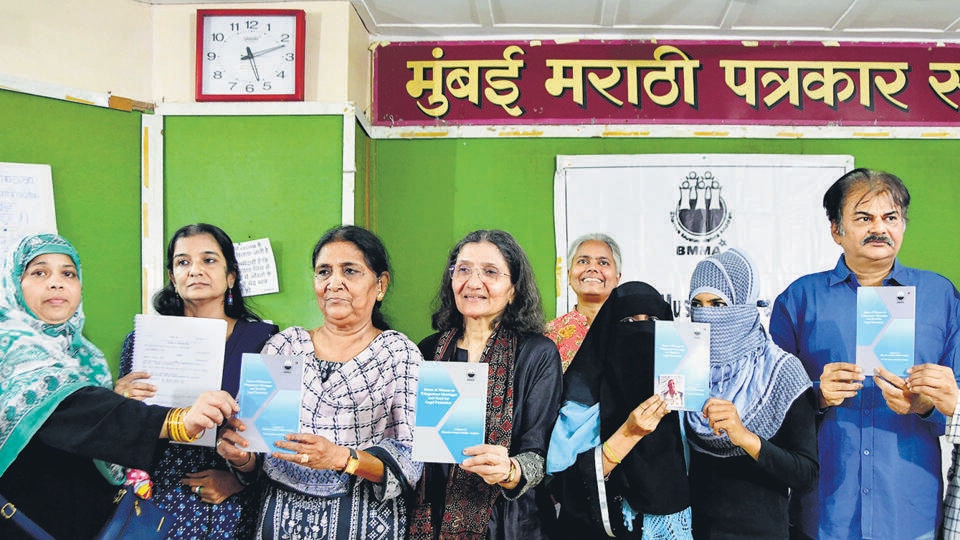
The study, conducted across 11 states in India, surveyed the status of wives whose husbands are in polygamous marriages. The survey also focused on mental health of the women.
In a press conference on Tuesday, co-founders Zakia Soman and Dr Noorjehan Niaz demanded a comprehensive reform in Muslim family law and said that Muslim women have been denied legal protection in matters of family law in India.
The report that was made with questionnaires administered to 289 women and 50 case studies, highlighted that an overwhelming number of women said that they felt a sense of betrayal, loss of dignity and loss of self-respect when the husband married other women despite her being the wife.
Zakia Soman, co-founder of BMMA said, “It was difficult to get the women to talk since they were already going through lot of financial troubles or mental trauma and they did not want to relive their experiences. We spoke to 289 women who are in a marriage as either first wife or second wife to understand their emotional, social and financial condition. They shared with us details about their emotional state, economic status, their life condition and other aspects of being one of the two or more wives.”
The survey highlights severe mental health issues that plague women. Of the 289, 50% of the women said that they were depressed most of the time. 84% felt that polygamy should be outlawed and 73% even said that the husband who takes a second wife should be punished.
The survey also highlights that 45% of the husbands threatened their first wife with divorce if she resented his second marriage.
Two women who were victims of domestic violence, one who was the third wife and other who was the sixth wife of a man from Mumbai, shared their ordeals and challenges faced by them after they were abandoned by their husbands.
The organisation said that India has ratified the Convention on the Elimination of All Forms of Discrimination against Women (CEDAW) treaty of the United Nations and Article 16 of the CEDAW says that the state must take all appropriate measures to eliminate discrimination against women in all matters relating to marriage and family relations.
Another piece of data in the survey is that in 49% cases where the woman happens to be in a polygamous union, the parents have selected the spouse. In 45% cases the age of the husband at the time of the 1st marriage is between 21 and 26 years and in 38% of the cases the age of the husband at the time of the second marriage is between 21 and 26 years. With only 9% of the husbands having studied between graduation and post-graduation, it can be concluded that the educational level of husbands in such unions is also quite low.
On December 12, Supreme Court of India issued notices to the centre and Law Commission of India on a public interest litigation filed by BMMA requesting abolition on practices of polygamy and other practices like Mut’a marriages, Misyar marriages and Nikah-halala as they violate fundamental rights of the Muslim women in India under articles 14, 15, 21 and 25 of the Constitution.


