
 E-Paper



From building exteriors to a gallery’s interior, street art finds a new home
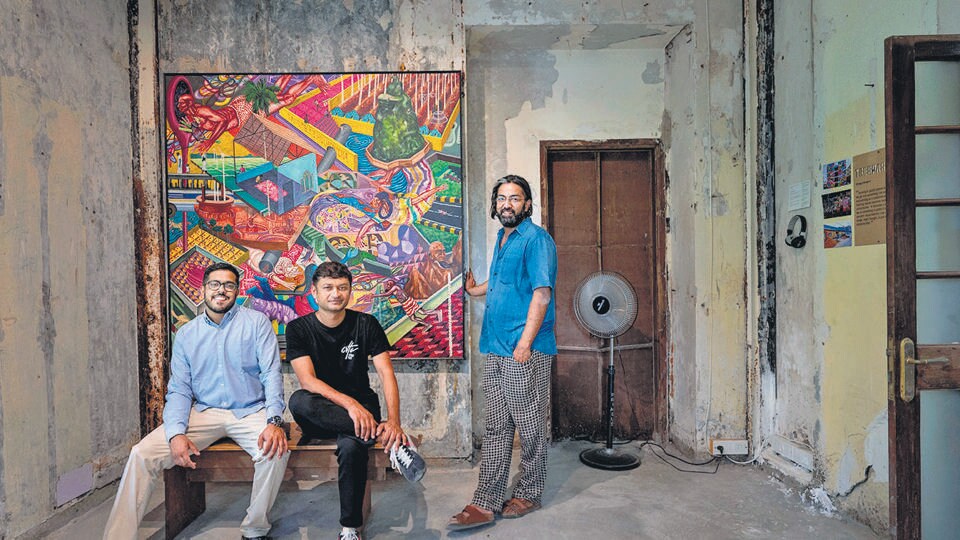
In a spacious room, surrounded by the bespoke works of artists Jasjyot Singh Hans, Anpu Varkey, and Aravani Art Collective (who also painted the rangoli portraits in Worli, on the parapet next to Atria Mall), Kumar, Kureshi and gallery director Joe Cyril sit for a chat.

 Prefer HTon Google


MUMBAI: In 2014, artist Amitabh Kumar had the privilege of having one of his works turn into a landmark. On a discoloured concrete wall in Shahpur Jat in Delhi, he had painted a blue cloud, which resembled a hairball more than cotton. “The locals say, ‘Woh gandi drawing se left lena,’” he laughs. “Now it’s known as the gandi drawing-wali gully. Which is okay, it’s beautiful.”
Painting in city streets can make you streetwise, because your audience isn’t the art collector or the art critic. It is the people looking up, after a hard day at work. “They give you an honest opinion,” says Kumar. “They will say, ‘It isn’t interesting.’ Or, ‘Kya bana raha hai?’ Initially, when you start out in street art, you certainly don’t want to become like (artist) Subodh Gupta, you want to become Shah Rukh Khan. You want to engage with the popular in that way, which is a game-changer. We come into this exhibition with the same ambition.”
Starting this week, Kumar has curated a new show for a new gallery at a new space. ‘Outsiders’ is anchored at the Kalanjee Project, an 8,000-sq-ft mansion in Cuffe Parade, with 70 works by 24 artists. Till May 21, it is the makeshift residence of XXL, a gallery founded by the St+art India Foundation to promote urban contemporary and post-graffiti artists. St+art India was also the force behind the recently concluded urban art festival at Sassoon Docks. One of its co-founders, artist Hanif Kureshi says, “The festival was purely for the public. There was nothing to sell, so the only outcome was that you could probably really like the artist. The nature of street art is to automatically address the public at large. That is the idea behind XXL as well.” Kumar says, “The show is about street art and graffiti art practices coming inside.”
In a spacious room, surrounded by the bespoke works of artists Jasjyot Singh Hans, Anpu Varkey, and Aravani Art Collective (who also painted the rangoli portraits in Worli, on the parapet next to Atria Mall), Kumar, Kureshi and gallery director Joe Cyril sit for a chat.
Kureshi says, “India’s contribution to the world art market is 1%. We have such a large population, diversity and cultural roots, but when it comes to art, our contribution is nothing. And, that’s unsettling for us. We want to provide a way in which we can broaden the current art market.” Kumar adds, “I am interested in creating spaces where artists can survive, forget becoming rich. This show represents the moment when we admit that things are changing.”
From vandals to artists
The exhibition creates common ground between the walls of Dharavi and Cuffe Parade. “The real artwork is the building,” says Kumar. “That a site like this still exists within the madly-growing Mumbai is amazing.”
The Kalanjee Project is a testament to the vision of erstwhile Bombay’s mercantile community, the stubborn men who tamed the sea and built houses that would outlast sea change. Haji Yusuf Ismail Sobani, the proprietor of Bombay Steam Navigation Company, was the original occupant in 1906. The property changed hands twice: first with the Sassoon family, and later with the Kalanjees in 1972.
Partitioned into two floors and nine rooms, the heritage stone mansion with stunning woodwork is inlaid with Islamic arches, eight-pointed stars, jali balconies, and portholes. “For our first show,” says Cyril, “we wanted a large place that was unseen by anybody.” Kureshi says, “Our aim is to give new experiences to people. Many people had never visited the Sassoon Docks, but the festival became an opportunity for them to come and explore. When you work with public spaces over a long period of time, the spaces come to you.”
The former residence was not given a total makeover. Exposed bricks, rotting beams and doorframes, peeling paint, and a moss wallpaper carry the remnants of an abandoned manor. Kumar says, “There’s no point in anaesthetising the space completely, when it has so much character. As a wider collective, one of our superpowers is site-specific response or intelligence to read the site. Those became the first active clues to decide on our picks.”
The line-up includes street artists with serious street cred, such as Daku, Sajid Wajid Shaikh, Afzan Pirzade, Do & Khatra, Osheen Siva, Trespassers, and the Vayeda Brothers. The show begins with a timeline on the origins of street art: from New York subway trains to the Berlin Wall, from Basquiat to Banksy. In India, “detailed truck art, exaggerated political slogans, regional cinema ads on billboards”, and Warli and Gond frescoes have all contributed to its evolution. Cyril says, “One of our goals is to concentrate on the bits missed out by the market or the gallery system. We have spent time researching street art, and creating a timeline and an archival section to educate the people. We want to take away some of the intimidation of visiting a gallery.”
Kumar adds, “My main motivation for the show is for the unannounced public to meet the artists. There’s a huge gap between our sociocultural life and art. It’s in the interest of the stakeholders in the contemporary art world to continuously mystify it. We’re trying to do the opposite.”
As we exit the show, there’s a group of uniformed kids from a local BMC school taking selfies against artist Filthy Luker’s inflatable octopus, whose long, green tendrils are floating outside. If they actually take their first step inside the palatial bungalow, the show is already a win, for all those on the outside, looking in.


