
 E-Paper



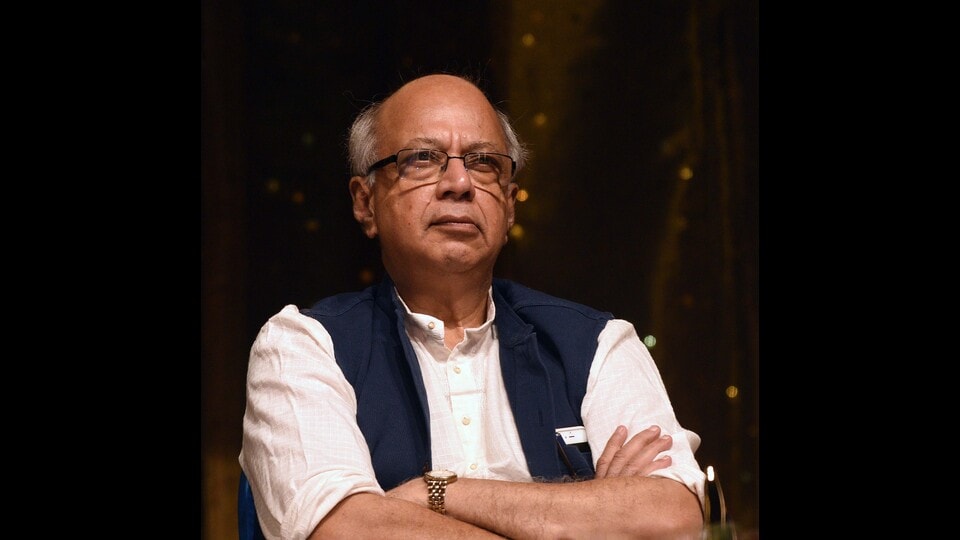
Satish Alekar: The playwright who takes a peek at our world from the wings
Satish Alekar was able to make a lifetime of work out of the tiniest patch of the earth just because of his encyclopedic knowledge about Pune

 Prefer HTon Google


Satish Alekar was able to make a lifetime of work out of the tiniest patch of the earth just because of his encyclopedic knowledge about Pune. Because the roots were so deep that he could take a tiny suburb, and write a whole shelf-load of great plays. ‘Begum Barve’ and ‘Mahanirvan’ are the funniest and most tragic plays ever penned.
When the playwright Satish Alekar and his motley gang of Chandrakant Kale, Mohan Agashe and Ramesh Medhekar re-joined forces for a re-run of ‘Begum Barve’, no one knew quite what to expect. They weren’t even sure themselves. The bored babus, Jawdekar and Bawdekar, and of course Begum Barve (the wannabe from the Sangeet Nataka era), had enjoyed huge success. The play was theatre history. In end-2008, the play received tremendous adulation. It was a triumphant return. The Gang of Four were back!
‘Begum Barve’ proved, yet again, that it’s perhaps one of the best play-texts to emerge in this land. A close contender would be ‘Mahanirvan’ (first staged in 1974) again by Alekar. Two of my favourite plays.
I say this, because ‘Begum Barve’ and ‘Mahavirvan’ are the two reasons I believed in theatre and even today when I am wracked with scepticism and existential malaise, the two plays remain a ray of hope, even as the rest of the edifice is withering away, hopelessly.
‘Begum Barve’ like ‘Mahanirvan’ is a play which is tinged by multiple uncertainties and a peculiar mixture of hope and melancholy and music. One of the strengths of ‘Begum Barve’’s remarkable tale is that it acknowledges the myths (and Alekar’s own mischievous myth-making) while trying doggedly to get to the facts of the Sangeet Nataka tradition which Alekar and Marathi theatre is so steeped in. Right from the start there is no nonsense about an era whose time has come and gone, even as the playwright cuts through the fabrication of a nostalgic realist fable of an unidentifiable beginning shrouded in mystery.
In a superb passage, Begum Barve (Chandrakant Kale) yearns to be the next Balgandharva. Begum Barve cherishes the shawl that the star once gave him, it is the only real remnant in a transitory world of fake opulence, fake applause, fake razzmatazz.
Alekar stays true to the flavour of Sangeet Nataka. But what could be yet another humdrum play about the goode olde days, is saved by Alekar’s unusual documenting of an alternative version. This attention to the small details of Begum Barve’s life makes the play a trifle daunting, but the rewards are great. Structured in many ways around places as well as periods, the audience and reader are treated not only to insightful reflection on the Sangeet Nataka, but also an insight into Pune subterranean life – including an exemplary account of feudalism, and the rot in our society. Herein lies the energy and ambiguity that make Alekar’s writing so compelling. The audience is being exhorted to an act of imagination, to abandon passivity and dare to invent a new kind of reality.
Alekar says: “I have always been asked about the element of the wonderful or the fantastic. We don’t ask such questions about Hindi films because it is taken for granted. Realistic plays don’t get asked about their realism. In fact, popular Hindi movies are reviewed for their fantastic content. Fantasy has been so well incorporated in this medium that the average audience readily expects it.”
The playwright explains, “‘Begum Barve’ was the outcome of three different trajectories of memory.”
The first recollection was of a beggar couple – one of them extremely obedient and loyal to the other who suffered from a handicap. They stayed under the staircase of a chawl which Alekar’s friend owned, where he used to go to study for his MSc.
The other memory was of an extremely feminine, male incense stick vendor. It seems he was an actor who had played secondary female parts in old plays. Anyway, his mannerisms, his story and his whole persona was firmly embedded in Alekar’s mind.
The third recollection is of the time when my friends, both newly married, had taken up their jobs in the same medical college where Alekar worked. It so happened that another appointment was made for the same post and since there were only two vacancies, the service of one of Alekar’s friends would be terminated. This was obviously a mistake and the problem was resolved in 48 hours, but the extreme tension the two friends were subject to, to which Alekar was a witness. It had a profound impact on him.
Satish Alekar visualised these three incidents. It led him towards ‘Begum Barve’. The play grew in bits and pieces, and as things conjured up in his mind, he wove them into the play.
The play ends in bitter-sweet equivocation. Shanta Gokhale’s tries to triumph over the difficulties of translating the play into an alien language with its alien culture, English. Alekar’s text has, as a rule, stood in defiance to translations. Chandrakant Shah’s Gujarati version ‘Master Fulmani’, lived to tell a tale but it did its things rather disappointingly by dumbifying the gloom and even the pathetic image of Begum Barve yearning for an adolescent virginal performance. The cathartic expletives became celebratory, the funereal became fun.
The stark, almost anti-theatre original production must be watched, and the play read, simply because of the dignity of the thing. And this is the residue at the core of Alekar’s ‘Begum Barve’ and ‘Mahanirvan’, a sense of the unswerving endurance and resilience of the ordinary Punekar as their social hopes repeatedly fall foul of grim reality.
And to imagine, ‘Mahanirvan’ would not have been staged in its present form. The play was originally written for the Diwali issue of Mouj Publication at the insistence of its editor Ram Patwardhan. However due to its peculiar length it came back to Alekar “unpublished”. Theatre Academy had presented Alekar’s ‘Mickey’ and ‘Memsaab’ in 1973. After eight shows of ‘Mickey’ and ‘Memsaab’, Theatre Academy “insisted that Alekar write and produce a play for the state-level drama competition”. And that’s how, Alekar reworked ‘Mahanirvan’ into two acts. Alekar says, “If Ram Patwardhan had accepted ‘Mahanirvan’ for publication in Mouj, the play-production would not have been conceived.”
I am delighted (nay overjoyed!) that Team Thespo is presenting the Lifetime Achievement Award to Satish Alekar. He is a playwright who it is impossible to overlook. He is the first truly contemporary playwright of our times. For starters, no Marxist baggage, no mythification of the ancient past. His plays burst with stories, images and chaos. It is personal history intermingled with modern folk. Then there is the structure in terms of form and story-telling. All the spice of great theatre.
The tragedy of theatre (at least in western Maharashtra) is, there have been too few ‘Begum Barve’s or ‘Mahanirvan’s in the past three decades. When the curtain falls in ‘Begum Barve’, Javdekar is suggesting that everything has to be investigated; and that too from the beginning. Perhaps that’s what we need to do.
A million and one salaams, Satish Alekar sir. Hopefully they award you with the Jnanpith and Nobel next. I certainly would.
(Ramu Ramanathan is a playwright and poet.)


