E-Paper



Two chronic waterlogging spots become flood-free this year
The BMC also came up with a new plan, which included an RCC open drain with grating on both sides of Dr Babasaheb Ambedkar Road, and connected the drainage line at the King’s Circle railway station to the Gandhi Market pumping station. This additional work upped the project cost by ₹7.25 crore. The overall cost of the project was ₹21.78 crore

 Prefer HTon Google


MUMBAI: Gandhi Market in Matunga and Hindmata in Dadar East—the two chronic flooding spots that were metaphors for monsoon woes—have been knocked off the BMC’s list of worst flood-prone spots this year. The credit goes to the civic body’s extensive and dedicated flood mitigation measures in these two locations.
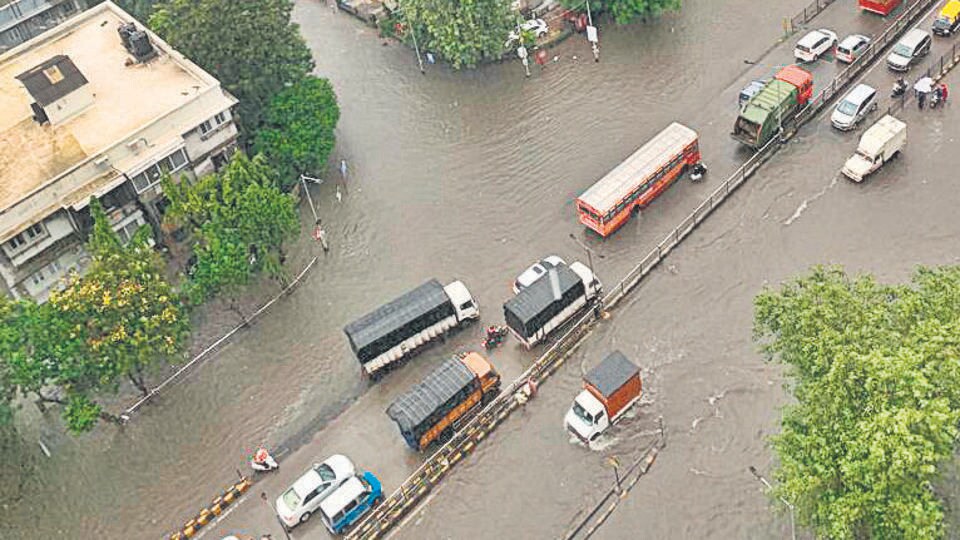
At a meeting in Delhi last week, an IAS officer from the Punjab municipal corporation expressed surprise to civic chief Iqbal Singh Chahal that Mumbai did not make headlines this month during the monsoon. “I told him about the holding tanks that we had constructed in Gandhi Market and Hindmata, how they suck out water from these areas and transfer them to an underground tank,” said Chahal. “This year, both places faced zero flooding. The shopkeepers there will tell you how things have changed after 50 years.”
What helped Gandhi Market stay afloat was a mini pumping station with a capacity to pump out 2.33 lakh litres of flood water per minute. The pumping station includes a pit and a stormwater drain line that carries the water from Gandhi Market and the main arterial road up to Bharat Nagar railway nullah near King’s Circle, which further carries it into the sea.
The BMC also came up with a new plan, which included an RCC open drain with grating on both sides of Dr Babasaheb Ambedkar Road, and connected the drainage line at the King’s Circle railway station to the Gandhi Market pumping station. This additional work upped the project cost by ₹7.25 crore. The overall cost of the project was ₹21.78 crore.
Hardeep Singh, committee member of the Mahatma Gandhi Market Association and an old-time shop owner, said that up until last year, shopkeepers would store their garments in the attic whenever it rained at night. “If we didn’t, we’d incur losses of lakhs of rupees,” he said. “We’d also invariably have to shut shop for a few days when there was heavy rain. This year, we didn’t have to shut at all since the water didn’t even reach our shop gates.”
Harish Ahujaa, owner of Ahujaa Store, reminisced about a time when as children, they would get 10 holidays every monsoon on account of flooding in the area. “Last year, it minimised a great deal and this year it is negligible,” he said. “Earlier, we had to down our shutters with just 50 mm of rainfall. This year, despite heavy rainfall, we didn’t have to. We are thankful to the BMC.”
The traders of Hindmata in Dadar East, which also became flood-free this monsoon, used to have exactly the same monsoon routine as the shopkeepers of Gandhi Market. “The BMC would alert us before heavy rains, and we would store our wares in the attic,” said Sanjay Shelar, a worker from Divya Fashions in Hindmata. “This monsoon we were spared this trouble.” Added Kushal Gala of Hindmata Cloth Store, who has been selling sarees for 67 years, “Our sarees would get spoiled and we would incur losses in lakhs. But this year we faced no problem.”
The BMC managed to keep Hindmata flood-free this year at a cost of ₹110 crore, with additional work of ₹15 crore still in the pipeline. A mega rainwater-holding pond with a 1.05-crore-litre capacity was constructed in the first phase. The second part of the project included the construction of a holding pond at Pramod Mahajan Kala Park in Dadar West, with a 1.9-crore-litre capacity. The second pond helps to reduce water-logging in the area.
“The BMC has installed mega-capacity dewatering pumps at a cost of ₹25 crore at Gandhi Market,” said Nikhil Desai, member of the F North Citizens’ Forum. “Until last year, rain water would collect up to three feet, and all traffic would come to a standstill. Now with even 100 mm rainfall, it doesn’t get waterlogged—although on the opposite side of the road, near Matunga police station, the problem still persists.” Desai added that the Madhav Chitale Committee had recommended the pump solution 15 years ago.
Desai said that the pump capacity in Hindmata was greater. “Because the topography is saucer-shaped, waterlogging does take place but there is no rain-induced havoc anymore,” he said. “After the rain stops, water recedes quickly and instead of three feet of flooding, it is now one foot.”
Chahal said that the BMC had spent almost ₹150 crore on flood-mitigating measures, and had installed 600 dewatering pumps in the city. “The moment water starts coming up beyond eight inches, the pumps start,” he said. As Desai remarked, the inconvenience has reduced remarkably.