
 E-Paper



Under construction sea wall at Aksa Beach flouts NGT directions, say activists
Mumbai: Ongoing construction of an anti-erosion sea wall at Aksa Beach by the Maharashtra Maritime Board (MMB) flouts National Green Tribunal (NGT) directions issued earlier this year barring such activities across all coastal states in India, activists have alleged


Mumbai: Ongoing construction of an anti-erosion sea wall at Aksa Beach by the Maharashtra Maritime Board (MMB) flouts National Green Tribunal (NGT) directions issued earlier this year barring such activities across all coastal states in India, activists have alleged. Experts warn that the structure, if completed, will diminish Aksa Beach’s natural resilience.
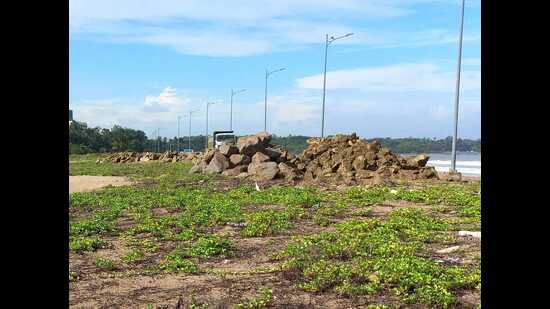
The shore is thickly carpeted with a sprawling vine known as ‘goat’s foots glory’, or Ipomea biloba, among other shrubs and ground vegetation which act as a natural barrier against erosion.
On April 11 this year, the NGT observed, “There is a need to replace hard structures like seawalls, groynes etc. with softer options such as beach nourishment, sand bypassing, dune planting, offshore submerged reefs, etc. Thus, the general principle of “working with nature” would be a better approach for cost-effective and sustainable coastal protection measures.”
The NGT also directed all coastal states to upgrade their respective Shoreline Management Plans by identifying eroding stretches within six months. “Pending preparation/updation of such SMPs by the Coastal States/UTs, no further hard structures for erosion control be raised or constructed,” the NGT’s principal bench observed.
The MMB, however, has continued reclaiming a portion of the sand dunes between Aksa Beach and INS Hamla, which according to environmentalists is one of the few remaining locations in Mumbai to host a thriving sand dune ecosystem.
Hard structures, they say, are stop-gaps, not solutions and they fundamentally alter the ecology of beaches and sandy shores, which goes against the principle of sustainable development.
“That stretch of the beach doesn’t need any wall at all. The ipomea biloba, and the ecosystem it supports, has more or less disappeared from the entire Mumbai coast,” said ecologist and writer Sunjoy Monga.
“Despite supposedly stringent regulations, it is really unfortunate how lightly various agencies are taking the issue of coastal protection. Every manner of violation continues unabated on what remains of the city’s natural shoreline, under the excuses of preventing erosion,” he added.
Shweta Wagh, an architect and urban researcher, also expressed dismay at the development. “This sand dune vegetation grows abundantly at Aksa beach. Unfortunately, it will soon be covered in concrete. Is this beach really in need of shore protection? The presence of sand dunes with dune vegetation is a clear indication that sand is being deposited along this stretch. It, therefore, does not face any threat due to erosion,” she said.
“The Mumbai Climate Action Plan refers to “nature-based solutions” when it comes to creating infrastructure for climate action. Why then are such natural ecosystems, which provide ecological services and are de-facto “nature-based solutions”, being undermined and systematically destroyed?,” Wagh questioned.
A year after it was initially deferred by the Maharashtra Coastal Zone Management Authority (MCZMA) last year, a proposal by the Maharashtra Maritime Board (MMB) for “seafront development and beautification at Aksa beach” was given a limited nod in June 2021, with permissions granted only for construction of an anti-sea erosion wall and parks and recreational grounds, as per the provisions of Coastal Regulation Zone (CRZ), 2011.
While according permission for the works in its 155th meeting earlier this year, MCZMA had clearly stated that other activities proposed by MMB, including parking spaces, gyms, volleyball courts and a food plaza, were prohibited in view of CRZ regulations.
MCZMA also instructed MMB to ensure that no construction takes place on the beach itself. Since MCMZA’s approval, however, similar seafront developments (by the public works department) at Versova Beach and Girgaum Chowpatty (by the city municipal corporation) violate CRZ regulations, with large portions of the sandy beaches being reclaimed or used as dumping grounds. Environmentalists have raised the issue at multiple levels, including with local legislators and parliamentarians.
“A trend seems to be emerging wherein authorities apply for CRZ clearance to carry out some permissible activities, and then during the execution, they end up violating the protected area. Take Versova, for example, where pretty much half of the sandy beach has been completely reclaimed under the guise of building an anti-sea erosion wall, and a promenade-like space has come up within the protected area. Similarly, at Girgaum Chowpatty, too, reclamation work happened in the CRZ-1 area. Aksa Beach has also been on the radar for development, and it is important for citizens to remain vigilant so that we do not lose another sandy beach in Mumbai,” said environmentalist Zoru Bhatena, who has mounted official responses to happenings at both Girgaum and Versova.
Despite requests, Praveen Khara, the regional port officer at the MMB in Mumbai, did not respond to requests for comment. An official with the MMB, who is privy to the project, said that landscaping and development of a food plaza for visitors are still on the cards, but that it will be done outside of the CRZ-1 area. “Construction of a sea wall is necessary to protect the tourism facility, otherwise, the entire thing can be washed away during a monsoon high tide. Our purpose is to boost tourism,” said the official, requesting not to be identified.
Stay updated with all the Breaking News and Latest News from Mumbai. Click here for comprehensive coverage of top Cities including Bengaluru, Delhi, Hyderabad, and more across India along with Stay informed on the latest happenings in World News.


