
 E-Paper



50 people, 20k calls a day: Inside the remdesivir war room in B’luru
Bengaluru: A 50-member team handles around 15,000 to 20,000 calls per day at the war room set up in Bengaluru to streamline the distribution of remdesivir in the state, amid the high demand for the antiviral injections


Bengaluru:
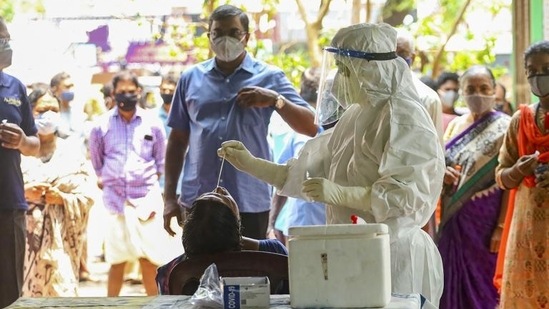
A 50-member team handles around 15,000 to 20,000 calls per day at the war room set up in Bengaluru to streamline the distribution of remdesivir in the state, amid the high demand for the antiviral injections. The war room was set up on April 21 after complaints regarding shortage and black marketing of oxygen and remdesivir began pouring in from across the state. Even though relatives of Covid-19 patients and hospitals continue to highlight shortage of injections, officials at the war room say differently.
A senior doctor supervising the war room, on condition of anonymity, said the large volume of calls is coming from the private sector. “There are three ways of getting remdesivir. First, it is given to patients admitted in private hospitals; second, patients admitted in private hospitals taken over by the government; and third through the prescription of private hospital or a doctor,” explained the official.
He said the total demand for remdesivir in government hospitals and private hospital beds taken over by the government is around 5,000-6,000 vials a day. “These beds cover at least 85% of the state’s demand, as per our calculations, since most Covid-19 cases come through the government agencies that control 80% of hospital beds. While the demand from the government-run agencies is around 5,000 to 6,000, in the private sector, which is around 15% of the demand, we get up to 20,000 calls per day,” he added.
While acknowledging that there is a shortage of the medicine, the doctor in-charge pointed to setting in of fear psychosis. “We need to understand that remdesivir is not a lifesaving drug. It should be administered to those who are in the moderate category. Remdesivir is an antiviral drug and works by interrupting the production of the virus and helps by preventing the virus from multiplying. But because of the increase in the number of cases or perhaps for ‘not taking a chance’, clinics and private hospitals have been prescribing the injection for most patients,” he added.
On the lower demand in government hospitals, he said the doctors at the hospitals are prescribing remdesivir only to those who will benefit from the injection. He added that since the injection has been prescribed for cases that do not require it, the demand was high.
The war room in-charge also said that a website was in the works to have a transparent distribution of remdesivir. He said that the website will contain details of patients who have been given the injections and details of the medical conditions.
Private hospitals, however, allege that despite setting up of the war room, the supply of the injection is not adequate. An administrator of a private hospital in Bengaluru said they were only getting 30-50 doses, even though their requirement is for 100 doses. “More importantly, many calls to the helpline go unanswered,” he added.
Dr HM Prasanna, president, PHANA, said that while all Covid-19 patients referred to by BBMP to private hospitals were getting the antiviral drug, supply to private hospitals remained inadequate. “We are not using the injection on all patients. We are clearly demarking them for those with moderate symptoms so that viral load reduces in these patients. But war room doesn’t find important to provide private hospitals with enough doses,” he said.
Karnataka health minister Dr K Sudhakar, on Monday, said the state has ordered 70,000 vials of remdesivir injection, of which 20,000 had arrived while the remaining would be supplied in the coming days.


