
 E-Paper



After return from Delhi, tight-lipped Baghel meets community leaders in state
Baghel has been silent after his return from Delhi and avoiding media but continuously meeting the various community representatives in Raipur.

 Prefer HTon Google


Three days after Chhattisgarh chief minister Bhupesh Baghel and health minister TS Singh Deo held separate meetings with the high command in the national capital over the reported two-and-a-half-year power-sharing formula, the CM met representatives of communities in the state on Tuesday. TS Singh Deo, who flew to Delhi again on Monday, is yet to return to the state.
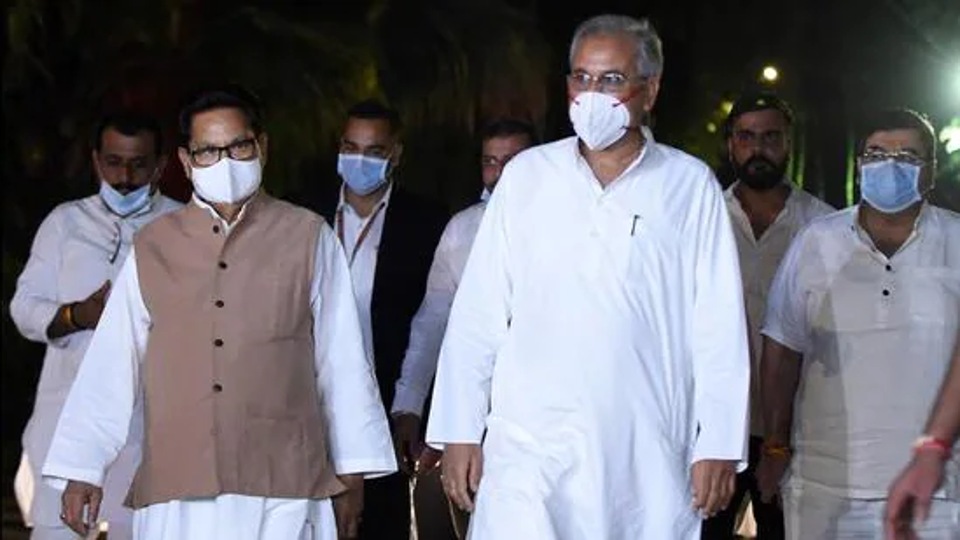
On Sunday, Baghel met Machhua Kalyan Board Chairman MR Nishad and parliamentary secretary Kunwar Singh Nishad, (both representatives of the fisherman community). He also met Chandranahu Kurmi Samaj’s (one of the other backward castes) representatives, who invited him for a congregation in Mahasamund district on September 26.
Although, functionaries close to Singh Deo asserted that the Delhi visit of the minister was ‘purely personal’, the timing of the visit has made headlines in the local dailies.
Baghel has been silent after his return from Delhi and avoiding media but continuously meeting the various community representatives in Raipur.
The same day, Baghel exhorted that the shortage of rainfall has given rise to ‘drought-like conditions’ in several areas and his government stands with farmers in this time of crisis.
“Farmers who have sown paddy, kodo-kutki (millet), arhar pulse in the ongoing kharif season and if their crops get destroyed due to lack of rainfall, they will be given an assistance of ₹9,000 per acre on the basis of survey (for assessment of damage) under the Rajiv Gandhi Kisan Nyay Yojana,” an official statement from Baghel stated.
The leaders and Congress functionaries are now eyeing the two-day visit of Congress leader Rahul Gandhi and hoping for some clarity with respect to the high command’s decision on the power-sharing formula.
On Saturday, after returning from Delhi, Baghel told the media that Gandhi will be on a two-day visit to the state this week.
“It is obvious that Rahul Gandhi will talk to leaders, functionaries and MLAs about everything including the government, policies and power-sharing formula... I don’t know what will happen but Gandhi’s visit will be crucial,” said a senior Congress leader.
However, Congress functionaries in the state claimed that the schedule of Gandhi’s visit is not finalised till now.
“Our party’s Chhattisgarh in-charge PL Punia will come first and chalk out the plan for Rahul Gandhi’s visit. On August 3, Congress general secretary Ajay Maken will be in Raipur to address a press conference on the new National Monetization Pipeline announced by the central government while Baghel ji will be addressing media, on the same issue in Lucknow. We are not expecting any political development before August 4,” said Shailesh Nitin Trivedi, chairman, Chhattisgarh Congress media cell.
Meanwhile, most of the Congress legislators are still in a state of confusion about the power-sharing formula and waiting for a clear indication from the high command.
“Both of them look confident in their statements after their return from Delhi on Saturday. Most of us are still in confusion about the power-sharing formula… One among the two leaders is misleading the MLAs and Congress,” said an MLA on condition of anonymity.
The bureaucrats of Chhattisgarh are also eagerly watching the political developments of the state.
“Things are not the same in Chhattisgarh as they were a week ago. Most of us are waiting for further political development because nothing is clear,” said a senior IAS officer.
“The Congress party is suffering in the ongoing tussle between the two leaders of the Chhattisgarh. I believe that whatever happens, the Congress will have to face the dent in the next assembly elections due to this infighting. Secondly, the whole bureaucracy is at a standstill since everyone is waiting for the final decision of Congress high command,” said Ashok Tomar, a political commentator, based in Raipur.
On Friday, Baghel met Gandhi and said that he had said “everything” to his leader. Asked if he would still be the chief minister when Gandhi arrives in Chhattisgarh, Baghel said he had invited him “as the chief minister”.
Singh Deo on Thursday fuelled the speculation about the change, saying anyone who plays in a team “wants to be the captain”.
In December 2018, in the aftermath of dominant Congress performance where the party won 68 of 90 seats, even as the party’s Delhi leadership sought to put out leadership fires in Madhya Pradesh and Rajasthan, Chhattisgarh emerged as a problem too.
Four state leaders, Baghel, home minister Tamradhwaj Sahu, speaker Charan Das Mahant and Singh Deo flew to Delhi, all eyeing the chief minister’s post. As Mahant settled for speaker, friction between Baghel and Singh Deo meant that Sahu first emerged as the frontrunner, but pushed by the idea that a third leader would take the top position, Baghel and Singh Deo, along with Punia and Gandhi, reportedly arrived at a power-sharing arrangement.
-kW0H-U20214218012MgB-250x250%40HT-Web.jpg)


