
 E-Paper



‘Climate change impacting J-K, time to recharge depleting water resources’: L-G
Jammu and Kashmir lieutenant governor Manoj Sinha said glaciers have reduced from 25 per cent to 17 per cent.


Jammu and Kashmir lieutenant governor Manoj Sinha on Monday underlined reconciliatory measures on war-footing to recharge rapidly depleting water resources in river and snow-rich Jammu and Kasmir before it proved too little, too late.
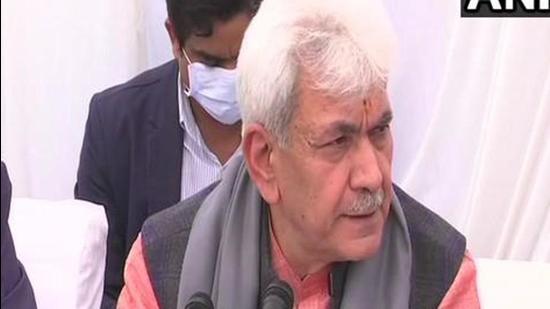
Addressing a gathering on the occasion of World Water Day, Sinha said that climate change has impacted Jammu and Kashmir as well where glaciers have reduced from 25 per cent to 17 per cent.
“Out of 208 hydrograph stations which were monitored, the water level in 171 wells has decreased. The water level has increased in only 37 wells in Jammu division,” he said.
Sinha also said that the water level in Kathua, Samba, Jammu and Udhampur districts has also gone down and efforts were needed to recharge them with the active support of the people.
“This is high time that we should work out an integrated strategy to increase the receding water level in the wells before it is too late,” he said.
He, however, expressed satisfaction that the Central Ground Water Board (CGWB) has kept all 20 districts of the UT in ‘safe category’.
“But it has also asked us to be cautious because climate change is also affecting J-K,” said Sinha.
The L-G said that 90 per cent of the water bodies, including ponds in J-K, remained ignored. In this context, he cited a report of Survey of India in 1911 regarding Wullar Lake in Kashmir Valley.
“As per the report, Asia’s largest freshwater lake today has shrunk to 75.82 sq kms from 91.29 sq kms open area. I have cited just one instance. There are many such lakes and ponds,” said the L-G.
In Udhampur district, he said, there were 26 lakes and water bodies which have now been reduced to only 19. Sinha called for the active participation of elected representatives and people of J-K in rainwater harvesting and water conservation activities.
On the occasion, he also inaugurated and laid the foundation for various water supply schemes, irrigation schemes and projects worth ₹117.49 crores.
He also underlined the need of supplying potable water through pipes to every household in the UT.
However, it may be stated here that many areas in Jammu city still san piped water supply, especially densely populated areas like Sainik Colony and Channi Himmat.


