
 E-Paper



Puri’s Rath Yatra takes place without devotees for the second consecutive year
Rath Yatra is one of the main festivals of Odisha that commemorates the annual journey of Lord Jagannath and his siblings from the 12th century Jagannath temple to their aunt’s abode in Gundicha temple, 2.5km away, in the presence of around a million devotees

 Prefer HTon Google


For the second time in its history, the famous Rath Yatra of Jagannath temple in Puri, Odisha, took place in the absence of devotees. The festival began Monday morning with a large number of priests pulling three colourful chariots through the town without the usual throng of devotees in deference to Supreme Court orders.
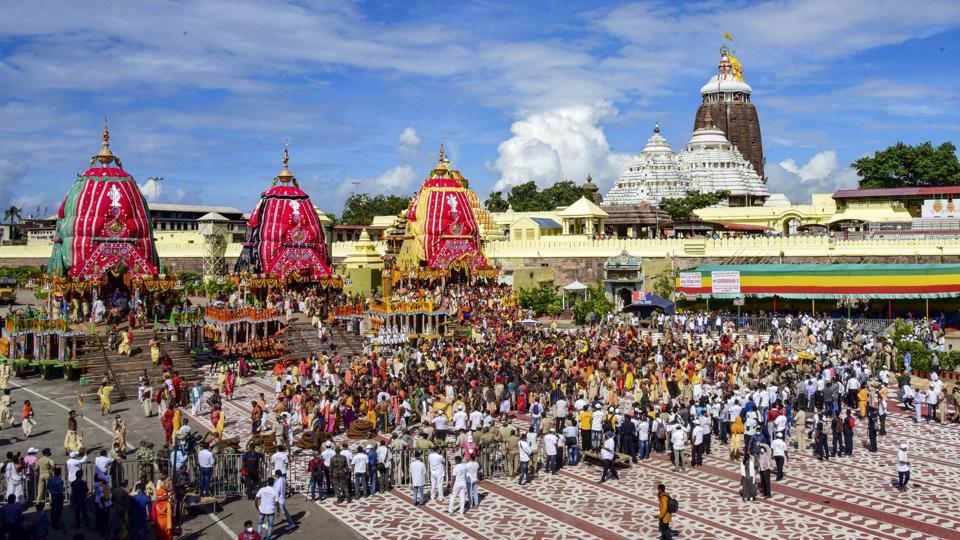
With chants of “Jai Jagannath” reverberating in the air, the trinity--Lord Jagannath and his siblings, Lord Balabhadra and Goddess Subhadra--were taken out from the 12th century temple to their respective chariots during a special ritual called pahandi bije to the beating of drums, cymbals and blowing of conches.
Chief administrator of Sri Jagannath temple, Dr Krishan Kumar, said the pahandi bije ritual was completed before the scheduled time. “Before the pahandi bije, rituals like aarti, avakasha, rosa homa (puja in the temple kitchen), surya and dwarapala puja, sakala dhupa and mangal arpana were concluded inside the temple,” he said.
Also Read | Amit Shah performs aarti at Jagannath Temple in Ahmedabad
Puri Gajapati Dibyasingha Deb, the first servitor of the temple, performed the chhera panhara ritual atop the three chariots after which they -- Nandighosh, Taladwaja and Darpadalana -- were pulled by around 1,500 priests, who have already tested negative for Covid-19 via RT-PCR.
Jagadguru Shankaracharya Swami Nishchalananda Saraswati Maharaj of Puri Govardhan Peetha also offered prayers atop the chariots.
Rath Yatra is one of the main festivals of Odisha that commemorates the annual journey of Lord Jagannath and his siblings from the 12th century Jagannath temple to their aunt’s abode in Gundicha temple, 2.5km away in the presence of around a million devotees. The Gundicha temple is the place where Jagannath is said to have taken the form in which he is currently worshipped. The Rath Yatra is the only time when Lord Jagannath comes out of his holy abode to give darshan to people of all religions, as except Hindus, no one else is allowed into the temple.
Last year, a three-judge bench of the Supreme Court, led by then chief justice SA Bobde had initially stayed holding the festival due to the fear of Covid-19 spreading. However, the bench reversed its order after an appeal by the petitioners as well as affidavit by the state and Centre arguing that the event had been held continuously for centuries. The apex court agreed to allow the festival with several preconditions, including the absence of devotees and the pulling of the three chariots by not more than 1,500 priests. This year, the apex court had disallowed holding of Rath Yatra in any other town of the state except Puri.
The Puri district administration barred the entry of any unauthorised person onto the main road in front of the temple from July 11, imposing a curfew. It said any sort of business activities barring medical emergencies would not be allowed in the town since 8pm on July 11 till 8pm on July 13. As many as 65 platoons have been mobilised to guard the town.
Prime Minister Narendra Modi and President Ramnath Kovind tweeted their wishes on Monday.
“Greetings to everyone on the special occasion of the Rath Yatra. We bow to Lord Jagannath and pray that his blessings bring good health and prosperity in everyone’s lives,” tweeted Modi.
President Kovind tweeted: “My warm greetings to all countrymen, especially all the devotees in Odisha, on this auspicious occasion of Rath Yatra. I wish, with the blessings of Lord Jagannath, the lives of all countrymen remain full of happiness, prosperity & health.”



