
 E-Paper



Hearths fired, Bawarchi Khana comes to life for Muharram
Officials with the Hussainabad and Allied Trust (HAT), the trust that manages the kitchen, said the services of the kitchen had been withdrawn two years back in the wake of the pandemic.


LUCKNOW
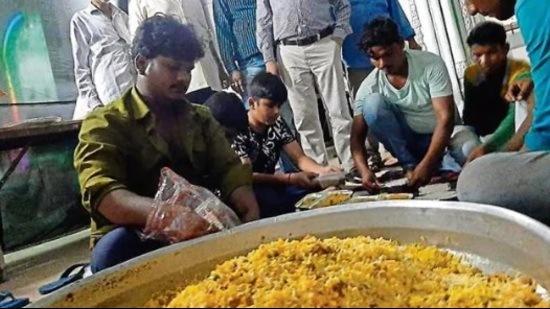
Bawarchi Khana—the Nawabi-era kitchen tasked with the preparation of Tabarrukh (sacred offerings) which is distributed among mourners (Azadaars) during Muharram, as part of Muharram rituals —has resumed services.
Officials with the Hussainabad and Allied Trust (HAT), the trust that manages the kitchen, said the services of the kitchen had been withdrawn two years back in the wake of the pandemic.
“Bawarchi Khana or the royal kitchen that will ensure the preparation and distribution of tabarrukh among Azdaars has been made operational this year as things are back to normal,” said Habibul Hasan, a senior employee with HAT.
“We have allocated a fund of ₹40 lakh this year for the distribution of tabarrukh and other religious practices, which are a tradition during the Muharram period. Since we have to cater to a large congregation of mourners and around 300 families of the descendants of nawabs, the preparation of tabarrukh has started well in advance at the royal kitchen,” Ahmed Mehndi, office superintendent, HAT, said.
Bawarchi Khana, established on the premises of Chhota Imambada, is believed to have been established by Muhammad Ali Shah, the third King of Awadh along with the iconic Bada Imambada in 1838, to ensure the preparation of tabarrukh (sacred offerings) distributed among thousands of ‘azadaars’ as part of a Muharram ritual. Besides, the king had also formed a trust—Hussainabad and Allied Trust (HAT), before his death in 1839, at a cost of 12 lakh to carry out religious practices (including distribution of tabarrukh) during Muharram. Interestingly, the trust is still functional and is carrying forward the royal legacy.
Officials with the administration said that like the last 180 years, this year too, they have the same menu for tabarrukh. “In the menu, we have tale huye aloo ka salan (fried potato curry), chane ki daal (split chickpea lentil), sheermaal (saffron coloured bread prepared in milk and sugar), Khamiri roti (yeast bread) and Bakarkhwani. This bread weighs around 750 grams and is only prepared for 300 families that are enlisted with trust as the descendants of nawabs,” he added.
Not only is the menu long, but the preparation is equally arduous. And to ensure the distribution of authentic tabarrukh, HAT ensures that it hires only traditional cooks.
“We have been preparing tabarrukh for quite some time, hence, we are aware of the quantity, quality of edibles we are dealing with,” said Sadiq Hussain, a cook who is heading the team of cooks.
HAT officials said that the distribution of tabarrukh is aimed at feeding the masses. “We have made sure that the food that is being distributed is adequate to meet the needs of the people. We start distributing tabarrukh from the 2nd Muharram to the 9th Muharram. The trust ensures the distribution of tabarrukh at Bada Imambada, Chhota Imambada and Shahnajaf Imambada after a religious ceremony (majalis),” an official said.


