
 E-Paper



Honey is turning life sweeter for Kashmiris, 70k bee colonies come up
Officials said Kashmir produces four varieties of organic honey. The government is now planning to establish seven lakh bee colonies in the Valley.


Many people in parts of Kashmir are able to earn a livelihood, thanks to around 70,000 honey bee colonies that have come up in different regions. With time, more and more young men and women are turning to bee-keeping as dozens of local honey brands have got established in Kashmir.
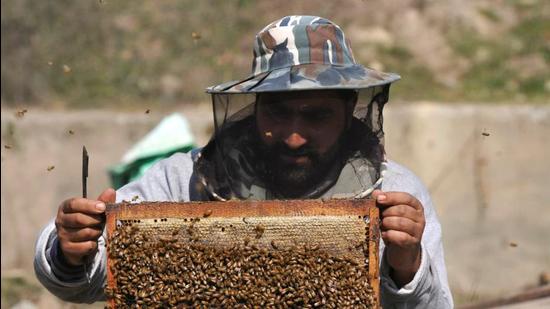
The nectar collected by the bees from the meadows, orchards, forests, gardens is considered among the finest across the globe and fetches anywhere from ₹80,000 to 1 lakh per quintal.
Officials said Kashmir produces four varieties of organic honey. The government is now planning to establish seven lakh bee colonies in the Valley that could generate more honey, revenue and employment for the youth. Last year, 7,206 quintals of pure honey was generated. Anantnag district alone produced 2015.06 quintals followed by Srinagar (1415 quintals).
In north Kashmir’s Baramulla, Ishfaq Ahmad Dar, a young entrepreneur, got four apiaries for his small orchard outside his house for the pollination. After a good apple harvest, Dar decided to get more apiaries.
“Initially, I didn’t think about honey but once I got good returns I decided to get more beehives. Now I have 150 hives through which I get five to six quintal of honey in a year,” Dar said. He said that he had engaged a couple of people as beekeepers and also seek timely advice from officers of the agriculture department for the maintenance of these apiaries.
Also read: No threat to Amarnath Yatra, but sticky bombs a new challenge - J-K DGP
“I am now able to earn ₹four to five lakh rupees and the market for real pure honey is always available in Kashmir,” he said, adding that he is planning to expand his beehives in the next season. “Its also a good business which seldom is in a loss,” he stated.
Another beekeeper, Farooq Ahmad Shiekh, who hails from Kupwara, said that he gets honey three to four times a year from his 100 apiaries established in his backyard in Handwara.
“I get two harvests in Kashmir and another in Jammu. I earn sufficient for my family. Though at times due to climate changes bee mortalities lead to losses. Most of the times, I generate good profit,” he said. Shiekh said that Kashmir nectar comes from the organic flora in the vast forests. “With every passing day, the demand for pure honey goes up,” he added.
Officials said they are already organising training-cum-sensitization programs on honey bee and their management as there is a tremendous scope of beekeeping in Jammu and Kashmir.
Director of agriculture, Kashmir, Mohammad Iqbal Choudhary, said that the department has prioritized upliftment of the apiculture sector and has designed and drafted Detailed Project Reports for promotion of high altitude honey in J&K under ‘Honey Mission’. “At present, we have more than 70,000 bee colonies and our target is to take this to seven lakh colonies by good management.
He said that the idea is to establish seven lakh colonies within the next five years which could generate employment for 1.14 lakh families. “Ours is considered the world’s best honey and we are trying to get the GI tag for this honey,” he said, adding that the apiculture cultivation is a way forward to double farmer’s income by 2022 with the latest technological intervention. He said that this is the only thing that hasn’t got any negative growth.
Choudhary said that the department has started the process of establishing viable beekeeping units as the sector has good potential to generate income not only in honey production but also in the production of by-products like beeswax, propolis, bee venom and royal jelly. “Apart from honey, its byproducts also have a great demand in the markets across the country,” he said, adding that a person with 100 hives can generate employment for four to five people.
He said within his department and districts there are separate officials for apiculture who guide farmers and beekeepers from time to time.
Javeed Iqbal, a wholesale honey dealer, said that people are always looking for quality honey as it has many health benefits. “Earlier we used to get most of our honey from other states and didn’t know about its quality. As more and more young people established beekeeping units, we turned to those units for honey. Even quality honey from Kashmir has a good demand outside Kashmir. The demand is growing,” he said.


