
 E-Paper



Krishna Janmabhoomi-Shahi Eidgah dispute: HC rejects Muslim side’s pleas, says Hindu worshippers’ suits maintainable
The court held that all suits of Hindu worshippers are maintainable and fixed August 12 as the next date of hearing


The Allahabad high court on Thursday rejected applications of the Muslim side challenging the maintainability of Hindu worshippers’ suits in the Shri Krishna Janmabhoomi-Shahi Eidgah dispute at Mathura.
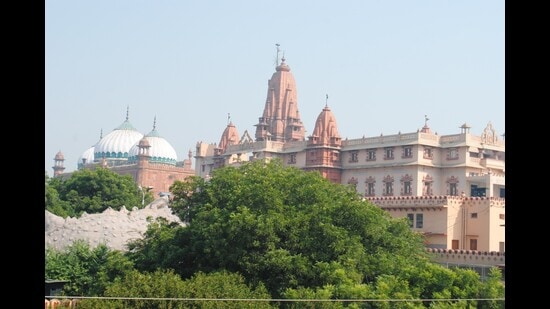
The court held that all suits of Hindu worshippers are maintainable and fixed August 12 as the next date of hearing for the framing of issues.
The controversy is related to the Mughal emperor Aurangzeb-era Shahi Eidgah mosque at Mathura, which is alleged to have been built after demolishing a temple at the birthplace of Lord Krishna.
The suits filed by Hindu litigants seek “removal” of the Shahi Eidgah mosque adjacent to the Krishna Janmabhoomi temple, as well as restoration of the temple.
The Muslim side said they will challenge the Allahabad high court order in the Supreme Court.
For its part, the high court held that these suits are not barred by the Limitation Act, Waqf Act and Places of Worship Act,1991, which prohibits conversion of any religious structure as it existed on August 15,1947. It also said the suit was not barred by a compromise dated October 12, 1968.
With this, Justice Mayank Kumar Jain paved the way for all 18 consolidated suits to be heard on their merits.
The court said that objections raised by defendants cannot be decided without framing of issues and considering evidences.
“The constructive possession of the deity over the land from the time immemorial and the legality and validity of the compromise dated 12.10.1968 are questions of fact that can only be proved by the evidence to be led during the trial,” the court observed.
“What relief can and cannot be granted has to be decided by this court on the basis of the pleadings and evidence available on record. Beside this, the plaintiffs have claimed several reliefs such as cancellation, declaration, mandatory injunction as well as for possession which are subject to evidence to be led during the trial,” the court added.
Rejecting the applications challenging maintainability of the suits, the court observed, “On reading of the plaints as a whole and in a meaningful manner, perusal of the material placed on records, consideration of the arguments advanced by the rival parties, and settled legal propositions, I conclude that the plaints in all the suits of the plaintiffs disclose a cause of action and they do not appear to be barred by any provisions of the Waqf Act, 1995; the Places of Worship (Special Provisions) Act, 1991; the Specific Relief Act, 1963; the Limitation Act, 1963 and Order XIII Rule 3A of the Code of Civil Procedure Code, 1908.”
On the objection of the Muslim side that the structure is a waqf property as per the notification of February 26, 1944, the court observed, “The present superstructure came into existence on the basis of the compromise dated 12.10.1968. It is also to be taken into consideration that during several rounds of litigation, prior to institution of Suit No. 43 of 1967, nowhere it was pleaded that the suit property was a waqf property….Thus, at this stage it cannot be assumed that the suit property was notified as a “waqf property” under this notification ( notification of 1944).”
Earlier, Justice Mayank Kumar Jain had reserved his verdict on June 6,2024 after hearing pleas of Shahi Eidgah mosque committee and the UP Sunni Central Waqf Board.
They (Muslim side) had moved applications under Order 7 Rule 11 of the Civil Procedure Code (CPC) regarding maintainability of suits of Hindu worshippers.
Raising preliminary objection on the maintainability of suits, the Muslim side had submitted before the court that the suits are barred by limitation.
As per the counsel for UP Sunni Central Waqf Board, the parties had entered into a compromise on October 12, 1968 and said the compromise was confirmed in a civil suit decided in 1974. The limitation to challenge a compromise is three years, but suits were filed in 2020 and thus present suits were barred by limitation Act, they had contended.
Other counsel for Muslim side had pleaded that suits are barred by Waqf Act and Places of Worship Act, 1991, which prohibits conversion of any religious structure as existed on August 15,1947.
“We will challenge the Thursday order of the Allahabad high court before the Supreme Court where August 5 is fixed on various other aspects related to issue of Sri Krishna Janmabhoomi and Shahi Eidgah Mosque,” said Tanveer Ahmed, the secretary and counsel for management committee of Shahi Eidgah Mosque.
Ahmed had been contesting cases for Shahi Eidgah Mosque in Mathura Courts since September 2020 till they were transferred to the high court in May 2023.
According to the news agency PTI, Hindu side counsel Vishnu Shankar Jain told reporters that with the dismissal of the plea challenging maintainability, the high court will continue to hear all the cases.
He said the Hindu side will next move the Supreme Court asking it to vacate its stay on an earlier Allahabad High Court order that had allowed a survey of the mosque.
“We will also file a caveat regarding today’s order in the Supreme Court,” Jain said.
According to ANI, Uttar Pradesh deputy chief minister Keshav Prasad Maurya said, “We welcome the court’s decision. The construction of a grand temple at Ram Janmabhoomi happened after the judgment of the Supreme Court. I am confident that in the coming time, Shri Krishna devotees will also get justice.”
Deputy chief minister Brajesh Pathak said that the decision is according to the sentiments of the people.
“I welcome the decision given by the court. It is according to the sentiments of the people. Lord Ram & Lord Krishna are our ‘sanskriti, virasat, vichardhara’,” Pathak said.


