
 E-Paper



Krishna Janmabhoomi-Shahi Eidgah dispute: HC reserves order on Muslim side’s plea challenging maintainability of suits
The high court is hearing 18 consolidated suits filed by the Hindu side seeking possession of the land on which the Shahi Eidgah mosque adjacent to the Shri Krishna Janmabhoomi temple is built.


The Allahabad high court on Friday reserved its order on an application filed by the Muslim side challenging the maintainability of suits in the Krishna Janmabhoomi- Shahi Eidgah dispute in Mathura.
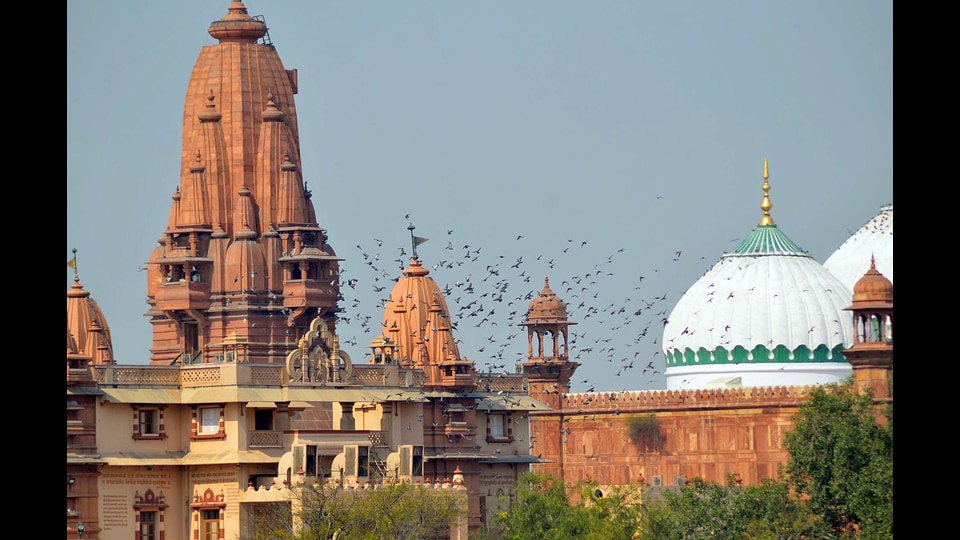
The high court is hearing 18 consolidated suits filed by the Hindu side seeking possession of the land on which the Shahi Eidgah mosque adjacent to the Shri Krishna Janmabhoomi temple is built.
Justice Mayank Kumar Jain reserved the order after hearing the parties concerned on the application filed under Order 7 Rule 11 of the Civil Procedure Code challenging the maintainability of suits on various grounds. The hearing continued for several dates. Advocate Tasneem Ahmadi, appearing for the committee managing the Shahi Eidgah in Mathura, had pleaded before the court that title suit filed by Hindu side is not maintainable as the same is barred by the provisions of the Waqf Act as well as Places of Worship Act 1991, which prohibits the conversion of any place of worship and provides for the maintenance of the religious character of any place of worship as it existed on the August 15, 1947.
It was further pleaded that the disputed property, the Shahi Eidgah masjid, is a waqf property. Hence, the present dispute relates to Waqf property and, therefore, the jurisdiction to hear the matter is only with the Waqf tribunal and a civil court has no jurisdiction to hear the case.
Further, the Muslim side said a compromise was entered into between Shri Krishna Janam Sthan Seva Sansthan ((earlier known as Shri Krishna Janam Sthan Seva Sangh) and the Shahi Eidgah Masjid committee in 1968 and the land on which the Masjid stands was given to the masjid committee. Later, the compromise was affirmed by a court in an order passed in 1974. The present suit was in violation of said compromise and judgment and thus not maintainable, the Muslim side further said.
It was further submitted that suits were filed for possession after removal of structure of Shahi Eidgah Masjid as well as for restoration of temple and for a permanent injunction. The prayer in the suit itself shows that the structure of Masjid (mosque) is there and committee of management is in possession of the same.
“In this way, a question/dispute has been raised on Waqf property and thus provisions of Waqf Act will apply and as such, it is the Waqf Tribunal which has the jurisdiction to hear the matter and not a civil court like the present one,” the Muslim side said. On the other hand, advocate Ajay Kumar Singh, appearing for the Hindu side, submitted that the present dispute is beyond the ambit of the Waqf Tribunal and only the civil court has the jurisdiction to decide the present dispute.
He put reliance on the judgment of Supreme Court reported in 1999, which provides that religious disputes have to be decided by the civil court.
In reply to the arguments raised by the Muslim side, Vishnu Shankar Jain submitted that the suit is maintainable and plea regarding application of Places of Worship Act as well as Waqf Act can only be determined by evidence by the parties in suit and the same cannot be decided while hearing an application under Order 7 Rule 11 of civil procedure code (CPC) challenging maintainability of the suits.
He further contended that merely by saying that now a mosque is there, the Waqf Act will not apply.
The religious character of the property cannot be changed merely by demolishing the same. He further submitted that it has to be seen and decided that whether alleged waqf deed is valid or not. If property is not a valid property of waqf, it would not be a valid waqf. All these things to be seen in trial and thus present suit is maintainable, he said.
On the question of limitation, he said that present suit has been filed well within time. The alleged compromise of 1968 came to the knowledge of plaintiff in 2020 and within three years of knowledge, the present suit has been filed. It was also said that if the Sibayat or trust is negligent and not performing its duty, the deity can come forward through next friend and can file suit and in such case the question of limitation does not arise.
On behalf of the Hindu side, in reply to the arguments raised by the Muslim side on the question of compromise in 1968, counsel in one of the suits Hari Shankar Jain submitted that in the alleged compromise, the deity was not a party.
“Besides, the deity was not even a party in the court decree passed in 1974. Therefore, it was submitted that the alleged compromise entered by Sri Janm Seva Sansthan was not a valid compromise, as it was not empowered to enter into any compromise. The object of the Sansthan was only to manage day to day activities and had no right to enter into such compromise,” Hari Shankar Jain argued.
The Places of Worship Act 1991 will not apply in the present case and it applies only in the case of undisputed structure and not in case of a disputed structure, as in present case, he said.
The Hindu side also argued that in the present case, the character of the structure is still to be decided in the suit and it is to be decided only by evidence and same cannot be decided in application under Order 7 Rule 11.
“An illegal construction on a temple cannot bar the institution of a suit. All this is to be decided in suit itself on merit,” the counsel submitted.
After hearing the parties, the high court reserved its order on the application.
HC transferred suits to itself in May 2023
The Allahabad high court on May 26, 2023 transferred to itself all the suits that were pending before the Mathura court praying for various reliefs pertaining to the Shri Krishna Janmabhoomi-Shahi Eidgah mosque dispute.
The high court had passed this order while disposing of a transfer application.
Thereafter, 18 suits were transferred from the Mathura district court to the Allahabad high court in which the common relief sought was for declaration and an injunction claiming right of Hindu community to the Shahi Eidgah Masjid in Mathura adjacent to the Krishna Janmabhoomi temple.
The suits also sought handover of the land, after removing any construction, over to the Hindu side and also to restrict the Muslim side from entering into the property on the premises of 13.37-acre land of Katra Keshav Dev, Mathura.
According to plaintiffs, the Masjid was constructed after demolishing a Hindu temple and such construction cannot be a mosque as no waqf was ever created and the land was never dedicated for construction of a mosque.
The plaintiffs had also sought relief that court may declare that the compromise dated October 12, 1968 and entered into between Shri Krishna Janam Sthan Seva Sansthan (earlier known as Shri Krishna Janam Sthan Seva Sangh), Mathura and Shahi Masjid Eidgah, Mathura. The compromise was not binding on plaintiffs- the deity and Hindu side, they said.
In connection with these suits, an application was moved by the Hindu side seeking the appointment of a court - monitored advocate commissioner to survey the Shahi Eidgah premises, adjoining the Shri Krishna Janmabhoomi temple in Mathura.
On December 14, 2023, the application was allowed. However, the order was challenged by the Muslim side before the Supreme Court, which stayed the execution of the order for appointment of the commissioner.
Thereafter, the high court started hearing the application of the Muslim side challenging the maintainability of the suits filed on various grounds, including that the suit is barred by Places of Worship Act and time barred.


