
 E-Paper



Meghalaya’s living root bridges inch closer to UNESCO heritage tag
Meghalaya chief minister Conrad K Sangma said that the living root bridges have been included in the UNESCO World Heritage Site tentative list.

 Prefer HTon Google


SHILLONG: Meghalaya’s famed living root bridges that existed for eons is on the road to being formally acknowledged by the world as priceless structures of the ancient history.
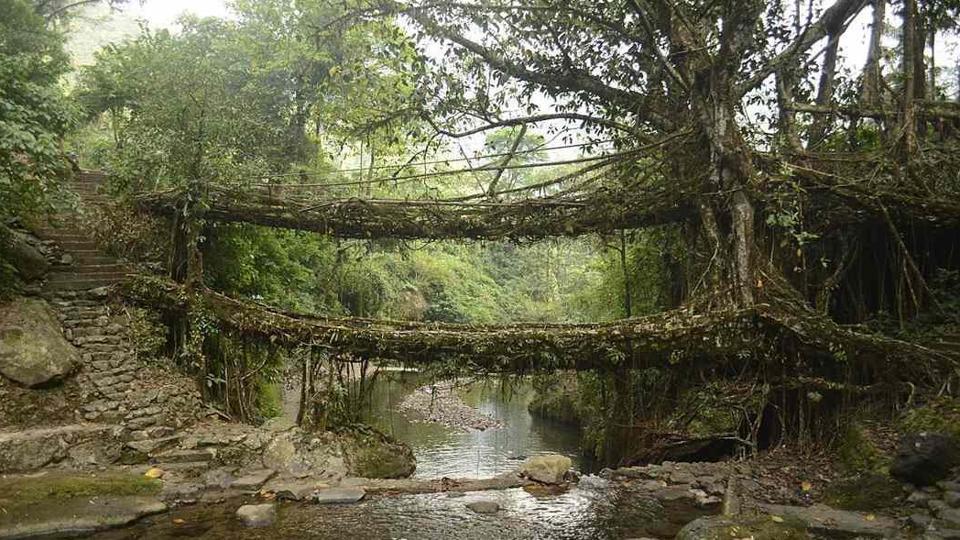
Taking to twitter, Meghalaya chief minister Conrad K Sangma said, “Delighted to share that “Jingkieng Jri: Living Root Bridge Cultural Landscapes of Meghalaya” has been included in the @UNESCO World Heritage Site tentative list. I congratulate all community members and stakeholders in this ongoing journey.”
There has been a sustained effort to get this elite inclusion through a series of field visits by scientists, who said in a unanimous voice that the living root bridges are a house of several critically endangered species of flora and fauna and therefore are definitely a reason to be considered as a UNESCO World Heritage site.
The scientists during their field visits came across unique species of orchids, amphibians, and mammals which have not yet been reported from anywhere else in the country.
The field visits also revealed key findings that indicated urgent need for attention to strengthen conservation measures for these unique living structures.
Meghalaya’s Jingkieng Jri (Living Root Bridge) are trailblazers that not only highlight the symbiotic relationship between nature and human culture to a global audience, but more so, it focuses on the need to adopt a balanced approach between economy and ecology, something which the state government has been working tirelessly in the past few years.
Many such living root bridges in the forests are conserved by the communities of Meghalaya in the customary practice of preserving the sacred groves known as ‘Law Kyntang’. These forests also possess a huge resource of medicinal plants and herbs. There lies a dire need for the larger world to go back to its roots and respect nature once again.
The living root bridges are incredible feats of engineering built by the indigenous people of Meghalaya. These bridges are built using the living roots of Ficus trees planted on both sides of a river and then made to span the width of the river until they meet at the middle.
These bridges are built by the Khasi and Jaiñtia tribes that live in the state and can be found mostly along the southern edges of Meghalaya including the villages of Nohwet (Riwai, Mawlynnong), Nongriat, Nongthymmai, Mawkyrnot, Nongblai, Khonglah, Padu, Kudeng Rim, Shnongpdeng and others.
An important point to be noted about the people of Meghalaya, is that they follow a matrilineal system i.e. lineage is passed down through the mother. The culture of the people of Meghalaya is also deeply intertwined with nature. People rely on nature for their daily needs and because of this, conservation of nature is crucial to them.
The Khasi and Jaiñtia people who reside in the southern parts of the state along the international border with Bangladesh are called the “War” people. Their main occupation is agriculture. The War villages are nestled on the hillsides while their agricultural lands are located in the valleys below. Most of their villages are only accessible by traversing huge cliffs, waterfalls, streams and rivers.
In the past, during monsoons, it was difficult for people to cross the many waterways without bridges. Attempts to use bamboo or wooden bridges across these waterways proved futile as these bridges could not last long in the heavy rains and strong waters. Living root bridges are an innovative and indigenous solution to solve this ancient problem.
The bridges are constructed by planting ficus trees on both sides of the waterways. Hollowed out a betel nut trunk are used to propagate the aerial roots from one side of the river to the other. When they reach the other side, they’re allowed to take root into the soil.
The roots are woven and nurtured until they mature and are able to bear the weight of people walking on them. This entire process can take 15 to 25 years to complete and the bridges formed can last for hundreds of years. Some bridges are as long as 100 feet and can take loads of more than 50 people.


