E-Paper



New specie, genus of snakes discovered in Western Ghats
The study’s authors are Harshil Patel and Tejas Thackeray from the Thackeray Wildlife Foundation, Patrick Campbell from the Natural History Museum in London, and Zeeshan A Mirza from the Max Planck Institute for Biology in Germany

 Prefer HTon Google


A team of researchers from Gujarat, Maharashtra, the United Kingdom, and Germany have identified a new genus and species of colubrid snakes within the biodiverse Western Ghats. Their discovery has been published in the international journal Taxonomy on August 21.
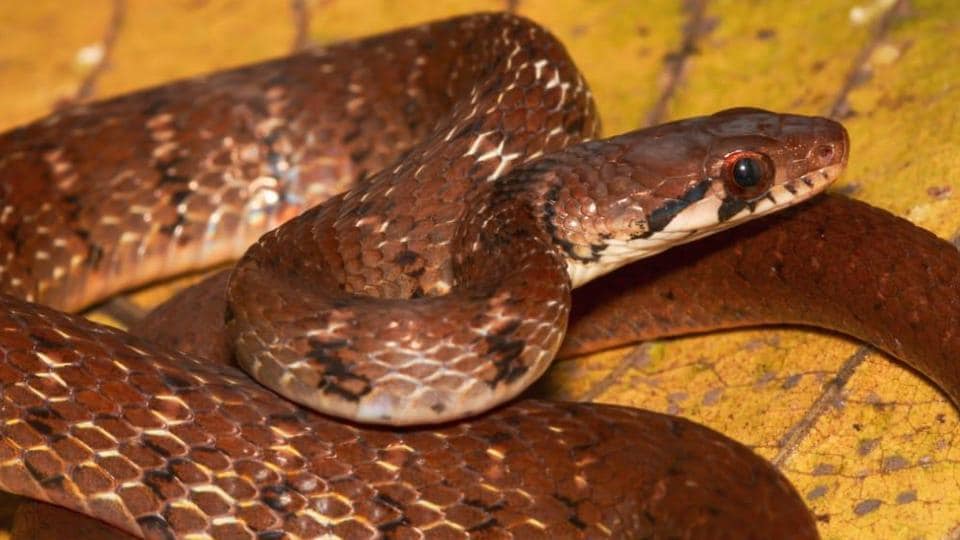
The new snake genus and species were found during dedicated surveys conducted by the researchers to document the biodiversity of the Western Ghats.
The new genus has been named Sahyadriophis, a combination of the Sanskrit word for the Western Ghats ‘Sahyadri’ and the Greek word for snakes ‘Ophis’.
The study’s authors are Harshil Patel and Tejas Thackeray from the Thackeray Wildlife Foundation, Patrick Campbell from the Natural History Museum in London, and Zeeshan A Mirza from the Max Planck Institute for Biology in Germany.
The new species, found in the northern parts of the Western Ghats, has been named Sahyadriophis Uttaraghati and we also call it the Northern Sahyadri keelback, said Patel, who hails from Valsad in Gujarat.
Patel, Thackeray and Mirza discovered that beddome’s keelback, a snake species found in the Maharashtra and southern parts of the Western Ghats, represents two distinct species.
“This prompted further investigation, which was supported by data from specimens at the Natural History Museum and the Bombay Natural History Society. Molecular data and computerised tomography scans of the skull features confirmed the presence of two species and revealed an entirely new genus, which is endemic to the Western Ghats,” said Patel.
The snakes of this genus are mostly active during monsoons. They mostly feed on frogs and their eggs. “The snakes are extremely docile in nature and seldom bite when handled. The juveniles bear a big blotch or a collar mark on the nape, which distempers as the animal grows. The new species differs from its Southern counterpart, Sahyadriophis beddomei (beddome’s Sahyadri keelback), in bearing a higher number of scales on the underside of the tail called subcaudals and a much longer tail,” according to the researchers.
The new species is currently known from the northern parts of the Western Ghats and further sampling would be necessary to define their exact ranges and to identify possible biogeographic barriers. The lineage of this species appears to be separated from its common ancestors about 20-30 million years ago.
“There are many unanswered questions like why is this lineage endemic to the Western Ghats? Is it because of the certain species of frogs and their eggs that they feed on that are found only here? Further sampling would be necessary to define their exact ranges and to identify possible biogeographic barriers,” said Patel.
The discovery of a new Western Ghats-endemic genus highlights the potential for the discovery of more distinct lineages. The new species is not just genetically distinct but is also morphologically distinct, say researchers.