
 E-Paper



Over 50k fines issued for wrong-side driving in Gurugram till August
Officials said due to the strict crackdown this year, the number of challans issued for wrong-side driving in the last eight months has exceeded the total number of violations registered under this category in 2020 and 2019.


More than 50,000 challans have been issued for wrong-side driving till August this year as part of the traffic police’s efforts to reduce road accidents in the city by stepping up enforcement and surveillance through CCTV cameras.
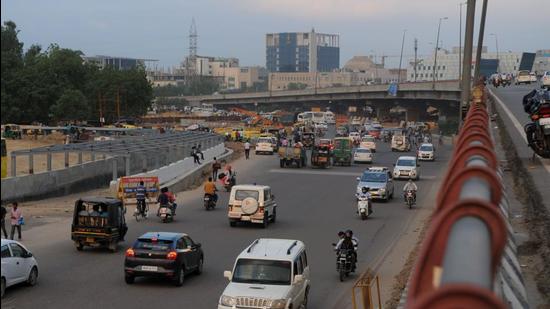
Officials said due to the strict crackdown this year, the number of challans issued for wrong-side driving in the last eight months has exceeded the total number of violations registered under this category in 2020 and 2019.
According to data available with the traffic police, the traffic police issued 52,746 challans for wrong side driving till August 31,with officials stating that the drive against the offence will be taken up on a large scale till the end of this year.
As part of their enforcement drive this year, traffic police officials said they have identified four spots in the city —Vatika Chowk, IFFCO Chowk, Hero Honda Chowk, and Rajiv Chowk — where instances of wrong-side driving are maximum and deployed traffic marshals round the clock to keep an eye out for those committing the offence.
“We observed many fatal accidents were occurring due to wrong-side driving across the city and accordingly, deputed our resources to curb the violation. Based on the feedback from our traffic marshals, we identified four major spots in the city, where the instances of wrong-side driving are maximum, which accounts for nearly 20-25% of all violations in the city,” said Ravinder Singh Tomar, deputy commissioner of police (DCP), Gurugram traffic police.
Tomar said wrong-side driving at the four spots was not due to engineering defects but primarily due to a behavioural issue.
“At all the four points, the distance to the next possible U-turn is less than a kilometre. Despite this, commuters drive on the wrong side to take a shortcut and save the little distance that they otherwise have to take for the U-turn. Enforcement and heavy penalties are the only solution to bring about a change, and hence, we have deployed traffic marshals at these spots 24x7,” said Tomar adding that traffic police are identifying more such spots in the city, where the offence is common and requires deployment of more marshals.
While traffic police said that there has been a drop in wrong side driving at Vatika Chowk, IFFCO Chowk, and Hero Honda Chowk, the violation is still common at Rajiv Chowk, especially during waterlogging.
“Often during heavy rains, the Medanta underpass gets flooded and so does the CH Bakhtawar Singh road. The underpass is closed as a precautionary measure. With limited road space available and congestion on the carriageway, many people take to wrong side driving. We are working with concerned departments to address waterlogging and curb violations,” said a senior traffic police official.
According to data available with the traffic police, 39,765 challans were issued for wrong-side driving last year and 49,761 challans in 2019.
Traffic police said that although there was less traffic for most part of last year on account of the Covid-19 outbreak, the enforcement in 2019 was much more.
“Our efforts to curb wrong-side driving will continue throughout the year. Our main aim is to reduce collisions caused by wrong-side driving and save lives of citizens while also sensitising them,” said Tomar.
Wrong-side driving has resulted in fatal accidents this year. On January 18, a pilot died after his car was hit by a speeding truck that was being driven on the wrong side near Sector 114 on the Dwarka Expressway.
On February 8, a 32-year-old man died after his car collided with a truck driving on the wrong side at the Southern Peripheral Road (SPR) near Badshahpur.
Traffic police also mentioned about the change in the department’s approach against wrong-side driving. In February, traffic police announced that wrong-side driving can attract FIRs against the offender under Section 279 (rash driving) of the IPC. Similarly, in January, traffic police announced that the licence of anyone found driving on the wrong side will be suspended while a repeat offence may lead to termination of the licence.
Along with the Gurugram Metropolitan Development Authority (GMDA), this year, the traffic police have installed red light violation detection cameras (RLVD) for monitoring at least 25 major crossings round the clock. Over 230 such cameras have been installed at key junctions, such as HUDA City Centre, Subhash Chowk, Bristol Chowk, Signature Towers, and IMT Chowk.
Tomar said the traffic police tower in Sushant Lok 1 and the GMDA’s integrated command and control centre (ICCC) in Sector 44 have been monitoring traffic violations through RLVD cameras, especially over the past two months.
Despite the efforts by traffic police, commuters said some stretches, like the one between Moulsari Avenue metro station-Ambience Mall, opposite the entrance to park drive on Golf Course Road (GCR), and MG Road U-turn flyover are prone to wrong-side driving.
“Every time I exit from the club drive on to GCR, I have to keep checking vehicles coming from the other end, driving on the wrong side. Just soon after, where a U-turn allows commuters to head towards Bristol Chowk, two-wheelers can be spotted regularly driving on the wrong side,” said Sandeep Kumar, a resident of DLF 5.
“Besides heavy enforcement, Gurugram traffic police also needs to identify the reasons leading to wrong-side driving. If the reasons are due to engineering defects, the same should be addressed and rectified along with local government bodies,” said Sewa Ram, associate professor and urban transport systems design expert at the School of Planning and Architecture (SPA), Delhi.
Talking about other solutions to check wrong-side driving, Sewa Ram said supervising intersections and junctions via CCTV cameras would help curb the offence. “If commuters are wary that they are under constant surveillance, their instinct to commit traffic violations would be kept in check. This method has proven effective in bringing down traffic violations across major cities such as Delhi and Chandigarh,” said Sewa Ram.


