
 E-Paper



Pak-origin wives of Kashmiri men stage protest, seek citizenship or deportation
Women having origin in Pakistan or Pakistan-occupied Kashmir (PoK), who had married Kashmiri men and came to Jammu and Kashmir under the 2010 amnesty policy for former militants by then chief minister Omar Abdullah, staged a protest in Srinagar on Tuesday, demanding citizenship or deportation to Pakistan


Women having origin in Pakistan or Pakistan-occupied Kashmir (PoK), who had married Kashmiri men and came to Jammu and Kashmir under the 2010 amnesty policy for former militants by then chief minister Omar Abdullah, staged a protest in Srinagar on Tuesday, demanding citizenship or deportation to Pakistan.
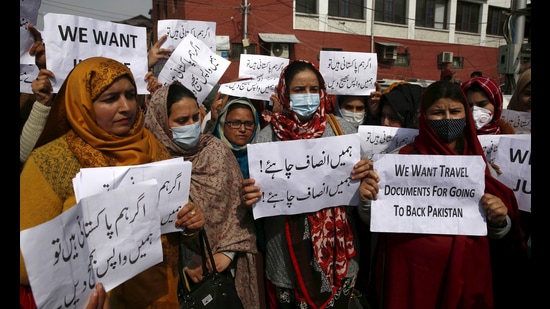
Dozens of women, along with their families, raised slogans at the Press Enclave in Srinagar before marching up to the Lal Chowk.
“For the past 12 years, we have been protesting peacefully again and again. We came here from Pakistan when rehabilitation policy was announced. Our husbands brought us here and but the government is neither giving us citizenship nor the travel documents,” said Saira Javed, a protester from north Kashmir.
The police intervened at the Lal Chowk where the women were demanding an audience with the deputy commissioner. A magistrate-level officer then arrived, prompting the gathering to disperse.
Some of the Kashmiri youths, who had crossed over to the PoK in the 1990s to get arms training, gave up violence, married there and started lives afresh. There are no official figure about such couples, but the protesters said they were 400 in number.
“The issue is that we don’t have any documents or any identity. The only identity we have is that she is the wife of a militant. Neither we nor our children can go anywhere. Neither can we send our kids to study outside,” said another protester.
Many of such couples entered India through Nepal route and the informal entry meant no official recognition of such families even as a rehabilitation policy had been announced.
The protesters said many among them have been divorced and some have lost their husbands.
“I came here in 2012. My mother died recently but I could not go to see her one last time. We can’t meet our relatives and family members. Parents of many women died during these years but they could not go even for the funeral,” said Saba Fayaz, another protester.


