
 E-Paper



Parents of Ambala man with rare genetic disorder seek affordable healthcare
Highlight high cost of treatment for spinal muscular atrophy at a janata darbar organised at the local PWD rest house on Saturday


A couple from Ambala met Krishan Bhardwaj, personal secretary to Haryana home minister Anil Vij, during the “janata darbar” organised at the PWD rest house in Ambala Cantonment on Saturday and demanded affordable healthcare for their wheelchair bound 19-year-old son, who is suffering from spinal muscular atrophy (SMA), a rare genetic disorder.
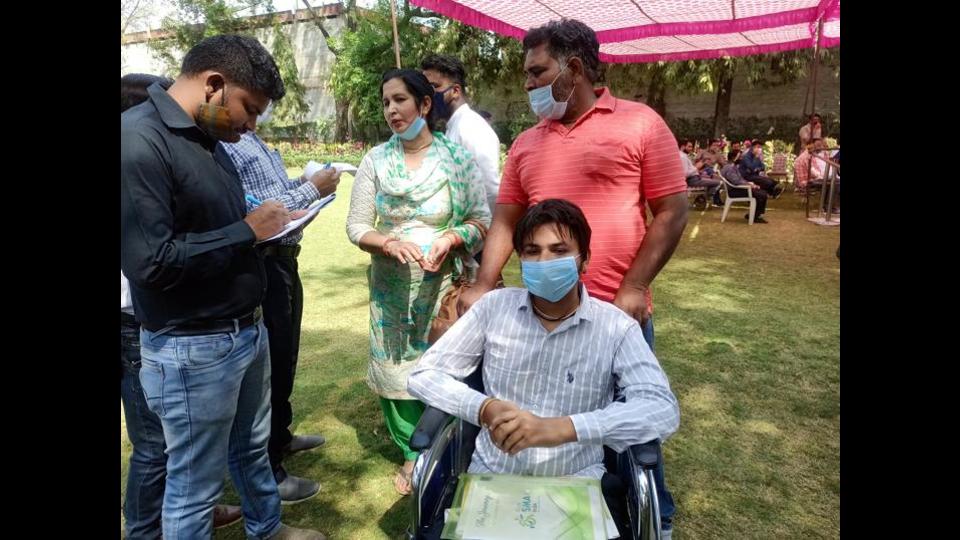
Ram Kumar, a farmer and Sushila Rana from Naraingarh’s Dehar village said that their son, Deepansh Rana, is suffering from Type-2 SMA and developed the symptoms when he was three years old.
SMA is a genetic disorder causing loss of specialised nerve cells, which causes weakness and wasting (atrophy) in the muscles, making movement impossible.
Dr Renu Suthar, associate professor of paediatrics neurology at the department of neurology, PGIMER, Chandigarh, said that the muscle weakness usually worsens with age and it is a lethal disease found in one out of 10,000 babies. “SMA mostly affects babies and children at a young age. In type-1 of the disease, the patient doesn’t live for more than one or two years. Children with type-2 and 3 live up to teenage years and adulthood, however, they are confined to wheelchair,” Dr Suthar said.
“He got infected with multiple diseases at an early age and we took him to PGIMER and later to Sir Ganga Ram Hospital in New Delhi. In 2005, doctors confirmed the disease, but global research was in a very early stage at that time. Since then, he is on wheelchair and completely depends on me even for basic needs,” Sushila said.
She was also representing Gurugram-based Cure SMA Foundation of India, as its Ambala coordinator. She said that there are more than 25 patients in the state battling this disease. Archana Panda, co-founder of the foundation said, “Now, there is treatment available for the disease in foreign countries and we want that the government should help us in avail of it through an economic model and arrangement of funds. Out of more than 25 patients in the state, most are from economically-challenged backgrounds.”
Last month, a six-month-old baby girl from Mumbai, Teera Kamat, needed medication to treat the disease costing ₹16 crore. Taxes amounting to ₹6 crore was rebated by Prime Minister Narendra Modi and the parents got the amount crowdfunded.
Dr Suthar said that there are three life-saving medicines for the disease approved by the US Food and Drug Administration, but none of them are available in India. She said that only one has been approved by the Drug Controller General of India (medication) which goes on for a lifetime.
Bhardwaj said the issue will be forwarded before VIj for an early redressal. Vij was unavailable for a comment.


