E-Paper



Pushed out of central Delhi, protesters take to Dilli Haat after Neha Bora's call
After police detained protest leaders on Sri Aurobindo Marg. Police said at least 200 were detained; smaller groups continued demonstrating before dispersing.

 Prefer HTon Google


Shut out of central Delhi, protesters regrouped at Dilli Haat around 1pm on Saturday, answering a call from All India Students’ Association (AISA) president Neha Bora. Police detained her and the other leaders on Sri Aurobindo Marg, and without them the crowd gradually thinned, though smaller groups tried to keep the protest going until late evening.
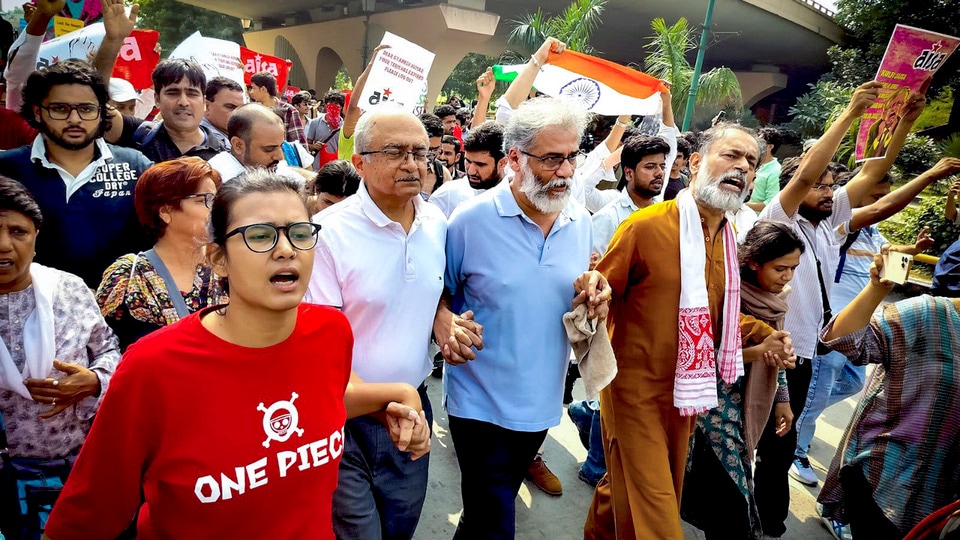
Until then, with the roads towards Jantar Mantar blocked, the demonstrations had been scattered. Students said they were responding to the Cockroach Janta Party’s (CJP’s) “Chalo Delhi” call to seek the resignation of Chief Election Commissioner Gyanesh Kumar.
Bora was joined by activist Yogendra Yadav, advocate Prashant Bhushan and Communist Party of India (Marxist-Leninist) Liberation leader Dipankar Bhattacharya, and at least 100 protesters followed them on a march from Dilli Haat towards Jor Bagh.
“Since a large number of protesters had gathered near the AIIMS flyover, a call was given for a march from Dilli Haat to Jor Bagh,” said Dhananjay, an AISA activist and former president of the Jawaharlal Nehru University Students’ Union.
Also Read | Delhi protest: Right-wing groups assault protesters, journalists amid heavy security deployment
Police detain protesters on Sri Aurobindo Marg
Security forces stopped the group on Sri Aurobindo Marg and put the leaders in a bus. Protesters blocked the bus with the leaders and stopped it from moving, and an hour-long scuffle followed.
“More than 100 protesters were initially detained. While some were later released, many others were taken to the detention centre in Maidan Garhi,” Dhananjay said. At least 200 protesters were detained from the spot, according to police officers, as the spot became the new rallying point for protesters who sought to join in.
Rishabh Jain, 20, got there too late. “I was headed to Jantar Mantar with my friends from Sarojini Nagar. But then we saw Neha Bora’s Instagram story; so, we came to Dilli Haat,” he said. “We were walking from Sarojini Nagar to Dilli Haat but by the time we reached, Neha had already been detained.”
Also Read | INDIA bloc to hold mega protest in Delhi on October 12, TMC says Mamata Banerjee to join
Nishant Kumar, a 20-year-old college student, was briefly detained during a demonstration outside the INA Metro station. “We were all outside the INA Metro station when a woman raised a slogan. The police rushed to detain her, and in the process, her spectacles fell to the ground. I moved to pick them up for her, but the police detained me as well,” he said. He was released after an hour.
“Police told us that they have the power to detain us, but recommended that we return home and protest from inside homes,” said Sonam, a 19-year-old protester.
Protesters decide to return home
After several attempts to revive the protest without a leader, protesters said they decided to go home. “Hundreds of us are here, but we can’t lead. So, ultimately, we decided to return home,” said Yuvraj Verma, 19.
Frequently Asked Questions