
 E-Paper



Sudden storm exposes holes in Gurugram’s infra
By 9 am, knee-deep water had transformed roads into rivers, halting vehicles and triggering breakdowns that stretched delays beyond 60 minutes. Winds gusting up to 80 km/h snapped power lines, uprooted trees and plunged swathes of old Gurugram into darkness, underscoring the city’s fragile disaster preparedness

 Prefer HTon Google


Gurugram: Gurugram’s crumbling civic infrastructure was brutally exposed once again as the season’s first pre-monsoon showers— just 45mm of rain over three-and-a-half hours on Friday morning—brought the city to its knees. Arterial roads across the city experienced crippling congestion, with bottlenecks on NH-8 at Hero Honda Chowk, Rajiv Chowk and Narsinghpur. The downpour’s ripple effects spread to Golf Course Road, Southern Peripheral Road, Udyog Vihar, Civil Lines and sectors 31, 38 and 44, forcing commuters into gridlock for hours on end. 50 trees uprooted.
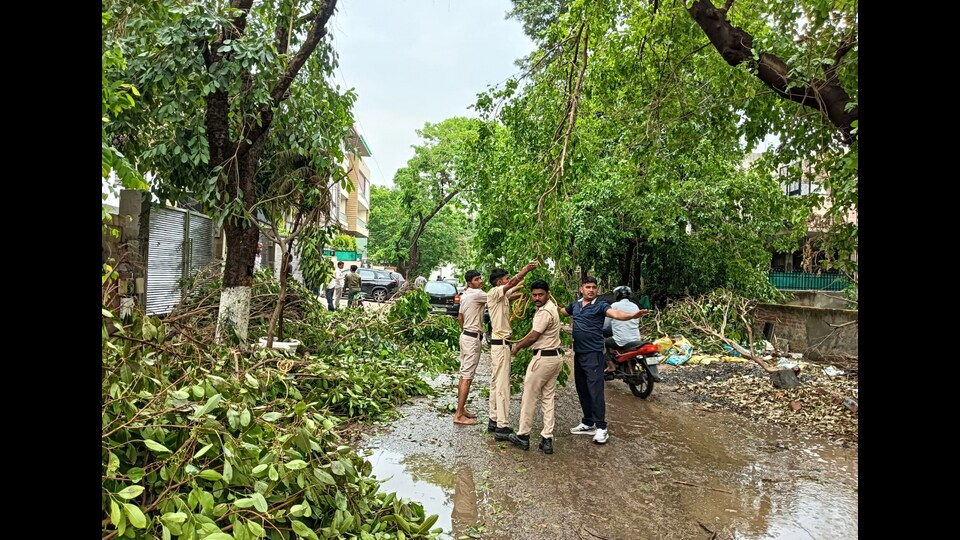
By 9 am, knee-deep water had transformed roads into rivers, halting vehicles and triggering breakdowns that stretched delays beyond 60 minutes. Winds gusting up to 80 km/h snapped power lines, uprooted trees and plunged swathes of old Gurugram into darkness, underscoring the city’s fragile disaster preparedness and the administration’s inability to respond effectively, despite advance identification of 112 flood-prone spots.
Wazirabad saw the highest rainfall at 47mm while Kadipur and Harsaru each received 44 mm. In contrast, Badshahpur and Sohna experienced significantly less rainfall, with 17mm and 18mm respectively. Manesar recorded 25mm, Pataudi had the least with just 5mm, and Farukhnagar also received 18mm of rainfall.
The India Meteorological Department (IMD) has predicted cloudy skies with the likelihood of rain or thundershowers until May 6. Over the next five days, the maximum temperature is expected to fluctuate between 34 and 35 degrees Celsius, while the minimum temperature will range from 19 to 20 degrees Celsius. The weather department has advised citizens to exercise caution, take necessary precautions during rainfall and strong winds, avoid unnecessary outdoor activities during heavy rain, and stay informed about the latest weather updates.
In one of the worst-hit pockets—Park Lane 3, A-Block, Sushant Lok 1—more than 100 families, including senior citizens and young children, watched helplessly as water levels soared to four feet within 30 minutes of rain. “Until 2023, a protective wall shielded us from runoff from DLF 4 and Chakkarpur,” said a resident. “Its removal in the name of beautification has turned our streets into a stormwater trough with only one small drain outlet. When the main storm drain is full, our water has nowhere to go.”
Beyond Sushant Lok, civic woes were echoed across other sectors. Manish Bhanot, RWA secretary of Bestech Park View Spa Next in Sector 67, lamented: “Step outside our society and you wouldn’t believe you’re in a tier-1 city. No drains, no roads—just chaos. This problem can be solved before the monsoon season, but civic amenities here remain a distant dream.”
Activists and social media users also commented on the chaos. Manesar resident and social activist Navdeep Singh filmed emerging water bodies in new development sectors, quipping on social platforms: “Looking for boat rides in Gurgaon? #VatikaLake is ready for you.” In Sector 102, Sandeep Phogat reported a gridlock on Dhankot-Basai Road, while in Sector 31, BS Yadav pointed out the culverting of five natural stormwater channels along NH-48 by the National Highways Authority of India and the Gurugram Metropolitan Development Authority (GMDA), which he said “halts all runoff from multiple sectors and Jharsa village, leaving even light showers to flood our sector”.
Responding to the deluge, executive engineer Vikram Singh of GMDA, said the authority had tracked on-ground conditions in real time. “We deployed manpower and pumping machinery to clear blockages caused by horticulture and plastic waste, removed plugs from drainage pipelines and executed quick discharges from underpasses and low-lying pockets,” he said, noting that drains at locations such as Mayfield Garden, Artemis Road and Subhash Chowk were cleared first. He added that mock drills for all city underpasses are scheduled for next week to enhance preparedness.
Despite these efforts, residents remain sceptical. They insist that only a permanent overhaul of internal drains (managed by MCG) and main stormwater channels (under GMDA) will avert recurrent flooding. With monsoon clouds gathering, Gurugram’s beleaguered population can only hope that the administration’s next round of promises translates into tangible progress—before the city drowns yet again.


