
 E-Paper



U20 Mayoral Summit concludes in Gujarat with six-point agenda for urban growth
Union housing and urban affairs minister Hardeep Puri praised the efforts by Prime Minister Narendra Modi-led government at the Centre and said that before 2014, urban areas were seen as “problematic and a challenge. But PM Modi has turned it into an opportunity.”

 Prefer HTon Google


The sixth Urban 20 (U20) Mayoral Summit concluded on Saturday in Gujarat’s Gandhinagar with a communique that set a six-point collaborative agenda for “sustainable, equitable and resilient” urban growth, prioritising water security and climate finance for cities for adaptation and mitigation.
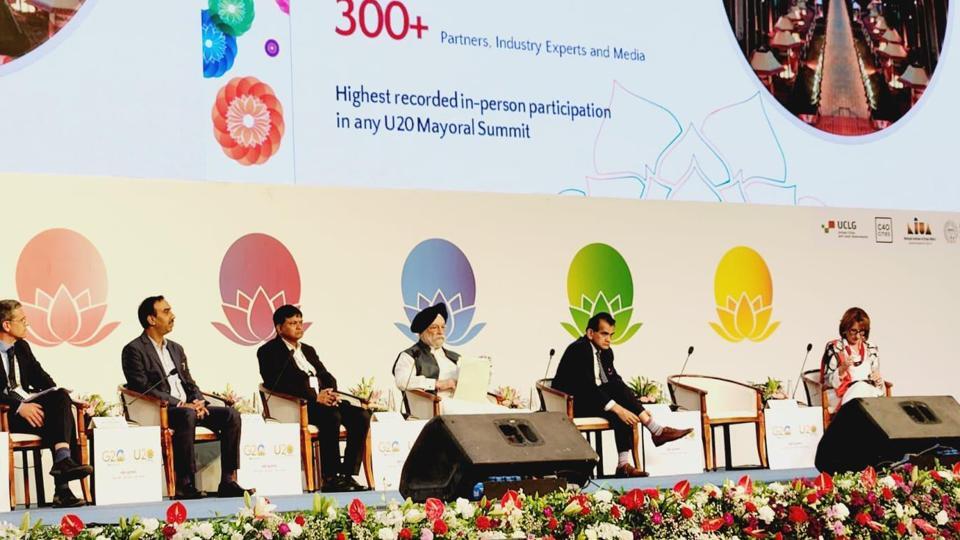
The two-day summit began Friday.
The communique outlines the vision for working collaboratively in “providing city-level solutions to global climate, economic and environmental issues”.
The communique – endorsed by 105 member cities – was handed over to Union minister of housing and urban affairs, Hardeep Puri, and G20 sherpa Amitabh Kant. It will be presented at the G20 meeting in September this year.
With its cities at the forefront of the climate crisis, the Communique emphasised the need to localise the global sustainability agenda shifting urban action “from intention to action”.
The six points of action include: encouraging environmentally responsible behaviours, ensuring water security, accelerating climate finance, championing “local” culture and economy, reinventing frameworks for urban governance and planning, and catalysing digital urban futures.
At the press conference at the summit venue, Kant said the G20, of which India currently holds the presidency, will take it forward in the leaders’ communique and get it implemented, adding that the critical focus was on “good urban governance and good urban planning, and the use of technology, without which cities can’t become the driver of growth.”
Puri said that the gathering of domain experts – mayors and city leaders – is very important because these are the people who provide leadership at the grassroots level and governance in cities. “But it is even more important when they collectively come up with a set of recommendations, which augur well for not only their own cities but cities globally. And they identify those actions that the rest of the system has to take,” he added.
“The U20 members stressed the need to overhaul development finance to increase support for climate action in cities, especially for adaptation in Global South cities facing the brunt of the climate crisis and close the massive finance gap holding back urban climate action,” the press statement from C40 Cities, a permanent convenor of U20, said.
The housing and urban affairs minister praised the efforts by Prime Minister Narendra Modi-led government at the Centre and said that before 2014, urban areas were seen as “problematic and a challenge. But PM Modi has turned it into an opportunity.”
He added that under National Democratic Alliance, the government’s spending on urban schemes increased manifolds compared to what it was under the United Progressive Alliance regime. “Between 2004 and 2014 (under the UPA government) the total expenditure on urban schemes was ₹1.57 lakh crore. In the last nine years, starting in 2014, it’s been ₹18 lakh crore,” Puri said.
Kant continued, “India has been a reluctant urbaniser but now we can leapfrog… jump forward… pole vault using technology like we are doing with the Svanidhi scheme by making everybody digitally literate, and also embedding digital technology in urban planning, in transport planning…”
Tokyo’s governor Yuriko Koike stressed on climate finance and water shortage. “It is an inconvenient fact that there is not enough financing available (for climate action),” she said, urging the G20 to collaborate to resolve the problem.
The Urban 20 (U20) Mayoral Summit was inaugurated on 7th July by Gujarat chief minister Bhupendra Patel and Kaushal Kishore, minister of state for housing and urban affairs.
According to the ministry of housing and urban affairs, the two-day-long mayoral summit saw the participation of over 430 delegates and 70 plus non-governmental organisations. This was a record turnout for the Urban-20, one of the engagement groups of G-20, which is a cohort of countries such as India, Indonesia, Brazil, Australia, Brazil, Canada, China, France, Germany, Japan, Republic of Korea, Mexico, Russia, South Africa, the UK and the US. Together, these countries house two-thirds of the world’s population, around 85% of the global GDP and over 75% of the global trade.
Delegates and participants from 57 cities across the world and 35 cities from India, including 45 Mayors, deputy Mayors of the global cities participated in the summit.
The summit got representatives from international cities such as Paris, Los Angeles, New York, Dubai, Durban, Riyadh, Rio, Johannesburg and Tokyo, as well as Indian cities.


