
 E-Paper



When means hold ability down - sans smart gizmos, bright kids unable to attend online classes
A survey revealed that half of all students were unable to access the content due to poor Net connectivity, lack of devices, or, due to there being just one smartphone in the house


For the city-dwelling teen/child to possess a smartphone, sometimes even two, is nothing out of the ordinary. For the family to have more smartphones than there are members, is commonplace. However, the scene changes dramatically as we move from an urban to a rural setting, where having one phone – and not always a smartphone – being shared by a family of four or five people, is not completely unheard of.
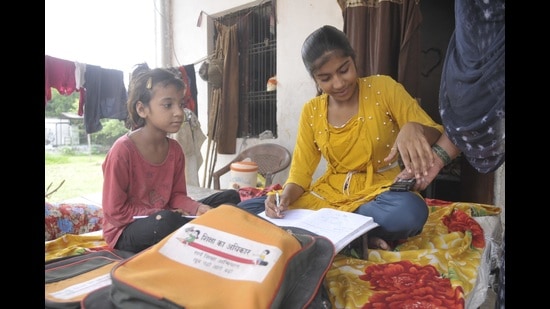
Forced by the pandemic and in a bid to keep students safe, schools and studies went online a year ago, and those with PCs, laptops and smartphones, or, blessed with the wherewithal to acquire them, graduated to learning through these gadgets.
Imagine how children from rural backgrounds coped with classes and studies. Their participation in school activities has declined remarkably. To put things in perspective, here are a few case studies:
A topper stumped by paucity
Less than a year ago, Nazia, a Class 7 student of a government school, in Sarojini Nagar block of Lucknow, was the brightest child in her class. Now, she struggles to keep up with her studies only because her family cannot afford devices like a desktop, laptop or even a smartphone.
The family of six lives in a single room with a makeshift kitchen and bathroom which they share with three other families in a dilapidated building.
The 13-year-old calls up her teachers over the phone and asks them about homework and problems she encounters while studying. Shazia steals time from a busy routine of helping with housework and taking care of her youngest sister to study for a few hours every day and even teaches young children in her locality for free.
Poor private school kids
Ifra Huzoor Khan, student of St Anjani’s Public School, Rajajipuram, Lucknow, was studying in Class 12 March 2020. In school, she was one of the top rankers, actively participated in all extra-curricular activities, won prizes for her oratory skills and was made the Head Girl.
She said, “Life changed, when, due to the lockdown, school started online classes. We had only one smartphone in the house which my father needed to run his shop.” It was a major source of grief that she could not attend any class on Zoom. “On days when my father didn’t need the phone, I called up my teachers to clear doubts. They were extremely encouraging and praised my efforts,” she said.
Circumstance-shackled siblings
Anupama, 16, is a high school student at Kesar Vidyapeeth Intermediate College on Zero Road, in Prayagraj. Her younger brother, Mayank Kumar, 14, is a Class 9 student at the same school. However, they don’t have even one smartphone between them to attend online classes. Reason: Their father, Shivbhau Yadav, who is a churmura (roasted puffed rice snack) seller, earns just enough to survive.
“We both relied on self-study and a few rare classes we could attend whenever my maternal uncle came to visit us from Kaushambi and lent us his smart phone. We both are desperately waiting for offline classes to begin,” she added.
Their teacher, Lalmani Pandey, pays the school fee of the two children and takes care of their other small needs to allow them to continue with their studies. “Anupama is a bright student, always coming first in class. Even last year, when the pandemic forced closure of schools and she could not attend online teaching, she came first,” he said with a smile.
An effort in the right direction
Prateek Mishra, 13, is a Class 8 student of a government-run upper primary school in Berui village, in the Baharia development block of Prayagraj. His mother, Nirma Devi, is a Class 4 employee and earns ₹2,500 per month – the only earning member of the family. They reside on the campus of Raj Narayan Inter College in Baharia, where Nirma Devi is also employed. She supports her family that includes her three children, including Prateek, her eldest child.
“When online teaching began on April 10, 2020, I was accessing it using our simple mobile phone at home. However, one day in mid-June it broke, and I was no longer able to attend online studies and access assignments,” he said.
Nirma Devi said that Prateek is a bright student and she did not want him to miss out on his studies. With three months’ payments in her Jandhan bank account, some money that she had saved, she made a down payment to buy a smart phone. The remaining amount was paid over five months.
Govt data says...
A survey undertaken by the state education department in mid-2020 revealed that as many as 50% of the 1.8 crore students enrolled in government-run primary and upper primary schools spread across 75 districts of UP were unable to access online content during the pandemic-hit academic year.
A recent control survey undertaken in 65 districts by the department involving 4,348 students established that despite all efforts just 50% of them were able to access online content.
The survey revealed that half of all students were unable to access the content due to poor Net connectivity, lack of devices, or, due to there being just one smartphone in the house, which was needed for other purposes.
In Prayagraj, over 2 lakh out of 4.16 lakh students enrolled in 2,477 government-run primary and 1,001 upper primary schools struggled to access online study during the pandemic hit year, concedes Vinod Mishra, district coordinator (training) of Samagra Shiksha Abhiyan.
A key reason for this is believed to be the digital divide that exists in the state.
The Annual Status of Education Report (ASER)-2018 showed that 91.7% families in rural UP had mobile phones but out of these, only 32.6% had smartphones and internet access. The study was carried out among 600 families each in 70 districts in rural UP.
ASER-2019 which covered two districts from UP—Lucknow and Varanasi—showed 94.7% families had mobile phones, but only 48% had smartphones in the state capital. In Varanasi, 56% had smartphones of the 97% families who were covered under the study. Remaining 41% had regular phones without internet facility. The report covered 1,200 rural families in both the districts. Television was however available at 61.5% and 71% households in Lucknow and Varanasi respectively.


