
 E-Paper



Wildbuzz: Peregrine power at Chandigarh’s Sukhna Lake
For birds the terror of a marauding Peregrine is akin to that of a psychopath killer stealing into an isolated house at night

 Prefer HTon Google


The killer’s face is heavily masked in black feathers like the Zodiac serial murderer who once terrorised San Francisco. The prey are smaller birds, who never know from where this killer with lightning speed and raking ‘knives’ will plunge upon their frail bodies.
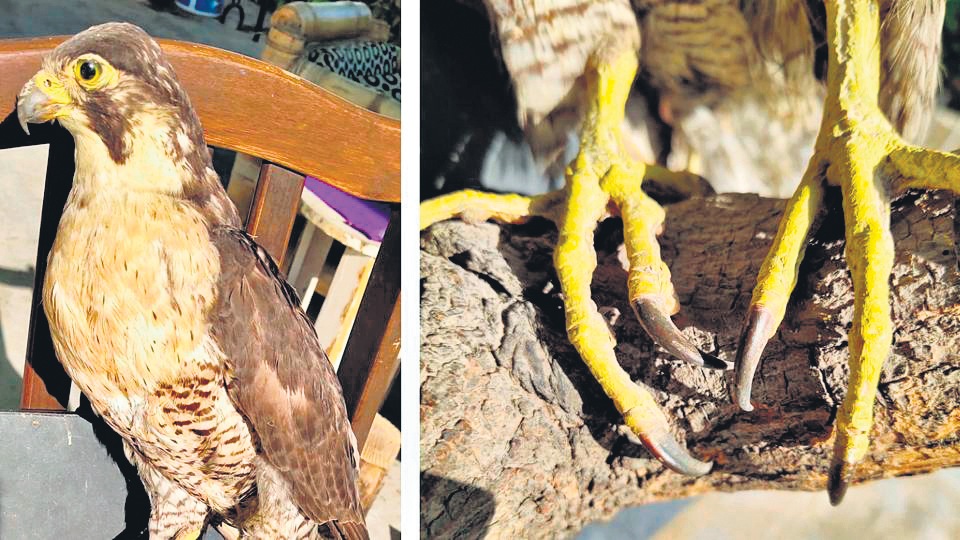
At the far end of the Sukhna Lake’s rowing canal, blood-curdling duels of escape or merciless death are being waged in the menacing mist.The world’s fastest creature and a winter migrant to India from the Eurasian Tundra, the Peregrine falcon, can be observed hunting migratory/resident birds. Historically a favoured bird of royal falconers, the Peregrine is recorded in Western studies achieving speeds of 390 km per hour. That incredible speed is accumulated when the Peregrine swoops in accelerating spirals on prey flying far below.
A dizzying blur of grey as it hurtles after prey at the Sukhna, the Peregrine’s hulk of a hooked beak is not the first strike weapon. The strategic weapons are talons (claws): four each on its yellow legs and curving cruelly like the tiger’s blood-loving claws. The Peregrine pounces upon the bird in mid-air and then rakes the prey open with the powerful hind claw. It can deliver a kickboxer’s flying blow with claws clenched into a ball as it lands on the unwary prey. The punch can just knock a prey bird senseless, disable or even kill it in mid-air. The raking hind claw is like an aerial saw and Peregrines have been witnessed slicing a Mallard’s wing, the prey falling to ground in two neat pieces!
Following a crippling strike, the Peregrine can clutch the wounded prey in mid-air with its talons and use the Tomial tooth (a sharp, triangular-shaped ridge on the outer edges of the beak’s upper mandible) to wrench off the bird’s head or bite into the neck and sever the spinal column. The Peregrine flies to a perch and the beak is used as a ripper to defeather the prey with agility and speed, exposing still hot blood and flesh for the falcon to gulp quickly and restore energies expended on speedy swoops.
Little wonder then, for birds the terror of a marauding Peregrine is akin to that of a psychopath killer stealing into an isolated house at night. As legendary ornithologist TC Jerdon once put it: “Often a large flock of duck has been forced to come within reach of my gun at some small tank by the downward swoop of a Peregrine, which hapless waterfowl dread even more than man (hunters armed with guns), and I have often had gunshot wounded teal, snipe and other birds carried off by Peregrines.”
Paying tribute to evolution’s ace of flying aces, Dr Salim Ali wrote: “A Peregrine will often stoop at a duck falling to a sportsman’s gun, and so intense is its concentration on the quarry then that it will stoop again and again after an initial miss, regardless of gunshots fired at it (by annoyed hunters) which may send its feathers flying”!
No more startling an anecdote of Peregrine power than the one recounted by Sarfrazuddin Malik, scion of erstwhile jagirdars from Dasada, Gujarat. Malik had trained on falcons with the family of late Baazdar Makekhan Fatekhan. The renowned Baazdar’s Pathan clan originally hailed from Talwandi Chaudhrian (Sultanpur Lodhi, Punjab) and he was hereditary falconer to the Maharajas of Bhavnagar. “I was out with a trained Peregrine in the early 1970s with Makekhan’s late son, Gulam Hussain. He flew the Peregrine at a flushed partridge. The falcon gathered so much momentum that when she came from above, landed on the partridge and kicked it hard with bunched talons, the prey was hurled to the ground with such force that it rebounded six feet in the air!” Malik told this writer.
vjswild1@gmail.com


