
 E-Paper



Green energy to power dedicated agri feeders in Bihar
State’s power distribution companies are going ahead with plans to set up a chain of grid-connected decentralised solar power plants to supply electricity in the dedicated agriculture feeders

 Prefer HTon Google


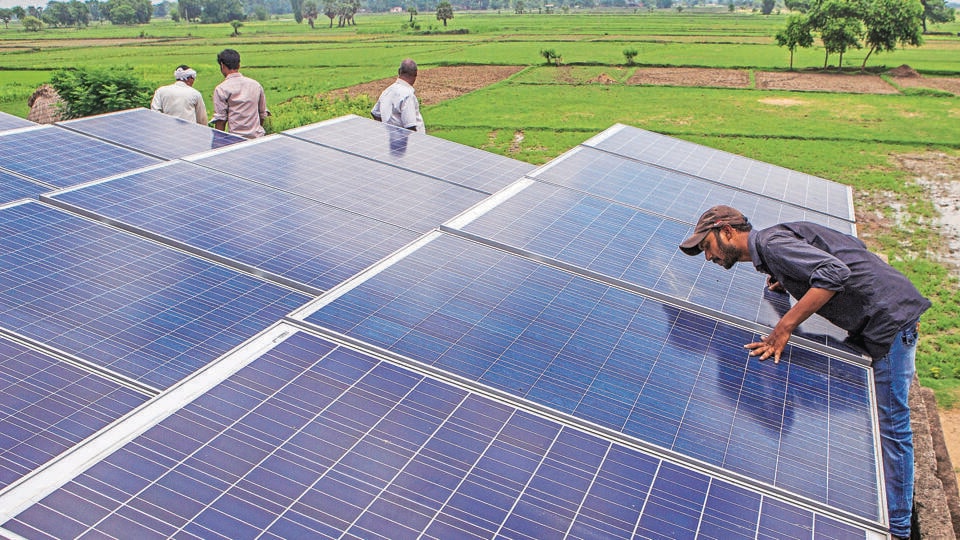
Green energy will be powering the agriculture sector soon in Bihar, where state’s power distribution companies (Discoms) are going ahead with plans to set up a chain of grid-connected decentralised solar power plants to supply electricity in the dedicated agriculture feeders, a senior official familiar with the development said.
Currently, the state had 1,354 dedicated feeders for agriculture and efforts are on to set up around 3,000 more such feeders by the end of this fiscal. All these feeders are being fed mixed electricity (renewable or alternative energy along with those from the thermal power plants) as of now.
However, after commissioning of the additional feeders, the discoms will rope in private agencies to set up around 700-800 solar plants with installed capacity of around 1 mega watt each to cater to electricity needs for the agriculture feeders, according to managing director of South Bihar Power Distribution Company Limited (SBPDCL), Mahendra Kumar, who is also the director of Bihar Renewable Energy Development Agency (Breda).
Officials of the electricity department said that work to set up around 3,000 more agriculture feeders under the Mukhyamantri Krishi Vidyut Sambhand Yojna (MKVSY) has begun under the centrally sponsored revamped distribution sector scheme (RDSS). “The survey for commissioning of agriculture feeders has been completed and electricity poles in 11 such feeders have been pitched in. Other equipment such as wire, transformers, distribution network, etc, would be raised in the next few months,” said Kumar.
The electricity department has been allocated a sum of ₹9,000 crore for implementing the first phase of the dedicated agriculture feeders under the RDSS till 2025-26 fiscal. Of the total funding, 60% comes from the Centre and the rest from the state government. “We will go for engaging private companies to set up 1MW plants in a big way, once the transmission and distribution network of the dedicated agriculture feeder is complete. We are also trying to assess the viability gap funding (VGF) of the project to cross-subsidise the solar power generation,” said the official, adding that tenders would be floated by the year-end to select best agencies to commission and operate power plants across the state.
Why solar energy for agriculture feeder?
As per the renewable power obligation (RPO), the state government has set the target of using renewable energy up to 40% of the total power consumption by the year 2030-31. Currently, the state is using around 19-20% power generated from the renewable sources of energy. Per capital electricity consumption has risen to around 350 kwh in 2023 from 280 kwh in 2017-18, with peak hour load hovering around 7000 MW during the last summer.
The Central government has committed to generate about 500GW power from alternative sources of energy by 2030 as part of its international obligation.
Officials said chief minister Nitish Kumar has also been emphasising on providing electricity in the dedicated agriculture feeders only during the day time so that exploitation of groundwater could be restrained. “Moreover, solar power is a dependable source of energy during the day time, unlike the power supplied by thermal power stations, which suffers disruptions for many reasons. Solar power plants would be connected with grids, so that surplus power would be purchased by the discoms in accordance with the power purchase agreements,” said the SBPDCL MD.
Solar powered water pump scheme discontinued
Responding to the farmers’ demand to ensure timely supply of power for irrigation, the Breda had in 2017-18 launched the distribution of solar-power water pumps with 2HP and 3HP capacity. The scheme was lapped up by the farmers and more than 2,000 such pumps along with photovoltaic (PV) panels and convertors were distributed with huge subsidy (75% of the capital investment). But the scheme had to be discontinued owing to maintenance issue at far-off places.
Officials said that operation and maintenance of grid connected solar plants is more easy and financially viable as compared to the solarised water pumps, which were more cost intensive. “Solarised agriculture feeder schemes are doing good in Maharashtra and Karnataka. Private agencies are also earning handsomely for their investments in solar plants under Resco model, under which all cost from establishment to operation and maintenance is borne by the private agencies.


