
 E-Paper



Civic Sanskriti: Handprint’s actions towards sustainability
The Handprint draws on wisdom from our collective heritage and represents the belief that we can make a difference. Our individual and collective actions can solve environmental problems, decrease the human footprint, and make the world more sustainable

 Prefer HTon Google


PUNE In 2007 at a school in Hyderabad, a discussion was being done on ecological impact by my colleagues at the Centre for Environment Education. Srija, a ten-year-old, asked why we always talk about our impact and not what we can do for sustainability.
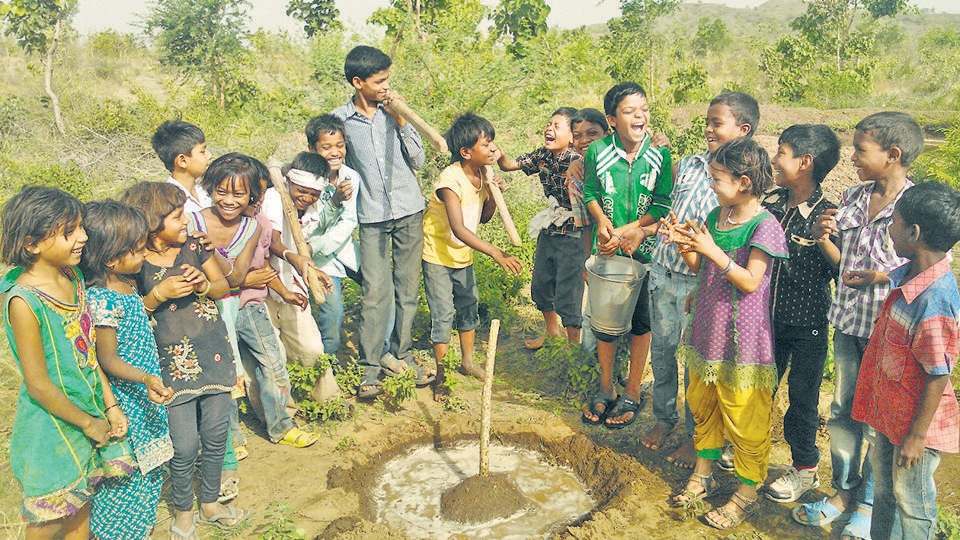
It is her question that inspired the idea of the “Handprint.” The Handprint was adopted at a conference on Education for Sustainable Development in Ahmedabad, as an international symbol for actions to create a better world. And November 27 was declared by the delegates as Handprint Day.
Concern for the environment is embedded in our traditions. The Yujur Veda entreats us to “not disturb the sky and not pollute the atmosphere”, while the Rig Veda says: “Do not harm the environment; do not harm the water and the flora; the earth is my mother; I am her son; may the waters remain fresh; do not harm the waters. Do not cut trees, because they remove pollution.”
Care for the environment is also reflected in the Constitution of India, Article 51(A) (g) which sets a constitutional obligation on the citizens of India “to protect and improve the natural environment, including forests, lakes, rivers and wildlife, and to have compassion for living creatures.”
The Handprint draws on such wisdom from our collective heritage and represents the belief that we can make a difference. Our individual and collective actions can solve environmental problems, decrease the human footprint, and make the world more sustainable.
The Handprint goes beyond the idea of individual action. It also contains the ideas of learning through action and action along with others. These dimensions are particularly relevant when one considers the climate and ecological changes that our children and their children will have to face within the foreseeable future.
Children and youth will need not only knowledge, but systems thinking and critical thinking competence, as well as the ability to communicate and collaborate.
Above all, they will need empathy and a caring attitude towards one another, and the living world.
When we act on our own, we may develop our individual capabilities to plan, act, and reflect. When we act with others, we may develop a larger understanding and enhance our ability to communicate, collaborate and live together.
Anyone can take Handprint action. Just start with any positive action that is possible – cycling instead of using a car, composting instead of throwing mixed waste, or changing to more efficient lights, among others. Whenever it is time to do more, when you feel you are ready to work with others to make a larger difference, you can take that next step. You may become part of a campaign for an environmental or social issue or even lead one.
Handprint includes citizenship action, advocacy for sustainability, and participation in decision-making to make it more realistic, representative, and responsive. You might stand for elections and play a leadership role or help conduct a citizens’ assembly and support a whole community to take collective Handprint actions.
It might not be easy, or it might be fun. Others bring different perspectives, and you might enjoy looking at things differently. Handprint actions can become a hobby and bring their own rewards in new learning and satisfaction of being involved in positive ways.
Sanskriti Menon is senior programme director, Centre for Environment Education. She writes on urban sustainability and participatory governance. Views are personal. She can be reached at civic.sanskriti@gmail.com


