
 E-Paper



How rush-hour traffic halves your speed across Indian cities: Delhi crawls at 19 kmph, Mumbai 15, Bengaluru 13
Delhi to Kolkata, Jaipur to Indore — a WRI India study maps which Indian cities' commutes get the worst, and why more road width isn't the fix.

 Prefer HTon Google


Peak-hour traffic slowdown is no longer confined to the metros, and the length of roads may not always determine which cities cope better, a WRI India analysis of road networks across 20 cities has found.
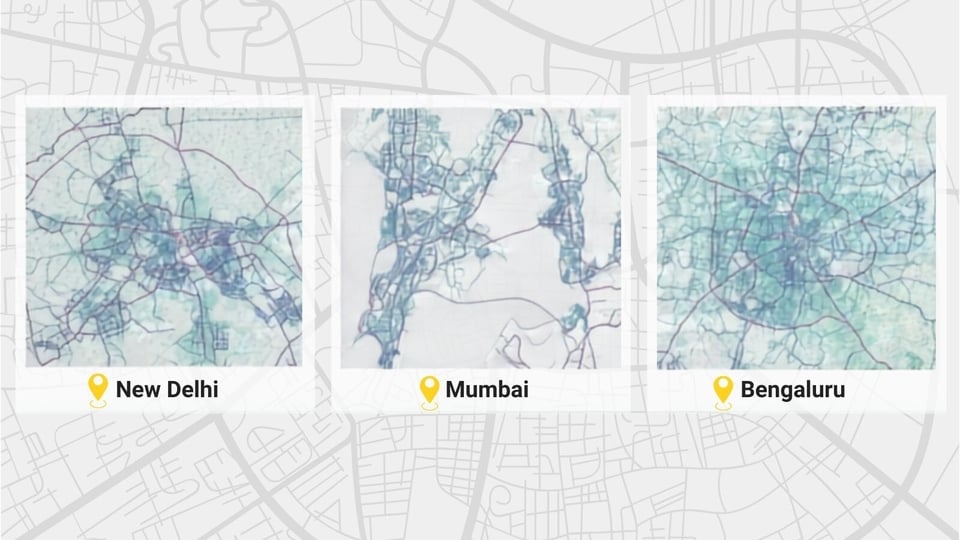
The speed drop
Every Tier 1 city in the study loses more than half its free-flow speed by peak hour. Delhi's fall is the steepest in absolute terms, from 46 kmph to 19 kmph. Hyderabad and Mumbai both drop from 40 kmph to 15 kmph, Bengaluru from 38 kmph to 13 kmph, and Kolkata from 29 kmph to 11 kmph — the lowest peak speed recorded among all 20 cities in the study.
Also Read | Bengaluru ranked as India's 2nd slowest city in terms of traffic in 2024, Kolkata takes lead
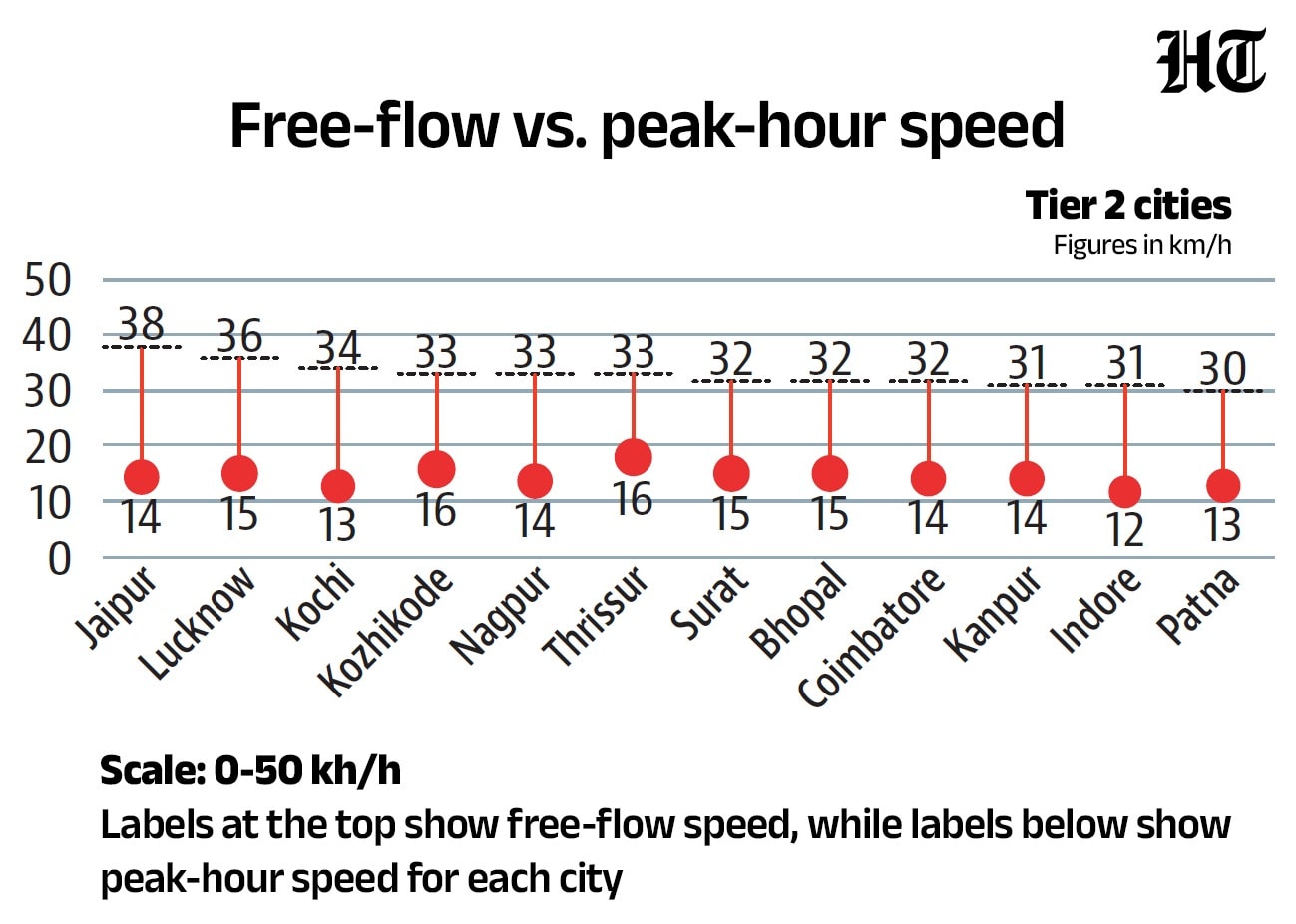
Tier 2 cities post smaller absolute drops but follow the same pattern. Jaipur falls from 38 kmph to 14, Lucknow from 36 to 15, Indore from 31 to 12.
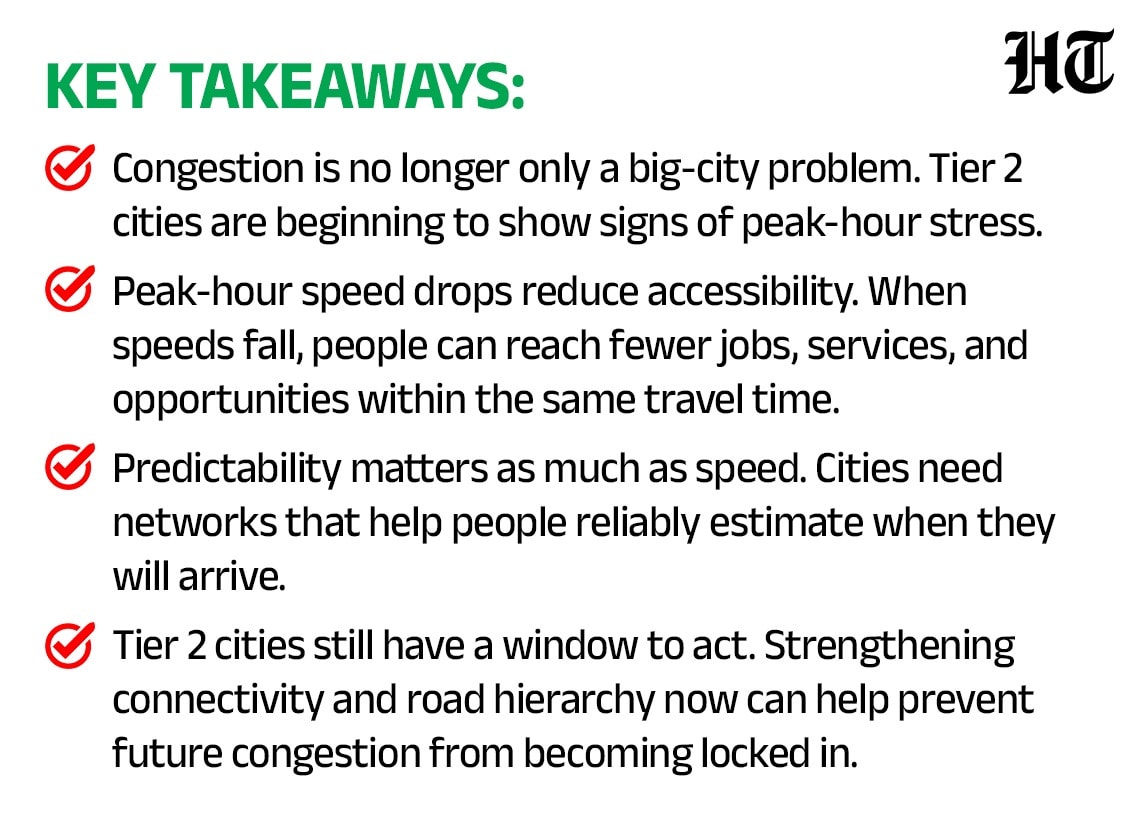
WRI India says the drop reduces the area people can reach in the same travel time, limiting access to jobs, services and education.
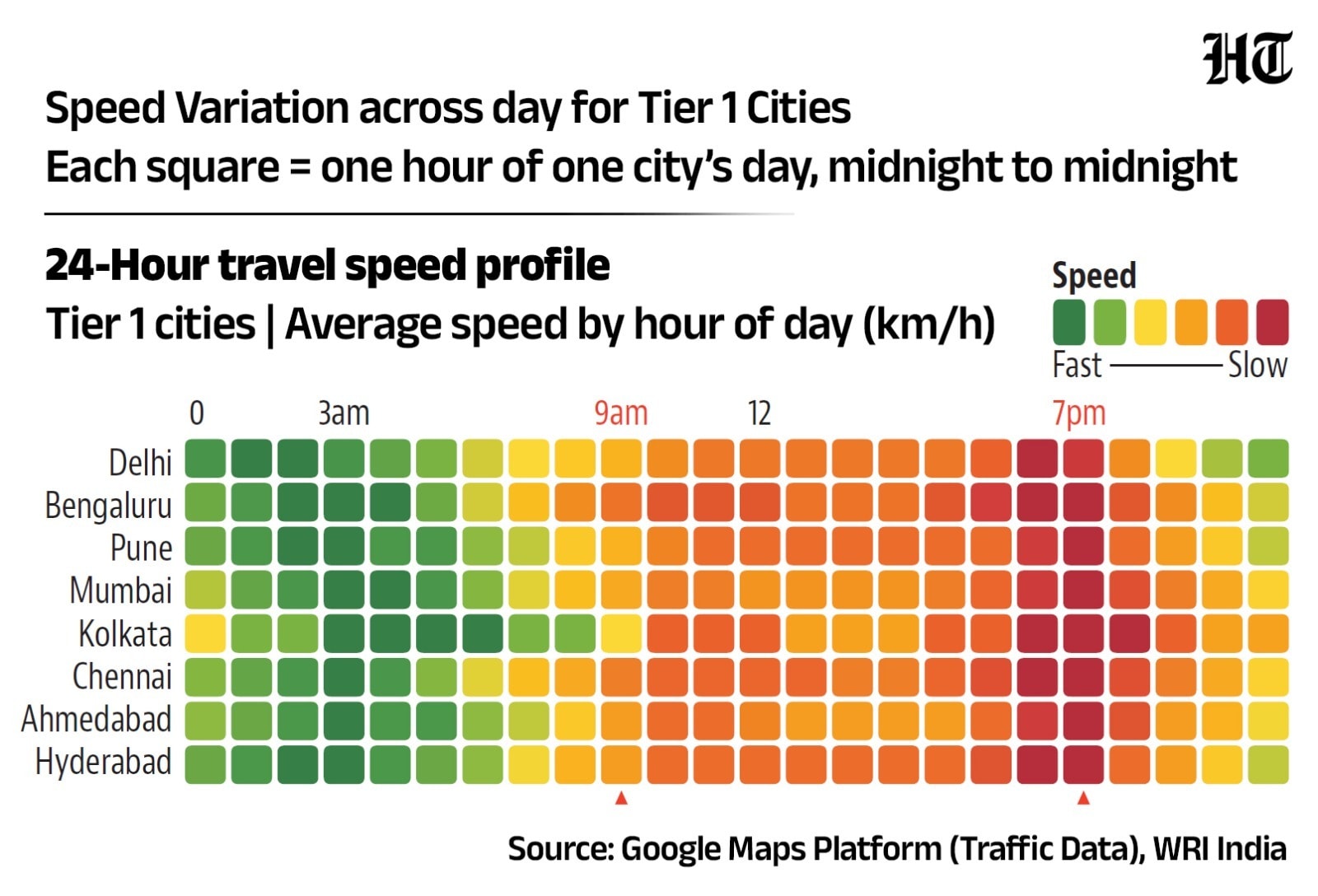
Congestion patterns differ
Delhi and Hyderabad begin the day at similar free-flow speeds, and then diverge. Hyderabad recovers around midday and Delhi stays congested for much of the day. Bengaluru shows sustained congestion with little relief.
Also Read | Bengaluru second on list of world's most congested cities; 7 days lost in traffic in 2025, says index
Mumbai has more persistent traffic conditions and fewer sharp swings between peak and off-peak.
Among Tier 2 cities, Thrissur sees only a brief evening slowdown, while Indore stays congested for longer. So, two cities that have the same average speed for commuters can deliver very different commutes — one predictable, one not.
Why connectivity matters
The report's point is that how a network is arranged matters more than its total length.
Drive 7.5 km from a point in Delhi, and a commuter can reach 65% of the area a straight 7.5 km circle would cover. In Kolkata, that figure falls to 59%. The WRI India report says Delhi fares better because the Yamuna has more crossings than the Hooghly has in Kolkata — fewer river crossings mean longer forced detours.
The same logic plays out within a single city. In Bengaluru's Whitefield, two points 3 km apart require a 4.7 km drive, a detour of 1.7 km. In Basavanagudi, an older and more tightly gridded part of the city, the same 3 km gap adds only 400 metres.
Built on narrow streets
Hyderabad has 95% of its roads under 10 metres wide, Kolkata 94%, and Delhi and Chennai 92% each. Mumbai is the outlier, at 64%. In Chennai, Bengaluru and Pune, WRI India finds that secondary roads — the 10–35 metre band that is meant to feed traffic from neighbourhoods onto arterials — make up only 10–15% of the network, leaving commuters with few alternatives once the main corridors clog up.
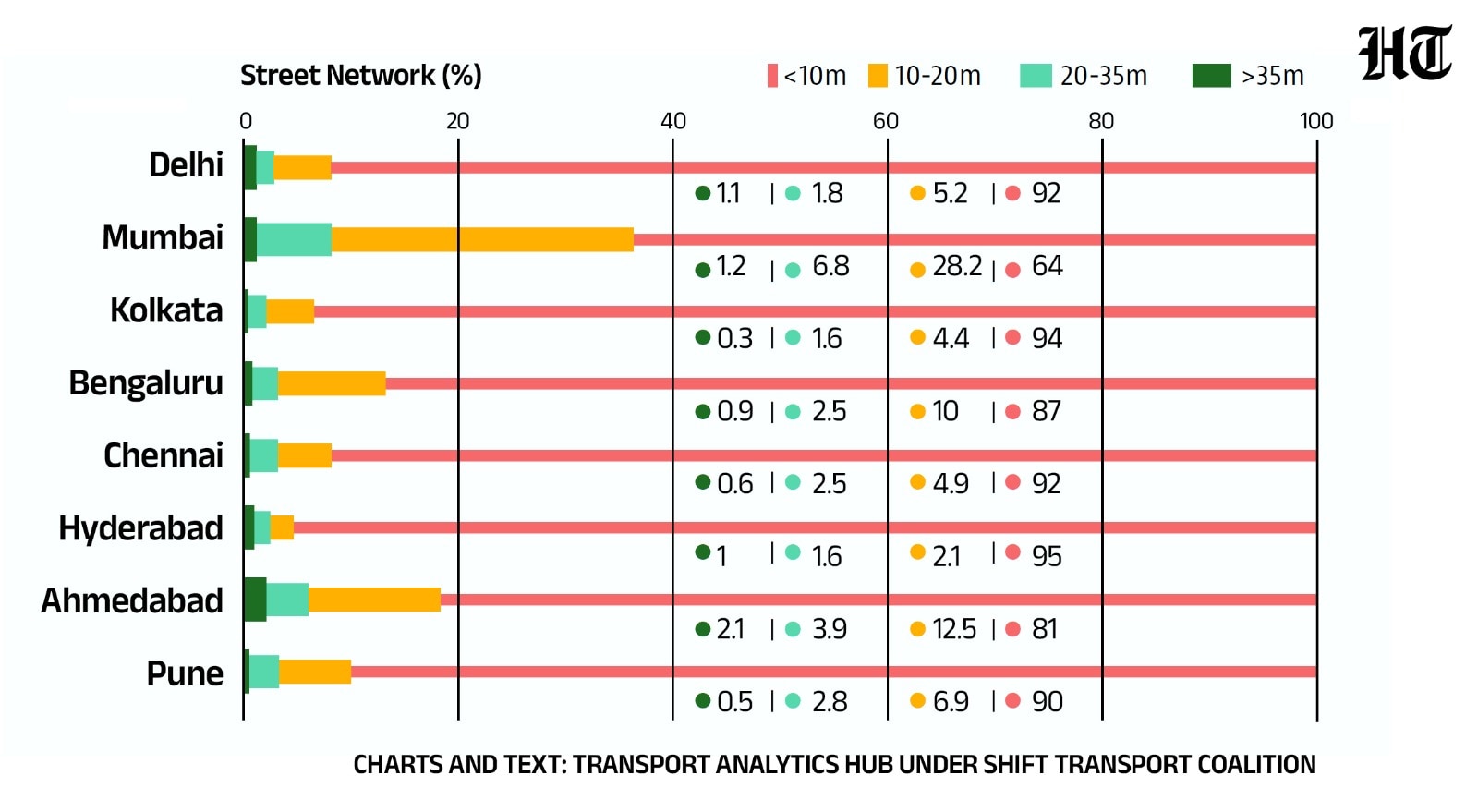
Mumbai has the largest secondary-road share among Tier 1 cities, at 35%, yet its congestion stays high regardless.
A well-built network is no guarantee
Jaipur has a relatively stronger road network than Coimbatore, the report finds. On the road, though, the two cities offer commuters a similar experience at peak hour — and by one measure, Coimbatore does better.
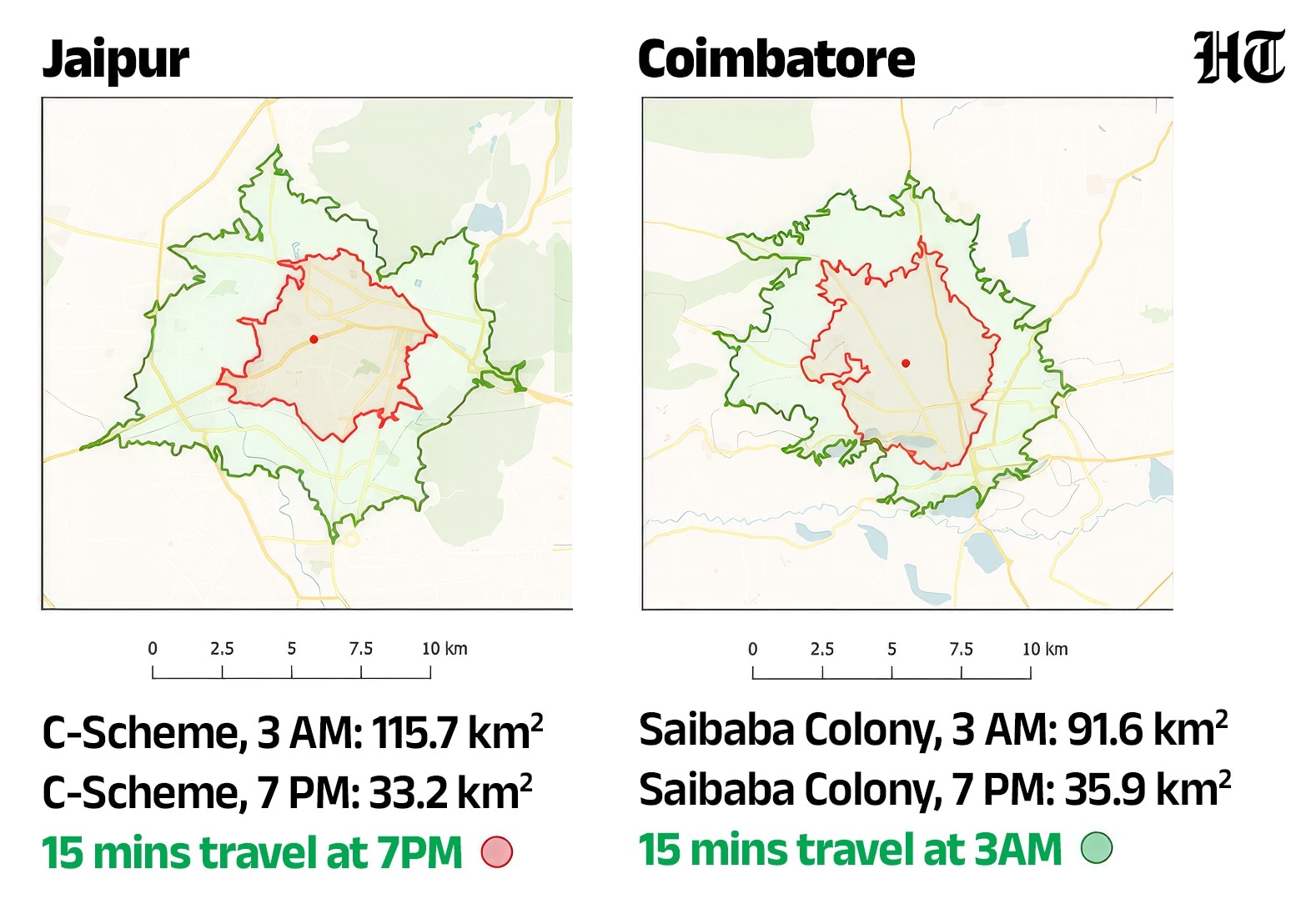
WRI India tracked how much of each city a commuter could reach in a 15-minute drive, at 3am and again at 7pm. From Jaipur's C-Scheme, that reach falls from 115.7 sqkm at 3 am to 33.2 sqkm at 7pm, a drop of more than 70%.
From Coimbatore's Saibaba Colony, the reach starts smaller, at 91.6 sqkm, but only falls to 35.9 sqkm at peak — ending up slightly ahead of Jaipur, despite the weaker network on paper.
That indicates good network design can shape how well a city moves. Heavy travel demand can still overwhelm it, the report concludes — a caution against treating road infrastructure as a fix on its own, without also managing how many vehicles that infrastructure is asked to carry.
Density is not the same as connectivity
Road density and road connectivity measure different things, and the two do not always move together, the report cautions.
Also Read | Minimising urban traffic congestion
Mumbai has considerably lower road density than Bengaluru, yet the two cities post a similar level of connectivity. The difference lies in how streets link up rather than how many exist. A dense grid riddled with dead-ends and disconnected pockets will move traffic worse than a sparser one where every street reaches a destination.
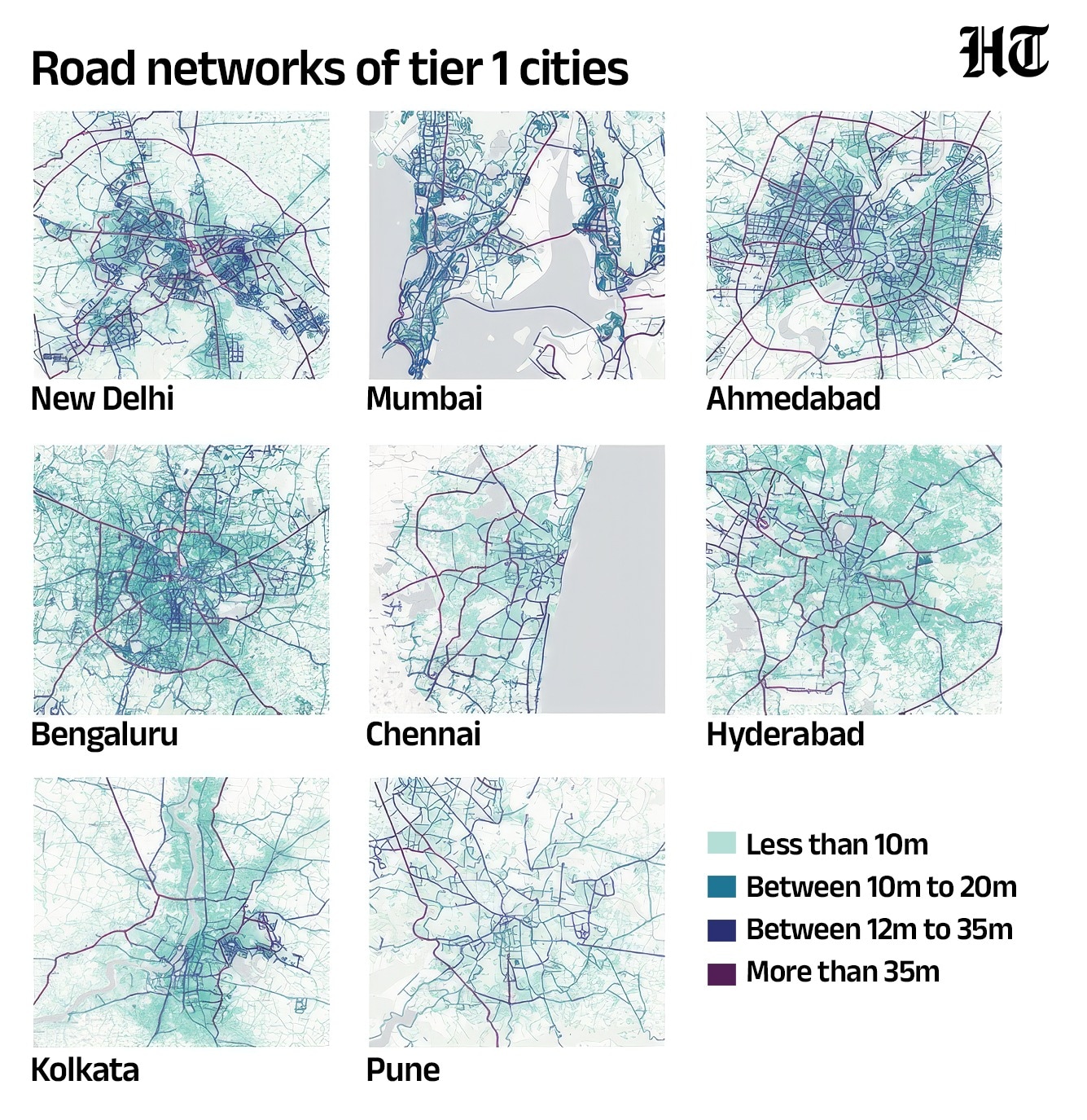
For city planners, the report’s implication is that adding road length is not, by itself, a solution — closing gaps in an existing network may do more for a commuter’s daily reach than building new roads without considering connectivity usage.


