
 E-Paper



Economic Survey: Congestion pricing, parking reforms key to decongesting cities; prioritise people over vehicles
The Economic Survey 2025–26 highlights congestion pricing and parking reforms as key tools to tackle urban traffic, citing examples from Singapore and London

 Prefer HTon Google


Targeted congestion pricing in dense business districts, combined with demand-based parking management, can reduce traffic congestion, improve travel speeds, and lower emissions, as demonstrated by global examples, the Economic Survey 2025-2026 released on January 29 said, highlighting measures adopted by cities such as Singapore and London to address urban congestion.
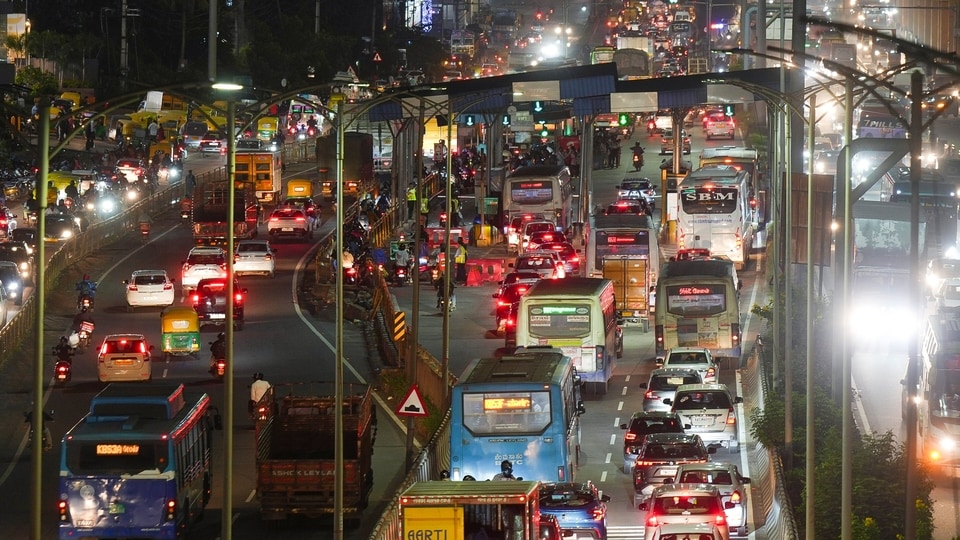
“Manage demand where geometry is most binding: Targeted congestion pricing in dense business districts, combined with demand-based parking management, can reduce traffic, raise speeds, and cut emissions, as seen internationally,” it said.
It noted that recent reforms, such as the Chennai Metropolitan Area Parking Policy (2025), whereby private vehicle use is disincentivised, treats parking as valuable real estate, and prioritises walking, cycling, and public transport, show that such demand-management tools are feasible complements to transit investment.
The survey highlighted the steps taken by the authorities in Singapore and London to tackle congestion. Singapore Electronic Road Pricing (ERP) is a dynamic, electronic, congestion-pricing system that automatically charges vehicles when they pass under a toll gantry during peak periods. It is specifically designed to manage and reduce traffic congestion, and decades of data from Singapore show that it works very effectively, the survey stated.
The London Congestion Charge is a cordon-based, area licensing system where vehicles pay a daily fee to enter, leave, or move within a designated central London zone, it added.
The survey also suggested scaling up city bus fleets, accelerating e-bus adoption, and mainstreaming last-mile and shared mobility as other elements that could be used to curtail congestion in cities.
Loss in productivity due to traffic congestion across cities
The Economic Survey noted that there are several estimates of the loss in productivity from traffic congestion across cities. The Economic Survey also highlighted the loss of productivity due to mobility issues. It said that resolving the challenge requires prioritising modes with the greatest carrying capacity, across short and long distances.
“There are several varying estimates of the loss in productivity across cities resulting from traffic congestion. A Centre for Science and Environment (CSE) report on Delhi’s congestion troubles states that an unskilled worker stands to lose between ₹7,200 - ₹19,600 per year due to congestion. Similarly, skilled and highly skilled workers can lose as much as ₹8,300 - ₹23,800 and ₹9,000 - ₹25,900 a year, respectively,” it noted.
A working paper by the Institute for Social and Economic Change (ISEC)17 estimated the loss of productive hours due to the late arrivals caused by traffic congestion would be around 7.07 lakh hours in 2018 for Bengaluru city, translating to a monetary cost of around ₹11.7 billion. A 2018 report by Uber–BCG estimated that costs associated with traffic congestion in the four metros of Delhi, Mumbai, Bengaluru, and Kolkata were $22 billion per year, it ntoed.
Also Read: Can Gurugram become the next Singapore? Social media post sparks debate
According to the TomTom Traffic Index 2024, commuters in Bengaluru, Mumbai, and New Delhi lost 117 hours, 103 hours, and 76 hours, respectively, per year due to rush-hour traffic in their respective city centres. Despite the variation in estimates, it is evident that the costs of mobility issues are high and on the rise, it noted.
Design cities to prioritise the movement of people, not vehicles
The Economic Survey said that effective treatment begins with identifying the underlying issue, a growing dependence on private vehicles.
Also Read: Economic Survey: More than 96 lakh homes delivered to beneficiaries under PMAY-U
“The vital signs of our cities are poor because roads are used more as storage for vehicles rather than corridors for people. Streets become congested not because citizens are moving excessively, but because cars carry too few passengers. Our roads have been utilised as storage for low-occupancy vehicles instead of facilitating movement for people,” it said.
“This diagnosis leads to the guiding principle: design cities to prioritise the movement of people, not vehicles,” it added


